The reputation Elliott Wave has for being subjective comes almost entirely from people who never learned where the firm ground is. The theory has exactly three rules that can never be broken, and a larger set of guidelines that are merely strong tendencies. Treat the rules as law and the guidelines as probabilities, and the framework becomes far more disciplined than its critics admit. Confuse the two — enforce a guideline as if it were a rule, or wave away a rule as if it were optional — and the whole thing collapses into guesswork.
This guide is the reference companion to Elliott Wave theory explained. It assumes you understand the basic 5-3 structure and want the precise constraints that govern a valid count.
Key takeaways
Q: What are the three rules of Elliott Wave theory?
A: Wave 2 never retraces more than 100% of wave 1; wave 3 is never the shortest of waves 1, 3 and 5; and wave 4 never enters the price territory of wave 1. These cannot be broken in a valid impulse.
Q: What is the difference between Elliott Wave rules and guidelines?
A: Rules are absolute and disqualify a count if broken. Guidelines — such as alternation, equality and channelling — are strong tendencies that make one valid count more probable than another, but breaking them does not invalidate anything.
Q: What is the rule of alternation?
A: If wave 2 is a sharp, deep correction, wave 4 tends to be a shallow, sideways one, and vice versa. Corrections within an impulse rarely take the same form twice in a row.
The three unbreakable rules
These three statements are absolute. In a standard five-wave impulse, none of them can be violated. If your count breaks one, the count is wrong — there is no interpretation, no exception, no "this time is different."
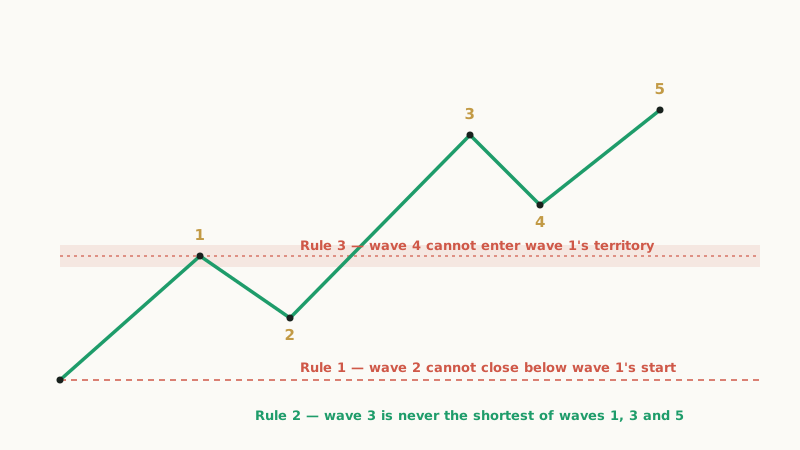
Rule 1 — wave 2 never retraces more than 100% of wave 1
Wave 2 can be deep — retracing 61.8% or even 78.6% of wave 1 is common — but it can never trade beyond the origin of wave 1. The logic is simple: the start of wave 1 is the low of the entire structure. If price falls below it, then what you labelled as wave 1 was not the start of a new impulse at all. This rule gives every long entry a clean, non-negotiable invalidation level.
Rule 2 — wave 3 is never the shortest impulse wave
Of the three motive waves — 1, 3 and 5 — wave 3 can never be the shortest. It does not have to be the longest (though it usually is), but it cannot be the runt of the three. This rule encodes a deep truth about trends: the heart of a move is its centre, where conviction is strongest. A count showing a feeble wave 3 sandwiched between larger first and fifth waves describes a trend with no engine — which is to say, not a real impulse.
Rule 3 — wave 4 never enters wave 1's territory
The low of wave 4 cannot overlap the high of wave 1. When the corrective fourth wave dips back into the price range that wave 1 occupied, the structure is no longer a clean impulse — the overlap signals that the move is corrective in nature. The one exception is the diagonal, a wedge-shaped pattern found in wave 1 or wave 5 positions, where limited overlap is permitted by design.
Each rule doubles as a built-in stop-loss. Rule 1 protects long entries at wave 2; rule 3 protects entries at wave 4. The theory hands you objective invalidation prices — use them.
The guidelines that shift the odds
Guidelines are where the real craft lies. They never invalidate a count, but when two counts both obey the rules, guidelines tell you which is more probable. The most useful ones:
Alternation
If wave 2 is a sharp, deep, fast correction, expect wave 4 to be a shallow, slow, sideways one — and vice versa. The market rarely produces two corrections of the same character back to back within one impulse. Alternation is one of the most reliable guidelines and helps set realistic expectations for how wave 4 will behave once wave 2 has formed.
Equality
When one of the motive waves extends (usually wave 3), the other two — waves 1 and 5 — tend toward equality in length or in Fibonacci proportion. This gives a practical way to project a likely wave 5 target once waves 1 through 4 are in place.
Channelling
A healthy impulse usually fits inside a parallel channel. Drawing a trendline from the end of wave 2 to the end of wave 4, then projecting a parallel line off the peak of wave 3, often frames where wave 5 will terminate. A move that breaks decisively out of its channel is a clue that the impulse may be complete.
Depth of corrective waves
Wave 2 tends to be deep (commonly 50–61.8% of wave 1), reflecting lingering disbelief in the new trend. Wave 4 tends to be shallow (commonly around 38.2% of wave 3), reflecting a market that now broadly accepts the trend and is merely pausing. These typical depths, drawn from Fibonacci, are covered further in the Fibonacci relationships guide.
Rules versus guidelines at a glance
| Statement | Type | If broken |
|---|---|---|
| Wave 2 < 100% of wave 1 | Rule | Count is invalid |
| Wave 3 not the shortest | Rule | Count is invalid |
| Wave 4 no overlap with wave 1 | Rule | Count is invalid (unless diagonal) |
| Alternation between waves 2 and 4 | Guideline | Count is less typical, still valid |
| Equality of waves 1 and 5 | Guideline | Count is less typical, still valid |
| Channelling | Guideline | Count is less typical, still valid |
Putting it to work
In live analysis the workflow is straightforward: use the three rules to throw out impossible counts, then use the guidelines to rank whatever survives. A count that obeys all three rules and satisfies alternation, equality and channelling is a high-probability read. A count that obeys the rules but violates several guidelines is technically possible but should be your alternate, not your primary. The mechanics of working through this on a chart are covered in how to count Elliott waves.
Extensions: the wave that does the work
One of the most useful tendencies in the whole framework is that one motive wave — and usually only one — will extend, becoming dramatically longer than the other two and often subdividing visibly into its own clear five-wave structure. On most trends, and especially in liquid forex pairs, it is wave 3 that extends. Knowing this shapes expectations: if wave 3 has extended powerfully, the guideline of equality suggests waves 1 and 5 will be roughly comparable, which gives a practical way to project where the move should run out of steam. Less commonly, wave 5 extends instead, producing a blow-off finish; rarely, wave 1 does. Identifying which wave is the extended one early is one of the highest-value reads a wave analyst can make.
Truncations and fifth-wave failures
Occasionally wave 5 fails to exceed the peak of wave 3, falling slightly short of a new extreme. This is called a truncated fifth or fifth-wave failure, and far from being a glitch it carries a clear message: the trend has run out of energy and a sharp reversal often follows. A truncation usually appears after an unusually strong, extended wave 3 that exhausted the move's momentum. It does not break any rule — the structure is still a valid five — but it is a meaningful warning that the correction to come may be deeper than usual.
Diagonals: the exception to rule three
The one place the no-overlap rule relaxes is inside a diagonal, a wedge-shaped five-wave structure whose sub-waves are permitted to overlap. Diagonals come in two forms. A leading diagonal appears in the wave 1 or wave A position and signals the start of a new move. An ending diagonal appears in the wave 5 or wave C position and signals that a move is nearly complete — it is the market's last, laboured push, typically followed by a swift retracement back to where the diagonal began. Recognising an ending diagonal is genuinely valuable: it warns that a trend is almost finished while price is still making new highs and sentiment is still bullish.
The diagonal is the only structure where wave 4 may trade into wave 1's territory. Outside a diagonal, overlap is fatal to the count. Treat any overlap you see as a question — "is this a diagonal?" — not as permission to ignore rule three.
What the rules predict after the pattern completes
The rules and guidelines do not just describe the impulse — they set expectations for what follows it. After a complete five-wave move, the theory anticipates a three-wave correction against it, and that correction very often retraces back toward the territory of the previous wave 4. This gives a logical first target for any pullback and a sensible zone to watch for the next impulse to begin. In trending forex markets, this rhythm — five up, three back toward the old fourth wave, then five up again — is the structural heartbeat that wave traders are trying to stay in step with.
Combined with the depth guidelines for waves 2 and 4, this turns the framework into something forward-looking rather than purely descriptive. You are never certain, but you are rarely without a reasoned expectation of where price should turn and where that expectation would be proven wrong.
Three rules, never broken. Several guidelines, frequently bent. Rules eliminate counts; guidelines rank them. Keep that hierarchy straight and most of Elliott Wave's alleged subjectivity disappears.