Counting Elliott waves is the part of the wave principle that breaks most traders' patience. The theory itself — five waves with the trend, three against it — takes an afternoon to learn. Applying it to a live, jagged forex chart, in real time, with money on the line, takes far longer. The good news is that almost all of the difficulty comes from approaching the count in the wrong order. This guide lays out a disciplined process that removes most of the guesswork.
Before going further, it helps to have the framework itself clear; the full model is covered in Elliott Wave theory explained. What follows assumes you know the basic 5-3 structure and want a method for labelling it.
Key takeaways
Q: How do you count Elliott waves step by step?
A: Start on a high timeframe to find the dominant trend, identify a clear five-wave impulse as your anchor, label the larger structure first, then drill down into sub-waves — checking the three rules at every step and keeping an alternate count ready.
Q: What timeframe is best for counting waves on forex?
A: Most wave traders anchor on the daily or four-hour chart to filter session noise, then refine on the one-hour. Counts below the one-hour on forex tend to be too noisy to rely on.
Q: How do you know if your wave count is wrong?
A: The three rules give exact invalidation prices. If wave 2 passes the start of wave 1, wave 3 is the shortest, or wave 4 overlaps wave 1, the count is invalid and must be redrawn.
Always count from the top down
The single most important habit in wave counting is direction of travel: start high and work down, never the reverse. Beginners almost universally do the opposite — they zoom into a five-minute chart, find a wiggle that looks like a five-wave move, and try to build a larger structure on top of it. That approach produces tangled, constantly-changing counts because a low-timeframe pattern carries no information about the trend it sits inside.
Open the daily chart first. Establish whether price is trending or ranging and in which direction. Only once the higher-degree picture is clear should you drop to the four-hour and then the one-hour to refine the count. Each lower timeframe should fit inside the structure you established above it. If it doesn't, the higher count is probably wrong — which is useful information, not a failure.
Find a clean impulse to anchor on
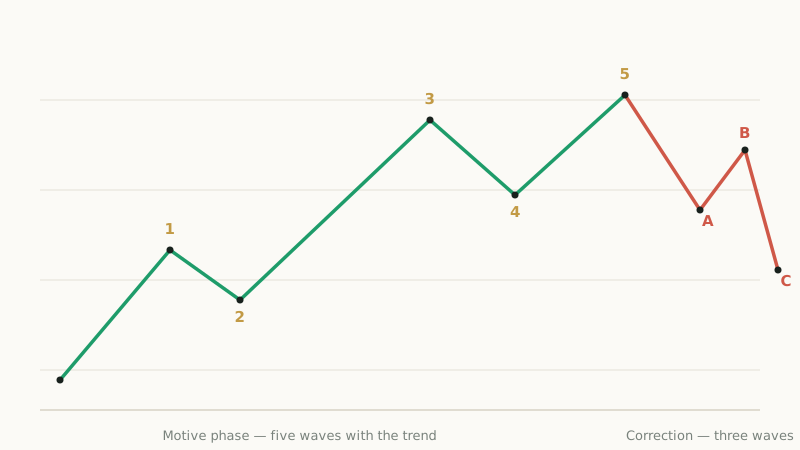
You cannot count from the middle of a move. Look for a clear, unambiguous five-wave sequence — ideally one with an obvious, powerful third wave — to act as your anchor. A strong wave 3 is the easiest leg to spot because it tends to be the longest, fastest and most one-directional part of any trend. Once you have a confident wave 3, the waves around it fall into place: the move before it is waves 1 and 2, the pullback after it is wave 4, and the final push is wave 5.
If no clean impulse is visible, the market is very likely in a correction. That is not a problem to solve by forcing a count — it is a signal to step back, as covered in impulse versus corrective waves.
Check the three rules at every step
Every time you place a label, immediately test it against the three unbreakable rules. They are the only objective constraints the theory provides, and they instantly disqualify a large share of bad counts:
- Wave 2 cannot retrace more than 100% of wave 1.
- Wave 3 cannot be the shortest of waves 1, 3 and 5.
- Wave 4 cannot overlap the price territory of wave 1 (outside a diagonal).
If a label breaks any rule, the count is wrong — full stop. Redraw it rather than rationalising the exception. The rules, along with the softer guidelines that help choose between two valid counts, are detailed in the rules and guidelines guide.
A rule violation is a gift. It tells you, objectively and immediately, that a count is dead — saving you from defending a structure the market has already rejected.
Use Fibonacci to confirm, not to force
Fibonacci ratios are a confirmation tool, not a labelling tool. Once you have a candidate count, measure it: does wave 2 retrace toward 50–61.8% of wave 1? Does wave 4 hold near 38.2% of wave 3? Does wave 3 reach 161.8% of wave 1? When the ratios line up with your labels, your confidence should rise. When they are wildly off, treat that as evidence the count may be wrong rather than evidence the market is misbehaving.
Always carry an alternate count
This is the habit that separates disciplined wave analysts from frustrated ones. At any moment, you should be able to state both a primary count (the structure you think is most likely) and an alternate count (the next most likely interpretation), each with its own invalidation level. The market does not owe you the primary scenario. When price breaks the primary's invalidation, you simply promote the alternate — no panic, no re-drawing under pressure, no emotional attachment to a single forecast.
In practice this means writing down, for the trade you are considering, the exact price at which your idea is wrong before you enter. That single discipline turns wave counting from a prediction exercise into a risk-management one, which is where its real value lies.
A repeatable counting workflow
| Step | Action | Question to answer |
|---|---|---|
| 1 | Open the daily chart | Trending or ranging? Which direction? |
| 2 | Find the clearest five-wave impulse | Where is the obvious wave 3? |
| 3 | Label the higher-degree structure | Where are we within the larger cycle? |
| 4 | Drop to 4H / 1H to refine | Do the sub-waves fit the bigger count? |
| 5 | Test every label against the rules | Does any rule break? |
| 6 | Measure with Fibonacci | Do the ratios support the labels? |
| 7 | Define primary + alternate + invalidation | At what price am I wrong? |
Run that sequence the same way every time and the count stops feeling like guesswork. You will still be wrong sometimes — every method is — but you will be wrong in a controlled, pre-defined way rather than chasing labels around the chart. A fully worked application on a major pair is available in the EUR/USD example.
What the process looks like in practice
Imagine EUR/USD has spent weeks grinding higher on the daily chart. Working top down, the daily tells you the trend is up, so you are looking for a bullish five-wave structure rather than trying to pick a top. Dropping to the four-hour, the most obvious feature is a long, steep advance that ran further and faster than anything around it — a textbook candidate for wave 3. You label it provisionally and work outward: the choppy move before it becomes waves 1 and 2, the shallow sideways pause after it becomes wave 4, and the final, slightly tired push to a new high becomes wave 5.
Now you test. Did wave 2 stay above the start of wave 1? Yes — rule 1 holds. Is wave 3 longer than both wave 1 and wave 5? Yes — rule 2 holds. Did wave 4 stay clear of wave 1's old high? Yes — rule 3 holds. The Fibonacci check agrees: wave 2 retraced about 61.8% of wave 1, wave 4 held near the 38.2% retracement of wave 3, and wave 3 ran close to 161.8% of wave 1. Every objective test supports the labels, so this becomes your primary count.
Crucially, you also write the alternate: perhaps what you called wave 5 was actually wave 3 of a larger structure still extending. That alternate has its own invalidation, and if price keeps powering higher past where wave 5 should have ended, you calmly switch to it instead of arguing with the chart. Neither scenario is a prediction you are emotionally married to — they are two mapped possibilities with two defined risk levels.
When the chart refuses to cooperate
Plenty of the time, no clean five-wave structure exists because the market is correcting rather than trending. This is the situation that drives traders to force counts, and it is exactly when they should not. Corrections unfold in threes, take many forms — zigzags, flats, triangles and their combinations — and are genuinely harder to label in real time than impulses. The professional response is to reduce conviction, widen your timeframe, and wait for a clean impulse to emerge before committing to a directional count again. Recognising the difference quickly is a skill in itself, examined in impulse versus corrective waves.
A useful tell: impulses feel urgent and one-directional, while corrections feel hesitant and overlapping, with lots of back-and-forth that keeps trapping breakout traders. If you find yourself relabelling the same stretch of chart repeatedly, that overlapping character is usually the market telling you it is correcting, not trending.
Practical setup and tooling
You do not need specialist software to count waves — any charting platform with a text or label tool works — but a few practical habits make the process far smoother:
- Use a multi-timeframe layout. Keep the daily, four-hour and one-hour charts visible together so the higher-degree context never drifts out of mind while you refine.
- Label on the chart, not in your head. Writing the numbers and letters directly onto price forces you to commit and makes rule violations obvious at a glance.
- Mark the invalidation line. Draw a horizontal line at the price where your primary count dies. If it is hit, you act mechanically rather than emotionally.
- Keep a count journal. Screenshot your primary and alternate at the time you make them, then review later. Counting improves fastest when you can see, in hindsight, which structural clues you read correctly and which you forced.
None of this makes wave counting effortless — it remains a judgement-heavy method — but a consistent process converts most of the difficulty from "what is this doing?" into "which of my two mapped scenarios is playing out?", which is a far more tradeable question.
Top down, anchor on a clear wave 3, test the rules at every label, confirm with Fibonacci, and never hold a count without an alternate and an invalidation price. Order of operations is everything.