
Elliott Wave theory is a method of technical analysis that argues markets do not move randomly but in recognisable, repeating patterns driven by the collective psychology of the people trading them. It was developed in the 1930s by Ralph Nelson Elliott, an accountant who, while recovering from illness, spent years studying decades of stock market data. What he found was a structure he believed was present at every scale: waves of optimism and pessimism that unfold in a consistent rhythm.
The core claim of Elliott Wave theory is deceptively simple. Markets advance in a sequence of five waves in the direction of the larger trend, then correct in a sequence of three waves against it. This 5-3 sequence is the fundamental building block of the entire model, and — crucially — it is fractal: each wave is itself made up of smaller waves following the same pattern, and is in turn part of a larger wave doing the same thing. Understanding that single idea is most of the battle.
The market is the visible record of human nature — and human nature, in aggregate, is more repetitive than any individual trader likes to admit.
Key takeaways
Q: What is Elliott Wave theory?
A: A framework developed by Ralph Nelson Elliott proposing that markets move in repetitive, fractal patterns — five waves with the trend, three against it — driven by crowd psychology.
Q: What are its three unbreakable rules?
A: Wave 2 never retraces more than 100% of wave 1; wave 3 is never the shortest impulse wave; wave 4 never overlaps wave 1's price territory. Break any one and the count is wrong.
Q: Is it reliable on forex?
A: It is a probabilistic map of market structure, not a crystal ball. Liquid currency pairs suit it well, but most traders pair it with Fibonacci levels and strict risk control rather than trading counts blindly.
Where the theory came from
Elliott did not invent his principle in a vacuum. Working in the early 1930s, he drew on the work of Charles Dow, whose observations about trends and market phases had already established that price action was not entirely chaotic. Where Dow described broad tides and waves in general terms, Elliott set out to define the exact, repeating geometry beneath them. He examined index data going back 75 years across every timeframe he could find, from yearly charts down to half-hourly readings, and concluded that the same patterns recurred at every level.
He published his findings in 1938 in a monograph titled The Wave Principle, and later expanded them in a 1946 work, Nature's Law: The Secret of the Universe, in which he argued the patterns reflected something fundamental about how crowds behave rather than anything specific to finance. For decades the theory lived in relative obscurity, kept alive by a small group of analysts — most notably Hamilton Bolton — before a major revival in the late 1970s when A.J. Frost and Robert Prechter published Elliott Wave Principle, the text that codified the modern interpretation most traders learn today.
That lineage matters because it explains both the theory's ambition and its blind spots. Elliott believed he had uncovered a near-universal law of mass psychology. That conviction is the source of the framework's elegance — and also of the overreach that its critics still seize on, as discussed later in this guide.
The 5-3 wave structure
Every complete Elliott cycle has two phases. The first is the motive phase — five waves, labelled 1 through 5, that drive price in the direction of the dominant trend. The second is the corrective phase — three waves, labelled A, B and C, that move against it. Together, those eight waves form one full cycle, which then becomes a single wave of the next-largest degree.
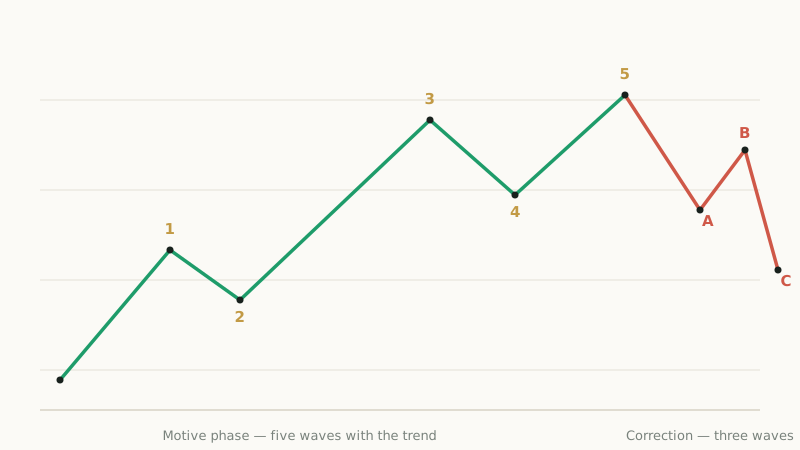
Within the motive phase, waves 1, 3 and 5 are impulse waves that move with the trend, while waves 2 and 4 are retracements that pull back against it. The defining feature of an impulse is that it makes progress — wave 3 in particular tends to be the longest and most powerful leg, the one that confirms a trend has genuinely taken hold and where the strongest momentum appears.
The corrective phase is where most traders come unstuck. Corrections are messier, slower and far more varied than impulses, which is why labelling them in real time is the hardest part of applying the theory. A simple A-B-C is only the baseline; corrections can stretch into more complex combinations, covered further down.
Motive versus corrective
Distinguishing a motive wave from a corrective one is the first skill any wave analyst has to build. Motive waves are directional and structured in fives; corrective waves are countertrend and structured in threes. Mislabel the two and every subsequent count inherits the error. The distinction is explored fully in impulse versus corrective waves.
Why five and three?
The numbers are not arbitrary. Elliott's argument was psychological: a trend needs to advance further than it pulls back in order to make net progress, and the five-wave structure is the minimum that allows three steps forward (waves 1, 3 and 5) to outweigh two steps back (waves 2 and 4). The three-wave correction that follows represents the market digesting that advance — profit-taking, doubt and a partial unwinding of the prior conviction — before the next cycle begins. Seen this way, the 5-3 rhythm is simply the signature of a crowd that swings between greed and fear but, over time, trends. It is the same impulse-and-pause dynamic that Dow theory described in looser terms.
The three unbreakable rules
Elliott Wave has a reputation for subjectivity, but it is anchored by three rules that are not negotiable. If a count violates any of them, the count is simply wrong and must be redrawn. These rules are what separate disciplined wave analysis from drawing squiggles after the fact.
| Rule | What it states | Why it matters |
|---|---|---|
| Rule 1 | Wave 2 never retraces more than 100% of wave 1 | If price falls below the start of wave 1, the move was not wave 1 |
| Rule 2 | Wave 3 is never the shortest of waves 1, 3 and 5 | Wave 3 is usually the strongest; a stunted wave 3 signals a bad count |
| Rule 3 | Wave 4 never enters the price territory of wave 1 | Overlap means the structure is corrective, not impulsive |
There is one technical exception to the third rule — overlap is permitted inside a diagonal pattern, a specialised wedge-shaped structure that appears in wave 1 or wave 5 positions. But for a standard impulse, the three rules hold absolutely. Beyond them sit dozens of guidelines — strong tendencies rather than laws — which are explored in the dedicated rules and guidelines guide.
Rules are binary and disqualify a count outright. Guidelines are probabilistic and merely make one count more likely than another. Confusing the two is the most common analytical mistake new wave traders make.
Wave personalities
Beyond their structure, each wave tends to carry a recognisable "personality" — a characteristic behaviour and sentiment backdrop that helps confirm a count as it develops.
- Wave 1 — the first tentative move off a low. Often mistaken for a mere bounce within the old trend, with sentiment still bearish.
- Wave 2 — a deep, convincing retracement that frequently retraces 50–61.8% of wave 1 and tempts traders into believing the old trend has resumed.
- Wave 3 — the strongest and usually longest wave. News flow turns positive, momentum expands, and breakouts run. This is the leg most systems are built to capture.
- Wave 4 — a shallow, sideways, often frustrating consolidation. It typically retraces far less than wave 2 (commonly toward 38.2%) and tends to alternate in form with it.
- Wave 5 — the final push, often on weakening momentum and bullish euphoria. Divergence between price and oscillators is common here.
The guideline of alternation ties two of these together: if wave 2 is a sharp, deep correction, wave 4 will tend to be a shallow, sideways one — and vice versa. Markets rarely repeat the same corrective form twice in a row within a single impulse.
Wave degrees
Because the pattern is fractal, Elliott classified waves into degrees — a naming hierarchy that lets an analyst describe which scale of trend they are talking about. A five-wave advance on a one-minute chart is a single sub-wave of a larger move on the daily chart, which is itself a fragment of something larger still.
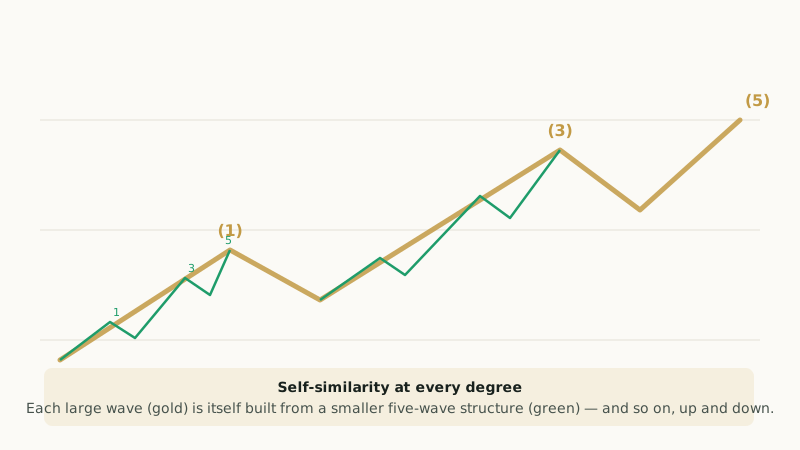
From largest to smallest, the commonly used degrees run: Grand Supercycle, Supercycle, Cycle, Primary, Intermediate, Minor, Minute, Minuette and Subminuette. The exact labels matter less than the principle they encode — that context is everything. A perfectly valid five-wave count on a 15-minute chart may be nothing more than wave 1 of a larger structure, and trading it without that awareness is how analysts get blindsided.
Fibonacci relationships
Elliott Wave and Fibonacci ratios are deeply intertwined. Elliott himself noted that wave relationships frequently align with the Fibonacci sequence, and modern practitioners lean on these ratios to forecast likely turning points and project targets.
- Retracements — wave 2 often retraces 50% or 61.8% of wave 1; wave 4 commonly retraces 38.2% of wave 3.
- Extensions — wave 3 frequently extends to 161.8% of wave 1, and sometimes 261.8% in strongly trending markets.
- Equality — when wave 3 is extended, waves 1 and 5 often work out roughly equal in length.
These are tendencies, not guarantees, but they turn a qualitative count into something measurable. A trader can use them to build a structured target and to improve the precision of an entry. The mechanics are covered in depth in the Elliott Wave Fibonacci relationships guide.
Fibonacci confluence — where several wave projections cluster at the same price — is far more meaningful than any single ratio. The market rarely respects one level in isolation; it respects zones where multiple relationships agree.
Corrective patterns
If impulses are the easy half of the theory, corrections are where it earns its difficult reputation. Elliott catalogued several distinct corrective forms, each with its own structure and implications. The three primary categories are:
- Zigzags — sharp, deep, three-wave corrections (labelled A-B-C) that move steeply against the trend. They feel like a genuine reversal but are countertrend moves.
- Flats — sideways corrections where the three waves are roughly equal in length, producing a choppy, range-bound look.
- Triangles — converging, five-wave (A-B-C-D-E) consolidations that typically appear in wave 4 or wave B positions and signal the trend is pausing, not reversing.
These can also chain together into combinations — a double or triple three — which is precisely why real-time correction labelling is so demanding. The practical takeaway is to hold corrective counts loosely and wait for the structure to resolve before committing, rather than forcing a clean A-B-C onto a market that is building something more complex. Each pattern has its own dedicated breakdown, starting with the zigzag and flat correction guides.
Applying Elliott Wave to forex
Elliott Wave originated on equity indices, but it transfers well to forex for one simple reason: it measures crowd psychology, and the major currency pairs are among the most liquid, most widely watched markets in the world. The deeper the participation, the cleaner the psychological footprint the theory is designed to read.
That said, forex carries quirks worth respecting. Currencies trade in pairs, so a wave structure on EUR/USD is simultaneously the inverse structure on USD/EUR — direction is always relative. Pairs are also heavily influenced by scheduled fundamental events such as central bank decisions, which can distort or truncate an otherwise textbook count. For that reason, experienced wave traders tend to:
- Track the higher-timeframe count first, then drill down — never the other way around.
- Trade primarily in the direction of wave 3, the highest-probability leg.
- Use the invalidation levels the rules provide as natural, logical stop placements.
- Treat every count as a hypothesis with an alternate, not a prediction set in stone.
The step-by-step mechanics of labelling a live chart are covered in how to count Elliott waves, and a worked example on a major pair appears in the EUR/USD case study.
Timeframe selection deserves particular care on forex. Because currency pairs trade around the clock across the Asian, London and New York sessions, the same structure can look very different depending on which session's volatility dominates a given candle. Many wave traders anchor their analysis to the daily and four-hour charts — high enough to filter session noise, low enough to act on — and treat anything below the one-hour as too noisy for reliable counts. The principle of multiple-timeframe confluence applies throughout: a count carries far more weight when the daily, four-hour and one-hour structures all tell a compatible story.
Common mistakes to avoid
Most of the frustration traders feel with Elliott Wave comes not from the theory itself but from a handful of avoidable errors in how it is applied. The same mistakes recur again and again:
- Counting from the bottom up. Starting on a low timeframe and trying to build upward almost guarantees a tangled count. The higher-degree structure has to frame the lower one, not the reverse.
- Forcing a five where there is a three. When a move refuses to resolve into a clean impulse, it is usually because it is corrective. Fighting that signal is how analysts end up redrawing the same chart a dozen times.
- Ignoring the alternate count. Disciplined wave analysis always carries a primary and an alternate scenario, each with its own invalidation. Traders who fall in love with a single count have no plan when price proves them wrong.
- Treating guidelines as rules. A wave 2 that retraces only 38.2% does not break anything — it simply makes one count slightly less typical. Only the three hard rules can disqualify a structure.
- Trading the count instead of the level. The count's value is that it points to a specific invalidation price. A trade taken without a defined level where the idea is wrong is a guess wearing a label.
A wave count is most useful precisely when it is wrong — because the rules tell you, at an exact price, that it has failed. That clarity around invalidation, more than any prediction, is what makes the framework worth learning.
Strengths and criticisms
No serious treatment of Elliott Wave is complete without the case against it. The most persistent criticism is subjectivity: because corrections can take so many forms and because the count is fractal, two competent analysts can look at the same chart and label it differently. Critics argue this flexibility makes the theory unfalsifiable in practice — that it explains everything after the fact but predicts little before it.
Supporters counter that the three rules impose genuine, testable constraints, that the framework's value lies in defining low-risk entries with clear invalidation rather than in perfect prediction, and that no analytical method survives without judgement. The honest position sits in between: Elliott Wave is a powerful lens for understanding market structure and managing risk, but a poor fit for anyone seeking mechanical certainty.
For a head-to-head with another classic structural framework, see the comparison of Elliott Wave versus the Wyckoff method — two very different attempts to answer the same question about what really moves price.
Where the theory earns its keep is not in calling exact tops and bottoms, but in three quieter contributions. It forces a trader to define context before acting, by insisting every move be placed within a larger structure. It supplies logical, non-arbitrary invalidation levels through its rules, which doubles as a risk-management discipline. And it provides a shared vocabulary — wave 3, the spring of a correction, a fourth-wave triangle — that lets analysts reason about structure precisely. A trader who takes only those three habits from Elliott Wave, and leaves the prophecy behind, has gained something durable.
Elliott Wave is a map, not the territory. Its job is to tell you where you probably are and where the structure breaks — define your invalidation, respect the three rules, and let the higher-timeframe context lead every decision.