
It is tempting to treat trading frameworks as competitors, but Dow Theory and Elliott Wave are better understood as parent and child. Elliott Wave did not arrive to overthrow Dow Theory; it grew directly out of it, taking Dow's foundational insight about trends operating across multiple scales and refining it into something far more precise and ambitious. Comparing the two is therefore less about choosing a winner than about understanding how a broad foundation became a detailed structure — and what each offers the trader. This guide lays out the lineage, the key differences, and how to think about using them.
It builds on Dow Theory explained and Elliott Wave theory explained, and complements the related comparison in Elliott Wave vs Wyckoff.
Key takeaways
Q: What is the difference between Dow Theory and Elliott Wave?
A: Dow Theory is the broad foundation — trends, phases and confirmation — describing market direction in general terms. Elliott Wave is a more precise, fractal elaboration that specifies the exact structure of trends as five-wave impulses and three-wave corrections, aiming for greater predictive detail.
Q: Did Elliott Wave come from Dow Theory?
A: Yes. Ralph Nelson Elliott built directly on Dow's foundation, particularly Dow's idea of trends operating across multiple scales. Elliott refined the general trend concept into a specific, fractal wave structure with detailed rules.
Q: Which is better, Dow Theory or Elliott Wave?
A: Neither is strictly better. Dow Theory is simpler and more robust but less precise; Elliott Wave is more detailed and predictive but more subjective and harder to apply. Many traders use Dow's principles as a foundation and Elliott Wave for finer structure.
The lineage
Ralph Nelson Elliott developed his wave principle in the 1930s, and he was explicit that he was building on the work that came before, Dow's especially. Dow had established that markets move in trends and that those trends operate on multiple scales — the tide, the waves, the ripples of primary, secondary and minor trends. Elliott took this multi-scale insight and asked a more demanding question: is there a precise, repeating structure to these trends, and can it be specified exactly?
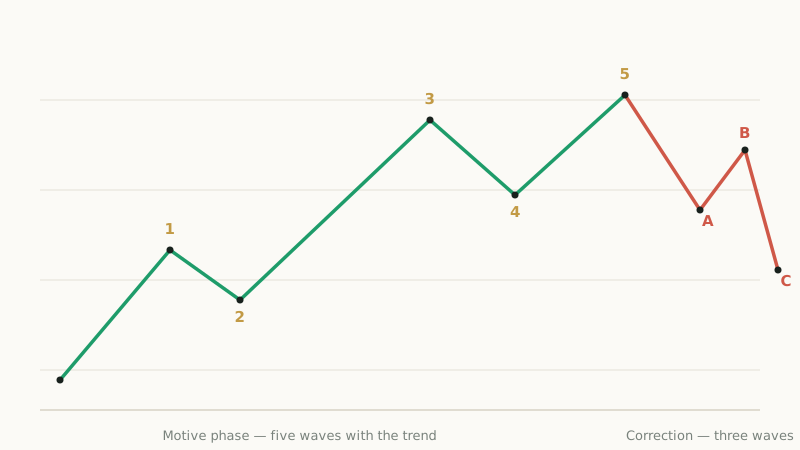
His answer was the five-wave impulse and three-wave correction, nested fractally across degrees — a far more detailed and rule-bound elaboration of Dow's general observation that trends contain smaller trends. Where Dow said "trends operate on three scales," Elliott said "every trend is a five-wave move built from smaller five-wave and three-wave moves, governed by specific rules." Elliott Wave is, in this sense, Dow Theory's multi-scale idea pursued to its logical and most ambitious conclusion.
Precision versus generality
The central difference between the two is the trade-off between precision and robustness. Dow Theory is general: it tells you the market is in an uptrend, which phase it is roughly in, and whether related markets confirm — but it does not attempt to specify exactly where the trend will turn or how far it will go. That generality is also its strength: there is relatively little to misread, the framework is robust, and its signals, while late, are dependable.
Elliott Wave is precise: it specifies the exact structure of the trend, counts the waves, and projects targets and turning points with Fibonacci ratios. That precision is its appeal — it promises far more detailed and actionable forecasts than Dow's broad strokes. But precision comes at a cost: the detailed wave counting introduces considerable subjectivity, multiple valid counts can coexist, and the framework is correspondingly harder to apply and easier to misread. Elliott Wave attempts much more than Dow Theory, and in attempting more, it risks more.
Dow Theory and Elliott Wave sit on a spectrum from robust-but-vague to precise-but-fragile. Dow tells you roughly where you are with high reliability; Elliott tries to tell you exactly where you are with lower reliability. The right tool depends on whether you value dependability or detail more.
Predictiveness and reliability
This trade-off plays out directly in how the two frameworks are used and criticised. Dow Theory's signals are famously late: by the time confirmation arrives and a trend is declared reversed, a significant portion of the move may have passed. Dow followers accept this lateness as the price of reliability — the framework rarely cries wolf, even if it speaks slowly. Its predictions are modest but trustworthy.
Elliott Wave aims to be earlier and more specific, identifying potential turning points before they are confirmed by price. When a count is correct, this is enormously valuable. But the subjectivity that allows such early calls also produces the hindsight-fitting and frequent re-labelling that critics highlight, as discussed in the honest assessment of Elliott Wave. The two frameworks thus embody opposite philosophies of forecasting: Dow waits for confirmation and accepts being late; Elliott attempts anticipation and accepts being wrong more often. Neither philosophy is universally superior; they suit different temperaments and goals.
Using them together
Because they are parent and child rather than rivals, the two frameworks can complement each other well. A common approach is to use Dow Theory as the robust foundation — establishing the primary trend, the phase, and confirmation from related markets — and Elliott Wave for finer structure within that established context. Dow tells you the tide is rising and you should be looking for longs; Elliott attempts to tell you which wave of the advance you are in and where it might pause or end. The Dow-level read keeps the Elliott-level count anchored to a robust directional bias, which is exactly the discipline Elliott Wave most needs.
This layering also guards against each framework's weakness. Dow's lateness is mitigated by Elliott's attempt at earlier, more precise entries; Elliott's subjectivity is constrained by Dow's robust, hard-to-misread trend bias. A trader who reads the primary trend with Dow's reliability and then refines entries with Elliott's structure — always carrying the alternate count and respecting invalidation — gets something of the best of both. The frameworks were never really in competition; the child simply added detail to what the parent established.
Both on forex
On currencies, both frameworks apply with their usual character. Dow's price-based principles — trends, phases, persistence — translate cleanly to forex, with the confirmation tenet adapted through correlated pairs and the dollar index rather than stock averages. Elliott Wave applies as it does on any market, since it is purely price-and-proportion based and needs no volume data. The volume tenet of Dow Theory is the only element that suffers from forex's lack of true volume, and it is the least essential of the two frameworks' shared ideas.
For the forex trader, the practical recommendation mirrors the general one: use Dow's robust trend and phase reading to establish a dependable directional bias, and layer Elliott Wave's structure on top for finer entries and targets if you find it adds value — always with the discipline, alternates and invalidation that Elliott Wave demands. Understanding both, and how the second grew from the first, gives a deeper grasp of market structure than either alone, and a clear view of the foundations on which all modern technical analysis rests.
A side-by-side summary
It helps to set the two frameworks' characters directly against each other. On scope, Dow Theory is broad and foundational, describing markets in general terms, while Elliott Wave is a specific, detailed structural model. On precision, Dow offers general direction and phase, whereas Elliott specifies exact wave counts, targets and turning points. On objectivity, Dow's principles are relatively robust and hard to over-interpret, while Elliott's wave counting introduces significant subjectivity and the possibility of multiple valid readings.
On timing, Dow is deliberately late, confirming trends and reversals after they begin, while Elliott attempts to anticipate turns earlier. On reliability versus ambition, Dow trades ambition for dependability — modest but trustworthy reads — while Elliott trades dependability for ambition, promising more and therefore risking more. And on learning curve, Dow's principles can be grasped quickly, whereas Elliott Wave demands extensive study and practice to apply with any consistency. Across nearly every dimension, the pattern is the same: Dow is the simpler, sturdier foundation; Elliott is the more elaborate, more powerful, and more fragile structure built upon it.
The synthesis that emerges is not that one should be chosen over the other, but that they occupy different rungs of the same ladder. Dow Theory establishes the robust, reliable understanding of trend and phase that every trader needs; Elliott Wave offers an optional, more ambitious layer of structural detail for those willing to accept its subjectivity in exchange for finer resolution. A trader well served by Dow alone has lost nothing essential; a trader using Elliott without Dow's grounding has often lost the plot. Understanding the lineage — foundation first, elaboration second — is the key to using either, or both, wisely.
Elliott Wave grew out of Dow Theory, refining Dow's multi-scale trend idea into a precise, fractal wave structure. Dow is broad, robust, objective and late; Elliott is detailed, precise, subjective and anticipatory. They are parent and child, not rivals — use Dow for a dependable trend-and-phase foundation and Elliott for finer structure on top. Both translate to forex, with only Dow's volume tenet limited by the lack of true volume.