
Charles Dow reached for the sea to explain the market. The primary trend, he said, is like the tide — the great, slow movement that determines the overall direction. Secondary reactions are the waves that move against the tide, sometimes dramatically, but without changing its direction. And minor fluctuations are the ripples on the waves: brief, choppy and, in Dow's view, mostly noise. This tide-wave-ripple framework is one of the most enduring images in all of trading, and it amounts to the original statement of multi-timeframe analysis. This guide explains all three trends and how to trade across them.
This expands the second tenet from Dow Theory explained and connects directly to the fractal thinking that Elliott Wave would later formalise.
Key takeaways
Q: What are the three trends in Dow Theory?
A: Dow identified three trends by scale: the primary trend (the major direction, lasting a year or more), the secondary trend (intermediate reactions against the primary, lasting weeks to months), and the minor trend (short-term fluctuations of days, regarded largely as noise).
Q: What is a secondary trend?
A: A secondary trend is an intermediate reaction that moves against the primary trend — a pullback in a bull market or a rally in a bear market — typically lasting from a few weeks to a few months and retracing a portion of the primary move before it resumes.
Q: Which trend should traders follow?
A: Most traders align with the primary trend for direction and use secondary reactions to time entries in that direction. Dow regarded minor trends as noise that is difficult to trade reliably and easy to be misled by.
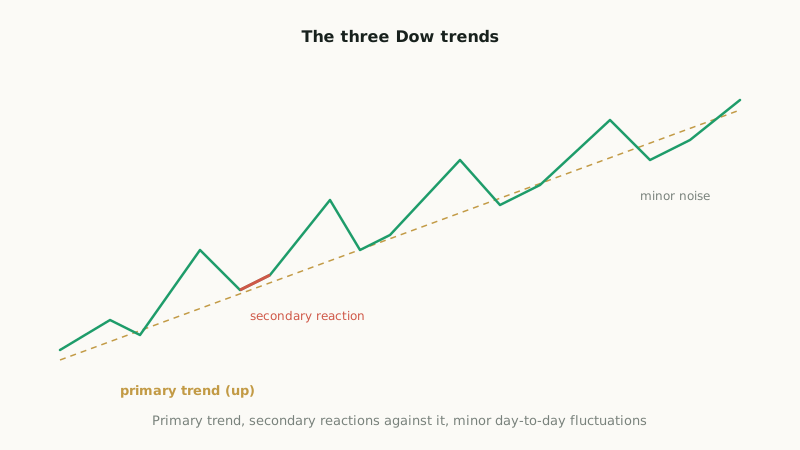
The primary trend
The primary trend is the major direction of the market, and the one that matters most. Dow described it as lasting a year or more — the tide that carries everything with it. A primary bull market is defined by a succession of higher highs and higher lows; a primary bear market by lower highs and lower lows. The primary trend is the dominant force, and Dow's sixth tenet — that a trend persists until a definitive reversal — applies to it most strongly: the primary direction is assumed intact until clear, confirmed evidence proves otherwise.
For the trader, the primary trend provides the all-important directional bias. Trading with the primary trend means trading with the tide — the path of least resistance — while trading against it is fighting a powerful current. The vast majority of successful trend-following aligns positions with the primary direction, using the smaller trends only to refine timing. Identifying the primary trend correctly is therefore the first and most consequential step in any Dow-based analysis.
The secondary trend
The secondary trend is an intermediate reaction against the primary — the waves moving counter to the tide. In a primary bull market, a secondary trend is a downward correction; in a primary bear market, it is an upward rally. Dow observed that these reactions typically last from a few weeks to a few months and retrace a meaningful portion — often something like a third to two-thirds — of the preceding primary move before the primary trend reasserts itself.
Secondary trends are both a danger and an opportunity. The danger is that a deep secondary reaction can look, in real time, exactly like a primary reversal, tempting traders to abandon or reverse their positions just before the primary trend resumes. The opportunity is that secondary reactions create the pullbacks that allow traders to enter in the direction of the primary trend at favourable prices — buying the dips in a bull market, selling the rallies in a bear market. Distinguishing a secondary reaction from a genuine reversal is one of the central challenges of trend trading, and it is where confirmation, phase analysis and structure all earn their keep.
The hardest question in trend trading is whether a move against the trend is a secondary reaction (buy the dip) or a primary reversal (get out). Dow offers no magic answer — but aligning with the primary trend, demanding confirmation of any reversal, and respecting persistence tilt the odds in your favour.
The minor trend
The minor trend is short-term fluctuation — the ripples on the waves — lasting from a few days down to intraday movements. Dow regarded minor trends as the least significant and the most unreliable of the three: they are heavily influenced by noise, easily manipulated, and difficult to interpret in isolation. His counsel was that minor movements are largely meaningless on their own and that fixating on them is a distraction from the trends that actually matter.
This is not to say short timeframes are useless — modern intraday traders work primarily in what Dow would call minor trends — but Dow's warning remains apt: the smaller the timeframe, the more noise relative to signal, and the easier it is to be whipsawed. Even traders who operate on short timeframes benefit from anchoring their analysis to the larger primary and secondary trends, treating the minor fluctuations as timing detail within a larger directional context rather than as standalone signals. The ripples are real, but they only make sense in relation to the waves and the tide.
The original multi-timeframe analysis
What makes Dow's three trends so important is that, together, they constitute the first clear articulation of multi-timeframe analysis — the practice every serious trader uses today. The principle is to read the larger trend for direction and the smaller trend for timing: identify the primary trend to establish bias, use secondary reactions to find favourable entries in the primary direction, and use minor movements only to fine-tune execution. The larger trend always governs the smaller; the smaller never overrides the larger.
This nested, scale-aware view of the market flowed directly into everything that followed. Elliott Wave's degrees are a more formal, fractal version of Dow's three trends; Wyckoff's analysis is always conducted with the larger trend in view; and the higher-timeframe-first discipline of Smart Money Concepts is the same principle in modern dress. Dow's tide-wave-ripple metaphor, simple as it is, captured a structural truth about markets that has never been improved upon, only refined.
The three trends on forex
Dow's trend framework maps cleanly onto the way forex traders use timeframes. A position trader works in the primary trend on the weekly and daily charts; a swing trader uses secondary reactions on the daily and four-hour to time entries in the primary direction; an intraday trader operates in the minor trends on the hourly and below, ideally still anchored to the higher-timeframe primary direction. The crucial, universal discipline — whatever your style — is to define the primary trend first and trade in harmony with it, using the smaller trends for timing rather than direction.
Because Dow's trends are purely price-based, they translate to forex without the volume caveat that limits some of his other tenets. The tide-wave-ripple structure is readable on any currency chart, and the assumption that the primary trend persists until definitively reversed is the foundation of currency trend-following. Used as the framework for organising your analysis across timeframes, Dow's three trends remain as practical today, on forex, as they were on the stock averages Dow watched over a century ago.
How to identify the primary trend
Since everything in Dow analysis hinges on correctly reading the primary trend, it is worth being concrete about how it is done. The core method is peak-and-trough analysis: tracking the sequence of significant highs (peaks) and lows (troughs). A primary uptrend is in force as long as price keeps making higher peaks and higher troughs — each rally exceeding the last high and each pullback bottoming above the last low. A primary downtrend is the reverse: lower peaks and lower troughs. The trend is presumed intact as long as this sequence continues.
The reversal signal, in Dow terms, comes when the sequence breaks. In an uptrend, the first warning is a rally that fails to exceed the previous peak, followed by a decline that breaks below the previous trough — the higher-highs-and-higher-lows pattern is violated, suggesting the primary trend may be turning. This peak-and-trough reversal is the same structural logic that Smart Money Concepts later formalised as a change of character, and that price action traders read as a break of market structure; Dow described it first. Confirmation from a related market and, where available, volume strengthens the signal.
Two practical cautions apply. First, only significant peaks and troughs count — the minor ripples must be filtered out, or every small wiggle looks like a reversal. Anchoring the analysis to a higher timeframe naturally does this filtering. Second, a single broken trough is a warning, not yet proof; Dow's insistence on confirmation guards against mistaking a deep secondary reaction for a true reversal. The discipline is to identify the primary trend from the sequence of significant peaks and troughs, respect it until that sequence definitively breaks and is confirmed, and resist the constant temptation to call a top or bottom prematurely.
Dow's three trends are the primary (the tide), the secondary (the waves against it) and the minor (the ripples of noise). Identify the primary trend through peak-and-trough analysis — higher peaks and higher troughs for an uptrend — and treat a broken sequence, confirmed, as a reversal signal. Trade with the primary for direction, use secondary reactions for entries, and treat minor moves as timing detail. It is the original multi-timeframe analysis, and it translates cleanly to forex.