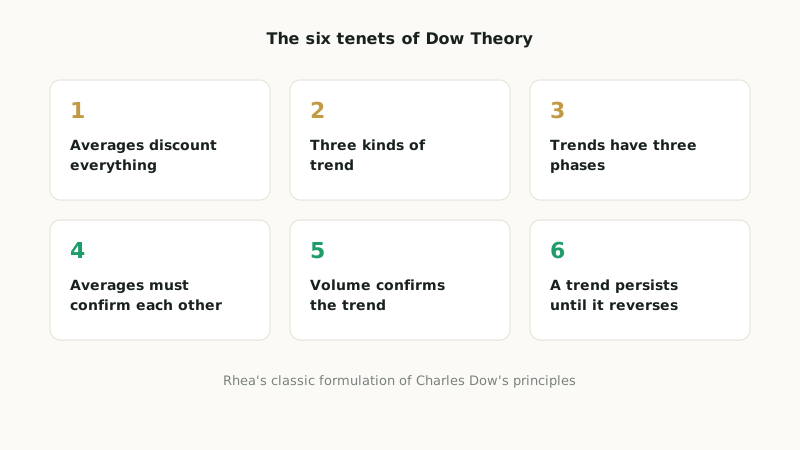
Dow Theory is most often taught as six tenets — the formulation Robert Rhea distilled from Charles Dow's editorials in the 1930s. Together they hold up the entire edifice of technical analysis, and each one repays close attention, because each contains an insight that later frameworks would inherit and build upon. This guide walks through all six in turn: what each one claims, why it matters, and — in the spirit of honest analysis — where it shows its age in the modern, and especially the forex, market.
This is the detailed companion to the overview in Dow Theory explained, where the tenets are introduced in brief.
Key takeaways
Q: What are the six tenets of Dow Theory?
A: The six tenets are: the averages discount everything; the market has three trends; primary trends have three phases; the averages must confirm each other; volume confirms the trend; and a trend persists until a definitive reversal signal appears.
Q: What does 'the averages discount everything' mean?
A: It means that all known information — every fact, hope and fear of every participant — is already reflected in market prices. The price is therefore the primary object of study, since it summarises everything the market collectively knows and expects.
Q: What is the most important Dow tenet?
A: Many traders regard the sixth tenet — that a trend persists until a definitive reversal — as the most practically important, since it is the basis of all trend-following and counsels against prematurely betting against an established trend.
1. The averages discount everything
The first tenet is the philosophical foundation: market prices already reflect all known information. Every fact, every expectation, every hope and fear held by every participant is, in Dow's view, already incorporated into the price. It follows that the price itself — not external news, not opinion — is the proper object of study, because it is the distilled summary of everything the market collectively knows. This is the original statement of the idea that "it's all in the chart," and it justifies the entire technical approach.
This tenet anticipates, in milder form, the efficient market hypothesis that would later be formalised by academics, though Dow's version is more pragmatic than absolute: prices reflect what is known, but they still move as new information arrives and as the balance of sentiment shifts. For the trader, the practical takeaway is to focus on what price is actually doing rather than trying to out-analyse the market on fundamentals it has already priced in.
2. The market has three trends
The second tenet classifies market movement into three nested scales: the primary trend (the major direction, lasting a year or more), the secondary trend (intermediate reactions against the primary, lasting weeks to months), and the minor trend (short-term fluctuations of days, largely noise). Dow's tide-wave-ripple metaphor captures this beautifully: the primary trend is the tide, secondary reactions are the waves, and minor movements are the ripples.
This is arguably Dow's most influential idea, because it introduced the notion that the market operates on multiple timeframes simultaneously — the seed of all multi-timeframe analysis and a direct ancestor of Elliott's fractal waves. It is examined in depth in primary, secondary and minor trends.
3. Primary trends have three phases
The third tenet holds that a primary trend unfolds in three phases driven by different participants. In a bull market: accumulation (informed money buys from a pessimistic public), public participation (the long, strong middle as the crowd joins), and distribution (informed money sells to a euphoric public). A bear market mirrors this. These phases are the origin of Wyckoff's accumulation and distribution schematics and of the institutional narrative in Smart Money Concepts, and they are covered in Dow Theory market phases.
4. The averages must confirm each other
The fourth tenet is Dow's distinctive confirmation principle: a trend is only valid if more than one average confirms it. Dow watched the Industrials (companies making goods) and the Rails (companies shipping them), reasoning that in a healthy economy both should advance together. A new high in one unconfirmed by the other was a warning. The logic was sound for an industrial economy where production and transportation were tightly linked.
This is the tenet that has aged most, at least in its specific form. The modern economy is not captured by two industrial averages, and the precise Industrials-versus-Transports relationship is less reliable than it once was. But the principle — that a trend is more trustworthy when a related market confirms it — remains valuable, and traders apply it today through index breadth, sector confirmation, or, on forex, correlated pairs and the dollar index.
The tenets divide into the timeless and the dated. The discounting of information, the three trends, the three phases and the persistence of trends remain foundational. The specific two-average confirmation and the volume tenet need adaptation for modern and forex markets — but their underlying logic survives.
5. Volume confirms the trend
The fifth tenet states that volume should expand in the direction of the primary trend. In a healthy uptrend, volume rises on advances and contracts on pullbacks; the reverse holds in a downtrend. Volume that fails to confirm — a price rise on shrinking volume — is a warning that the move lacks conviction. This is essentially the same insight Wyckoff formalised as the law of effort versus result, and it remains a cornerstone of volume analysis.
For forex traders, this tenet runs into the now-familiar limitation: spot currencies have no true volume, only tick volume as an imperfect proxy. Volume confirmation is therefore weaker on forex than on the stock market Dow studied, and is best treated as supporting rather than decisive evidence — the same adaptation that applies across Wyckoff and all volume-based analysis on currencies.
6. A trend persists until a definitive reversal
The sixth tenet is the most practically important for many traders: assume the existing trend continues until clear evidence proves it has reversed. Trends are presumed to remain in force, and the burden of proof lies with the reversal, not the continuation. This is the philosophical basis of all trend-following: do not anticipate a turn, do not fight an established trend, and wait for definitive confirmation before betting against the prevailing direction.
The difficulty, which Dow acknowledged, lies in distinguishing a genuine reversal from a mere secondary reaction — a deep pullback within an intact trend can look like a reversal in real time. This is the perennial challenge of trend-following, and it is why the other tenets matter: confirmation, phase analysis and trend classification all help judge whether a move against the trend is a temporary reaction or the start of something larger. The tenet counsels patience and respect for the established direction, which is sound discipline in any market, forex included.
The tenets in forex practice
Taken together, the six tenets give the forex trader a coherent foundational framework, adapted for the realities of the currency market. Focus on price as the summary of all information (tenet 1); read the market across its primary, secondary and minor scales (tenet 2); understand which phase a trend is in (tenet 3); seek confirmation from correlated instruments rather than two stock averages (tenet 4); treat tick volume as supporting evidence (tenet 5); and respect the prevailing trend until it definitively reverses (tenet 6). The dated specifics fall away; the durable logic remains, and it is the logic on which Elliott Wave, Wyckoff and the rest were built.
The tenets as a working checklist
The six tenets become most useful when treated not as abstract doctrine but as a practical checklist for assessing any market. Run through them in order and they form a coherent analytical routine. First, accept that price reflects what is known and make the chart, not the news, your primary evidence (tenet 1). Second, establish which primary trend the market is in and where the current secondary and minor movements sit within it (tenet 2) — this gives you direction and context in one step.
Third, judge which phase the primary trend appears to be in: is this the quiet accumulation after a decline, the strong public-participation middle, or the euphoric distribution near a top (tenet 3)? This tells you whether to be looking to enter, ride, or grow cautious. Fourth, seek confirmation from a related market — a correlated pair, an index, the dollar — rather than trusting a single instrument in isolation (tenet 4). Fifth, check whether volume (or, on forex, tick volume) is expanding in the trend's direction, treating it as supporting evidence (tenet 5).
Sixth and finally, default to the assumption that the established trend continues, and demand definitive evidence before betting on a reversal (tenet 6). Worked through this way, the tenets turn from a historical list into a disciplined sequence of questions: What is price saying? What is the primary trend? What phase is it in? Is it confirmed? Is volume behind it? And has it definitively reversed, or not? That routine, applied consistently, is the practical essence of Dow Theory — and a sound foundation for analysis in any market, forex included.
Dow's six tenets: averages discount everything; three trends; three phases; averages must confirm each other; volume confirms; and a trend persists until a definitive reversal. Used as a checklist — read price, find the primary trend, judge the phase, seek confirmation, check volume, respect persistence — they form a disciplined analytical routine. The discounting, trends, phases and persistence are timeless; the two-average confirmation and volume tenet need adapting for modern and forex markets.