Every great trend is really three trends in one. Dow observed that a primary move does not unfold uniformly but in three distinct phases, each dominated by a different crowd of participants and each with its own psychological character. The brilliance of the idea is that it describes a kind of relay race in which informed money and the public repeatedly trade places — the informed buying when the public despairs, and selling when the public grows euphoric. This guide explains the three phases — accumulation, public participation and distribution — who drives each, and how to recognise where in a trend you stand.
This elaborates the third tenet introduced in Dow Theory explained, and it is the direct ancestor of the detailed schematics in Wyckoff accumulation.
Key takeaways
Q: What are the three phases of a Dow primary trend?
A: A primary bull market has an accumulation phase (informed money buys from a pessimistic public), a public participation phase (the long middle as trend-followers join), and a distribution phase (informed money sells to a euphoric public). A bear market mirrors these in reverse.
Q: What happens in the accumulation phase?
A: In accumulation, informed or 'smart' money quietly buys near the lows while sentiment is still negative and most participants are uninterested. Prices move sideways or slowly, as the buying is done without driving the market up and revealing intent.
Q: How do Dow's phases relate to Wyckoff?
A: Dow's accumulation and distribution phases are the direct ancestors of Wyckoff's detailed accumulation and distribution schematics. Wyckoff elaborated the same phases into specific events and sub-phases, and Smart Money Concepts later rebranded the same ideas.
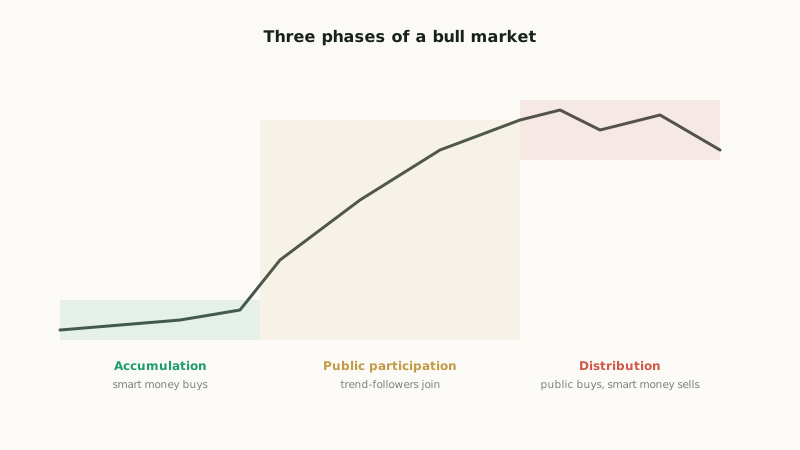
The accumulation phase
A bull market begins in accumulation, and it begins in gloom. Following a prolonged decline, sentiment is at its worst: the news is bad, the public is discouraged or has given up entirely, and few have any appetite to buy. It is precisely here that the informed money — those Dow believed understood value and saw the bottom forming — begins quietly buying. They accumulate positions gradually, careful not to drive prices up and reveal their intent, so the phase is marked by sideways or slowly basing price action rather than a visible rally.
To the casual observer, nothing is happening; the market looks dead, and that apparent deadness is the point. The accumulation phase is the foundation of the coming trend, built in plain sight but recognised by almost no one. This is the phase Wyckoff later mapped in granular detail with his selling climaxes, springs and signs of strength, and it is the same "smart money buys low" idea that animates Smart Money Concepts. Dow described it first, in broad strokes, as the quiet beginning of every bull market.
The public participation phase
The public participation phase is the longest and usually the most profitable part of the trend. As prices begin to rise more visibly and the worst of the bad news passes, trend-followers and the broader public start to notice. Improving fundamentals provide reasons to buy, momentum builds, and a self-reinforcing cycle takes hold: rising prices attract buyers, whose buying pushes prices higher, attracting still more buyers. This is the steepest, most sustained part of the advance, and the phase in which trend-following strategies thrive.
For most traders, the public participation phase is where the money is made, because it is the part of the trend that is both clearly visible and still has room to run. The skill is in joining it early enough — ideally as the accumulation phase resolves into the first clear signs of the new uptrend — rather than waiting until the move is mature and most of the gains have already occurred. Recognising the transition from accumulation to participation is therefore one of the most valuable reads in trend analysis.
The phases are a story of who is buying from whom. In accumulation, the informed buy from the despairing. In participation, the trend rewards those who recognise it. In distribution, the informed sell to the euphoric. The public's mood is, repeatedly, the contrary indicator.
The distribution phase
The trend's final act is distribution, and it is marked by euphoria. By now the news is uniformly good, optimism is rampant, and the public — having watched the market rise for a long time — piles in with conviction, certain the good times will continue. This eager, late-arriving demand is exactly what the informed money has been waiting for. Having bought in the accumulation phase near the lows, they now sell their holdings to the enthusiastic public near the highs, distributing their positions without crashing the price.
Like accumulation, distribution often appears as a sideways or choppy range rather than an obvious top, which is what makes it so treacherous — it can masquerade as a healthy pause right up until the markdown begins. The phase ends when the informed money has finished selling and demand is exhausted, after which prices begin to fall and a new bear market — with its own distribution, panic and despair phases — gets underway. Wyckoff's distribution schematic, with its buying climaxes and upthrusts, is the detailed elaboration of this phase Dow sketched in outline.
The phases in a bear market
A primary bear market mirrors the bull market's structure in reverse, with three phases of its own. It begins with distribution (the tail end of the prior bull, as informed money finishes selling), proceeds through a public participation phase (the long decline as the public recognises the downtrend and selling accelerates, often through fear), and ends in despair (panic, capitulation and exhaustion near the lows, where the next accumulation phase will eventually begin). The emotional arc is the inverse of the bull market: from complacency through fear to outright panic.
The symmetry between bull and bear phases reflects the cyclical view at the heart of Dow Theory and its descendants: markets move through a repeating cycle in which sentiment swings from despair to euphoria and back, and informed money systematically trades against the public's mood. Understanding both halves of the cycle is what lets a trader orient themselves — to ask, at any moment, which phase of which kind of market they are likely in.
The phases on forex
The phase concept translates well to forex, with a caveat about the "informed money" framing. Currency markets clearly move through cycles of pessimism, participation and euphoria, and the practical value of phase analysis is the same as on any market: it helps a trader judge whether a trend is young (worth joining), mature (worth riding with caution), or exhausted (worth fading or exiting). Recognising a long, quiet base after a decline as potential accumulation, and a euphoric, climactic top as potential distribution, is as useful on EUR/USD as on any stock.
The honest qualification is that the "informed money quietly accumulating" narrative is, like all such institutional stories, an interpretive model rather than a verifiable fact — the same caveat that applies to Wyckoff's Composite Man and SMC's institutions. What can be observed is the recurring pattern of sentiment and price through a trend's life. Treating the phases as a map of that observable cycle, rather than as literal proof of what insiders are doing, keeps the analysis grounded while preserving its genuine practical value for timing entries and exits across a trend.
The sentiment cycle behind the phases
The three phases are, at bottom, a map of crowd emotion, and reading them well means reading sentiment as much as price. Each phase corresponds to a recognisable emotional state, and the transitions between them are driven by the swing of collective mood from one extreme to the other. The accumulation phase coincides with despair and disinterest: the public has been hurt by the prior decline, the news is relentlessly negative, and few can imagine prices rising. This pessimism is exactly the condition that lets informed money buy cheaply — the worse the mood, the better the value.
The public participation phase tracks the slow return of confidence and then optimism: as prices rise and news improves, scepticism gives way to belief, and belief to enthusiasm. The distribution phase arrives with euphoria and greed: the news is uniformly glorious, caution is mocked, and the public buys with total conviction at exactly the moment informed money is selling. The emotional peak coincides with the price peak — which is why extreme bullish sentiment is so often a contrarian warning.
This gives phase analysis a genuinely useful contrarian dimension. When the news flow and crowd sentiment reach an extreme, the corresponding phase — and a possible turn — is often near. Uniformly terrible news and capitulation hint at accumulation and a bottom; uniformly wonderful news and euphoria hint at distribution and a top. The trader who learns to feel the temperature of the crowd, and to grow cautious precisely when everyone else is most confident, has internalised the deepest practical lesson of Dow's phases. The caveat is that sentiment extremes can persist longer than seems reasonable, so sentiment is a context for caution and confirmation, not a precise timing tool on its own.
A Dow primary trend unfolds in three phases — accumulation (informed money buys from a pessimistic public), public participation (the long, profitable middle), and distribution (informed money sells to a euphoric public) — mirrored in a bear market by distribution, participation and despair. The phases track the crowd's emotional cycle from despair to euphoria, which gives them a contrarian edge: grow cautious when sentiment is most extreme. On forex, treat them as a map of the observable sentiment cycle.