
Smart Money Concepts — almost always shortened to SMC — is a way of reading a chart from the assumed perspective of the largest participants in the market: the banks, funds and institutions whose orders are big enough to move price. Where classical technical analysis asks "what pattern is forming?", SMC asks "where is the money that the big players need, and how will they go and get it?" That single shift in viewpoint reorganises the whole chart around liquidity, market structure, order blocks and imbalance, and it has become one of the most widely taught approaches in modern retail forex. This guide lays out the entire framework — and, just as importantly, gives an honest account of what it can and cannot do.
SMC has its own dense vocabulary, and each major concept has a dedicated guide; this overview ties them together and shows how they fit.
Key takeaways
Q: What are Smart Money Concepts?
A: Smart Money Concepts (SMC) is a trading approach that reads price from the perspective of large institutional participants. It centres on market structure, liquidity, order blocks and fair value gaps, on the premise that institutions move price toward pools of resting orders to fill their positions.
Q: Is SMC the same as ICT?
A: SMC grew largely out of the Inner Circle Trader (ICT) teachings and shares most of its vocabulary. SMC is often used as a broader, more generic label for the same family of ideas about liquidity and institutional order flow.
Q: Does Smart Money Concepts actually work?
A: SMC is a popular interpretive framework, not a proven edge. Much of it overlaps with classic supply and demand, and its institutional narrative is unverifiable. Used as a structured way to read price and manage risk it can be useful; treated as a guaranteed system it is not.
The core premise
The foundational idea behind SMC is that markets are driven by the need of large institutions to fill very large orders — and that doing so is difficult. An institution wanting to buy a huge position cannot simply place one giant order without moving price against itself; it needs a pool of willing sellers to absorb its buying. The most reliable place to find that pool is wherever many other traders have clustered their orders, particularly their stop losses. Retail stops gather in predictable places: just above obvious highs, just below obvious lows, around round numbers and at equal highs and lows.
From this premise, SMC builds a narrative: price is driven toward these clusters of resting orders — these pools of liquidity — so that large players can fill their positions against the stops being triggered, after which price reverses and moves in the institution's intended direction. The dramatic spike that runs the stops and then sharply reverses, familiar to anyone who has been stopped out at the exact low before a rally, is in SMC terms a deliberate liquidity grab. Whether or not this narrative is literally true in every case, it provides a coherent lens for interpreting the otherwise baffling habit price has of hunting obvious levels before moving.
Market structure: BOS and CHoCH
The skeleton of SMC is market structure — the sequence of highs and lows that defines whether a market is trending or turning. In an uptrend, price makes higher highs and higher lows; in a downtrend, lower highs and lower lows. SMC formalises the moments these sequences break with two key terms. A break of structure (BOS) occurs when price breaks the most recent significant high (in an uptrend) or low (in a downtrend), confirming the trend is continuing. A change of character (CHoCH) is the first break against the prevailing structure — the earliest structural sign that a trend may be ending and reversing.
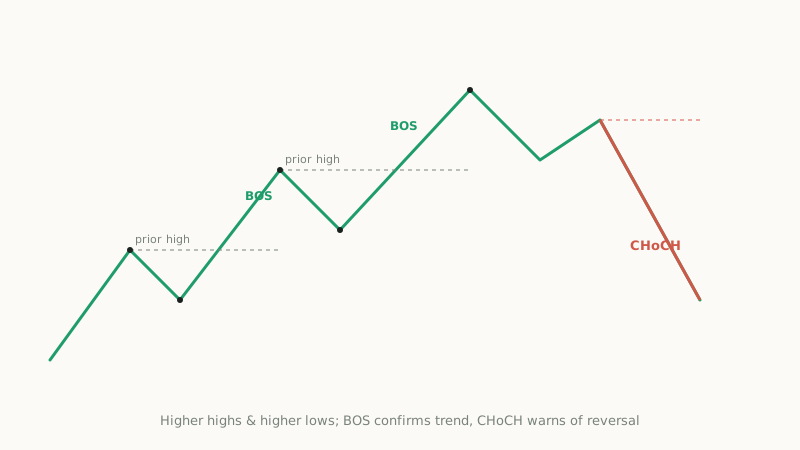
Reading structure correctly is the prerequisite for everything else in SMC, because the framework's other tools are only meaningful in the context of the trend they sit within. The full treatment is in break of structure explained; for now, the key point is that BOS and CHoCH give SMC an objective, price-based way to define trend and the moment it turns.
Liquidity
If structure is the skeleton, liquidity is the engine. In SMC, liquidity refers to the resting orders — overwhelmingly stop losses — that pool at predictable price levels. Stops from traders who are long sit below the lows they are protecting (sell-side liquidity); stops from traders who are short sit above the highs (buy-side liquidity). Equal highs, equal lows and obvious trendlines concentrate these stops further, creating especially attractive targets.
SMC reads price as being drawn toward these pools. A liquidity sweep or grab — a sharp move through a level that triggers the resting stops and then reverses — is treated as a signal that the move was about collecting orders rather than genuine directional intent. Recognising where liquidity rests, and watching for it to be swept, is one of SMC's most practical contributions, explored fully in liquidity in trading explained.
Order blocks and fair value gaps
Once a trader can read structure and liquidity, SMC offers two precise entry tools. The order block is the last opposing candle before a strong, structure-breaking move — in a bullish case, the final down candle before a powerful rally — interpreted as the area where institutions placed the orders that drove the move. Traders watch for price to return to ("mitigate") the order block as a potential entry in the direction of the impulse. The details are in what is an order block.
The fair value gap (FVG), or imbalance, is a three-candle pattern in which price moves so quickly that it leaves a gap — an inefficiency — in its range. SMC holds that price tends to return to "rebalance" these gaps before continuing, making them both targets and potential entry zones. The mechanics are covered in what is a fair value gap. Together, order blocks and FVGs give SMC traders specific, repeatable areas to act on rather than vague zones.
SMC is a stack: structure tells you the trend and when it turns, liquidity tells you where price is likely headed, and order blocks and fair value gaps tell you where to act once it gets there. Each layer only makes sense in the context of the one above it.
Premium and discount
One more concept ties the framework together: premium and discount. SMC divides any trading range into halves around its equilibrium (the 50% level). The upper half is the "premium" zone, where price is expensive and institutions are assumed to prefer selling; the lower half is the "discount" zone, where price is cheap and they are assumed to prefer buying. The principle is simple and disciplined: look for buying opportunities in discount and selling opportunities in premium, rather than chasing price at expensive or cheap extremes. It is essentially a structured way of insisting on favourable entry locations, and it pairs naturally with the Fibonacci thinking used elsewhere in technical analysis.
An honest assessment
SMC deserves a clear-eyed appraisal, because it is often oversold. Two things are true at once. First, much of its practical content is genuinely useful: defining trend through structure, respecting liquidity, insisting on favourable entry zones, and waiting for price to come to predefined areas are all sound, disciplined habits. Second, its institutional narrative — the story about what banks are deliberately doing — is essentially unverifiable, and a great deal of SMC overlaps with much older ideas, particularly classical supply and demand and support and resistance, rebranded in new vocabulary.
The framework also shares Elliott Wave's vulnerability to subjectivity and hindsight: with enough order blocks, gaps and liquidity levels to choose from, almost any move can be explained after the fact. SMC is therefore best understood as a popular interpretive lens and a discipline for reading price and managing risk — not as a proven edge or a mechanical system that prints money. Treated with that realism, and combined with strict risk management, it can be a useful part of a trader's toolkit. Treated as a secret decoded from the banks, it sets traders up for disappointment.
Applying SMC across timeframes
Smart Money Concepts is, at its core, a multi-timeframe method, and trying to use it on a single chart is one of the most common ways traders go wrong with it. The standard approach works from the top down. A higher timeframe — the daily or four-hour — establishes the dominant trend through its break-of-structure sequence and identifies the significant liquidity pools and the major order blocks and fair value gaps. This is the context layer: it tells you which direction you should be looking to trade and which zones matter.
A lower timeframe — the one-hour or fifteen-minute — is then used purely for entry timing within that higher-timeframe context. The classic sequence is to wait for price to reach a significant higher-timeframe zone (say a bullish order block in a discount area), then drop down and look for a lower-timeframe change of character and a smaller order block as a precise entry trigger. This nesting of context and timing is what gives SMC its favourable risk-to-reward profile, because the entry is small and tightly defined while the target is framed by the larger structure. A trader who skips the higher-timeframe context and reacts only to lower-timeframe signals is, in SMC terms, trading without knowing which way the current is flowing.
A sensible learning path
Because SMC has so many interlocking parts, it pays to learn them in a deliberate order rather than all at once. The foundation is market structure — reading trend through break of structure and change of character — because nothing else has meaning without it. Next comes liquidity, since it explains where price is likely to head and reframes obvious levels as targets rather than barriers. Only then do the entry tools — order blocks and fair value gaps — become genuinely useful, because they finally have a direction and a destination to operate within. Premium and discount sits across all of it as a discipline on entry location.
Rushing to the entry tools first — hunting order blocks before you can reliably read structure — is the path most beginners take and the reason many conclude the framework "doesn't work." Built up in the right order, with each layer resting on the one beneath it, SMC becomes a coherent way of reading price rather than a bag of disconnected tricks. The dedicated guides on each concept are designed to be read in roughly that sequence.
SMC reads price as a hunt for liquidity, built on market structure (BOS/CHoCH), with order blocks and fair value gaps as entry tools and premium/discount for location. It is inherently multi-timeframe — higher timeframe for context, lower for entry. Learn structure first, then liquidity, then the entry tools. Treat it as a lens and a risk framework, not a guaranteed system.