
Long before anyone spoke of order blocks, traders were drawing supply and demand zones — marking the areas on a chart where price had exploded away so violently that it left a footprint, an imbalance, that the market tended to respect when it returned. The idea is one of the most intuitive in all of technical analysis: where buyers once overwhelmed sellers so decisively that price rocketed upward, latent buying interest probably remains; where sellers once overwhelmed buyers and price collapsed, latent selling interest probably remains. This guide explains supply and demand properly — how the zones form, how to draw them, and how to trade the return.
This is foundational material that underpins much of modern Smart Money Concepts; in fact, the SMC order block is essentially a refined, rebranded version of the demand and supply zone.
Key takeaways
Q: What is supply and demand trading?
A: Supply and demand trading identifies zones on a chart where price previously moved away sharply, indicating an imbalance between buyers and sellers. A demand zone is where buying overwhelmed selling and price rallied; a supply zone is where selling overwhelmed buying and price dropped. Traders expect a reaction when price returns to these zones.
Q: How do you identify a supply or demand zone?
A: Look for a tight consolidation (a base) immediately followed by a strong, impulsive move away from it. The base is the zone: a demand zone if the move was up, a supply zone if the move was down. The sharper the departure, the stronger the zone.
Q: Are supply and demand zones the same as order blocks?
A: They are very closely related. Order blocks in Smart Money Concepts are essentially a refinement of supply and demand zones, adding the requirement that the move away breaks market structure and framing the zone in institutional terms.
Zones as imbalance
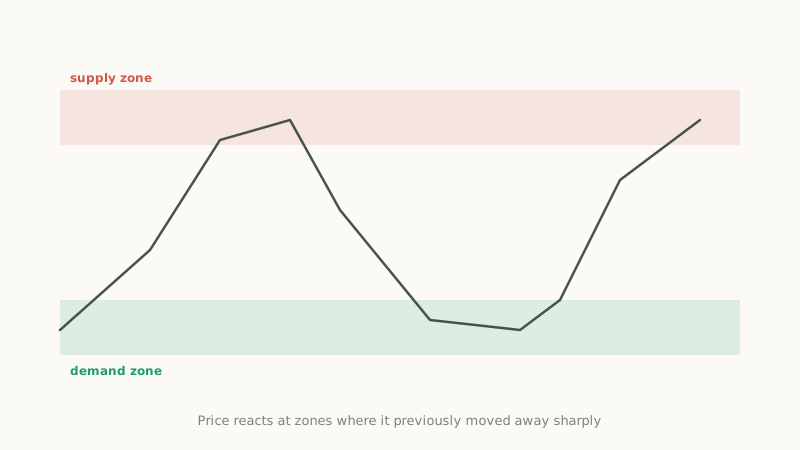
The core idea is that a sharp, impulsive move away from a level is evidence of a profound imbalance between buyers and sellers at that level. When price grinds sideways and then suddenly launches upward, it means buyers so overwhelmed the available sellers that the market had to reprice rapidly to find equilibrium. The area it launched from is a demand zone — a place where demand vastly exceeded supply. The reasoning is that not all the buying interest was satisfied before price ran away, so if price returns to that area, the unfilled demand is likely to reassert itself and push price up again.
A supply zone is the mirror image: an area from which price dropped sharply, indicating that sellers overwhelmed buyers. When price returns to a supply zone, the unfilled selling interest is expected to reappear and push price back down. In both cases, the zone is not a precise line but an area — the consolidation or base from which the impulsive move originated — and the strength of the signal comes from how violent and decisive the departure was.
The base patterns
Supply and demand zones form around a base — a short consolidation — sandwiched between two moves. The character of the moves into and out of the base classifies the zone and tells you whether it is a continuation or a reversal pattern. There are four canonical formations:
- Rally-Base-Rally (RBR) — price rallies, pauses in a base, then rallies again. The base is a demand zone, and this is a bullish continuation pattern.
- Drop-Base-Drop (DBD) — price drops, bases, then drops again. The base is a supply zone, a bearish continuation pattern.
- Drop-Base-Rally (DBR) — price drops, bases, then rallies. The base is a demand zone, and this is a bullish reversal pattern.
- Rally-Base-Drop (RBD) — price rallies, bases, then drops. The base is a supply zone, a bearish reversal pattern.
In every case, the zone you mark is the base — the tight consolidation — not the impulsive legs around it. The base represents the area where the orders that fuelled the explosive move were accumulated, which is why price is expected to react there again. Recognising these four patterns is the practical core of zone identification.
How to draw a zone
Drawing zones well is a skill worth developing, because a sloppily drawn zone is worse than none. The principle is to capture the base: the consolidation immediately preceding the impulsive move. A common method is to draw the zone from the open or close of the last candle before the explosive move to the extreme (the high or low) of the base. This gives an area rather than a line, with the understanding that price may react anywhere within it.
Two qualities separate strong zones from weak ones. The first is the strength of the departure: the more powerful, fast and one-directional the move away from the base, the stronger the imbalance and the more reliable the zone. A base followed by a slow, hesitant drift is a weak zone; one followed by a violent breakout is a strong one. The second is the tightness of the base: a narrow, brief consolidation produces a cleaner, more precise zone than a wide, drawn-out one. Zones built from a tight base and an explosive departure are the ones worth trading.
Why fresh zones are stronger
A crucial principle is that fresh, untested zones are stronger than ones price has already returned to. The first time price comes back to a demand zone, the maximum amount of unfilled buying interest is presumed to remain, so the reaction is likely to be strongest. Each subsequent return consumes more of that interest, so a zone that has been tested two or three times is progressively weaker and more likely to break. This is why experienced supply and demand traders prize the first retest of a fresh zone and become wary of zones that have already been revisited.
The practical implication is to identify zones before price returns to them and to favour the first touch. A zone that has held once or twice may still produce a reaction, but the odds degrade with each test, and a zone that price has already broken through is no longer valid — indeed, like an order block or fair value gap, a broken zone can flip and act in the opposite direction on a subsequent return. Tracking which of your marked zones are still fresh is a large part of trading the concept well.
A supply or demand zone is only as good as the move that left it. A tight base followed by an explosive, structure-changing departure makes a strong zone; a loose base and a sluggish move makes a weak one. And freshness matters — the first retest is the highest-probability one.
Zones versus support and resistance
Supply and demand is closely related to classical support and resistance, but with an important difference in emphasis. Support and resistance traditionally treats key levels as lines — a specific price that has held before. Supply and demand treats them as areas defined by the imbalance that created them, and it cares specifically about the explosive departure as evidence of that imbalance. In practice the two overlap heavily: a strong demand zone often sits at an obvious support level. The supply and demand framing simply adds a more precise, mechanism-based way of identifying which levels are likely to matter and where exactly the reaction should occur.
This relationship also clarifies how supply and demand connects to Smart Money Concepts. The SMC order block is, in essence, a supply or demand zone with an added requirement — that the move away broke market structure — and an institutional story layered on top. Recognising this lineage is useful: it means the decades of practical wisdom about drawing zones, favouring strong departures and prizing fresh zones applies directly to trading order blocks, and it explains why much of SMC feels familiar to anyone who learned supply and demand first.
Supply and demand on forex
On currency pairs, supply and demand zones are typically identified on the higher timeframes — daily and four-hour — where the imbalances are most significant, then used to frame intraday decisions. The workflow mirrors the rest of disciplined technical analysis: mark the significant fresh zones on the higher timeframe, wait for price to return to one in line with the larger trend, and refine the entry on a lower timeframe with a defined invalidation just beyond the zone. Combined with trend context and the location discipline of premium and discount, supply and demand gives traders a clear, mechanism-based map of where price is likely to react — the original version of an idea that SMC later refined and renamed.
Trading the zone: entries, stops and targets
Identifying a good zone is only half the job; the other half is executing the trade with defined risk. The basic approach is to wait for price to return to a fresh, well-drawn zone in line with the higher-timeframe trend, and to enter as price reaches it — either with a limit order placed at the zone's edge, or, more conservatively, after a confirming reaction such as a bullish candle signal or a lower-timeframe change of character within the zone. The conservative approach trades a little entry precision for confirmation that the zone is actually holding, which many traders find worth the trade-off.
The stop goes just beyond the far side of the zone — below a demand zone, above a supply zone — because if price trades cleanly through it, the imbalance has failed and the trade idea is invalidated. This gives the same clean, predefined invalidation that disciplined trading demands everywhere. The target is typically the next significant structural level or opposing zone: a long from a demand zone aims for the next supply zone or prior high, a short from a supply zone aims for the next demand zone or prior low. Because zones often sit at the origin of large moves, entries from them can offer favourable risk-to-reward — a tight stop just beyond the zone against a target many times larger. As always, the quality of the zone, the trend alignment and the freshness of the level matter more than the mechanics, but a clear entry-stop-target plan is what turns a marked zone into an actual, risk-defined trade.
Supply and demand zones mark areas where price moved away sharply, leaving an imbalance: demand zones (buyers overwhelmed sellers) and supply zones (sellers overwhelmed buyers), formed around a base in RBR, DBD, DBR or RBD patterns. Strong zones come from a tight base and an explosive departure, and fresh zones beat tested ones. Trade the first retest in the trend's direction, stop just beyond the zone, target the next structural level — it is the original order block.