
If Smart Money Concepts has a signature tool, it is the order block. It is the area most SMC traders use to actually enter a trade, and it is built on a simple, intuitive idea: the last move in one direction, just before price reverses sharply and breaks structure, marks the spot where large orders were placed. Find that spot, the reasoning goes, and you have located a level institutions care about — a level price is likely to respect again. This guide explains exactly what an order block is, how to identify the bullish and bearish versions, and how the concept of mitigation turns a zone on the chart into a trade.
It assumes the broader context set out in Smart Money Concepts explained, where the order block sits within the larger framework of structure and liquidity.
Key takeaways
Q: What is an order block?
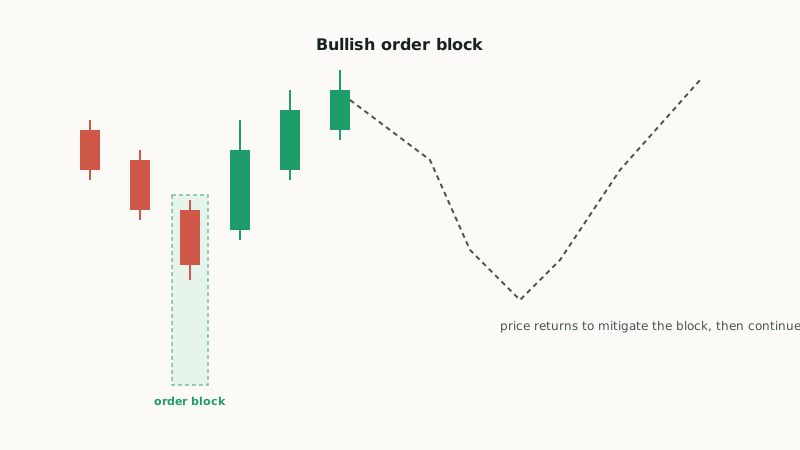
A: An order block is the last opposing candle (or cluster of candles) before a strong, structure-breaking move. A bullish order block is the final down candle before a sharp rally; a bearish order block is the final up candle before a sharp decline. SMC treats it as the area where institutional orders were placed.
Q: How do you identify a bullish order block?
A: Find a strong upward move that breaks market structure, then look back to the last down candle immediately before that move began. That candle's range is the bullish order block, and traders watch for price to return to it.
Q: What is order block mitigation?
A: Mitigation is when price returns to an order block after leaving it, allowing the orders presumed to rest there to be filled. SMC traders often look to enter as price mitigates the block, in the direction of the original move.
What an order block actually is
An order block is the last opposing candle before a strong, impulsive move that breaks market structure. The logic runs as follows: when an institution wants to drive price sharply higher, it must first accumulate a large buy position. It does so during the final phase of a decline — the last down candle or two — absorbing the selling around it. Once it has filled enough, the buying overwhelms the market and price rockets upward, breaking the prior structure. That final down candle, in this telling, is where the institutional buy orders live, and it becomes the bullish order block.
The bearish case is the mirror image: the last up candle before a sharp decline that breaks structure is the bearish order block, marking where institutional selling was placed. In both cases the defining features are the same — an opposing candle, immediately followed by a powerful move in the other direction, that breaks the existing structure. The break of structure is essential; a small move that fails to break anything does not qualify, because it shows no evidence that significant orders were involved.
How to identify one
Identifying an order block is a three-step process. First, find a strong, impulsive move — a sharp run that clearly breaks a prior swing high or low. Second, trace back to the last opposing candle immediately before that move began: the final down candle before a bullish break, or the final up candle before a bearish break. Third, mark that candle's range as the order block zone. Some traders use the candle body only; others include the wick; the practical choice depends on how conservative an entry you want.
Not every opposing candle is a valid order block, and this is where discipline matters. The quality of an order block depends on what followed it: the more impulsive the move away from it, and the cleaner the break of structure, the more significant the block. An order block that produced a powerful, one-directional rally breaking multiple levels is far more credible than one followed by a weak, choppy drift. SMC traders also prize order blocks that coincide with other signals — a fair value gap left by the impulsive move, or a liquidity sweep just before the block formed — because confluence strengthens the case.
Mitigation: turning a zone into a trade
An order block is only useful because of what tends to happen next: price often returns to it. This return is called mitigation, and it is the heart of how the concept is traded. The idea is that the institution that placed orders in the block did not fill its entire intended position there — some orders remain unfilled — so when price drifts back to the block, those remaining orders are executed ("mitigated"), and price resumes its original direction.
For the trader, this creates a plan: rather than chasing the impulsive move, wait for price to pull back into the order block, then look to enter in the direction of the original impulse, with a stop placed beyond the far side of the block. The appeal is a favourable risk-to-reward profile — entering at a level the move originated from, with a tightly defined invalidation just beyond it. If price trades decisively through the block instead of respecting it, the order block has failed and the trade idea is invalidated, cleanly and at a predefined price.
The break of structure is what validates an order block, and mitigation is what makes it tradeable. A candle only earns the label if a powerful, structure-breaking move followed it — and it only becomes an entry when price returns to it.
What separates a good order block from a bad one
Because almost any opposing candle can be labelled an order block in hindsight, the skill lies in filtering for quality. The strongest order blocks share several traits: they precede a genuinely impulsive move rather than a sluggish one; that move breaks structure decisively; the block sits in a sensible location relative to the larger trend (a bullish block in a discount zone of an uptrend, for instance); and it lines up with other SMC signals such as an unfilled fair value gap or a recent liquidity sweep. An order block that ticks several of these boxes is worth acting on; one that is simply "a down candle somewhere on the chart" is not.
This filtering discipline is also the honest answer to the criticism that order blocks are arbitrary. Used loosely — picking any candle that happens to work after the fact — the concept is indeed unfalsifiable. Used strictly, with a required impulsive break of structure and confluence, it becomes a reasonably objective way to define a high-quality entry zone. The difference is entirely in the discipline of the trader, which is the recurring theme across all of Smart Money Concepts.
Order blocks on forex
On currency pairs, order blocks are typically read on the higher timeframes first — the daily and four-hour — to identify significant blocks, then refined on lower timeframes for entry. A common workflow is to mark a higher-timeframe bullish order block in a discount zone, wait for price to return to it, and then drop to a lower timeframe to look for a change of character and a smaller order block within the zone as a precise entry trigger. This nesting of higher-timeframe context with lower-timeframe entries mirrors the multi-timeframe discipline that runs through all sound technical analysis. As always, the order block is held with a defined invalidation, and combined with the structure and liquidity concepts in the SMC overview rather than traded in isolation.
Breaker blocks and mitigation blocks
The order block has two close relatives that are worth knowing, because they describe what happens when an order block fails. A breaker block forms when an order block is violated — price trades decisively through it instead of respecting it — and then returns to it from the other side. The failed block "breaks" and flips its role: a bullish order block that gets blown through can become resistance on the way back up, acting as a bearish breaker. The logic is that the traders trapped by the failed level provide orders as price returns, much as broken support becomes resistance in classical analysis.
A mitigation block is a related idea describing a block that forms after a failed move, where price returns to allow trapped participants to exit (to "mitigate" their losing positions) before continuing. The distinctions between order blocks, breakers and mitigation blocks can get hair-splitting, and not every SMC trader uses all three terms consistently. The practical takeaway is simpler: an order block that fails is not just noise — the level where it failed can become significant in the opposite direction, so a violated block is worth keeping on the chart rather than erasing.
Refining the entry
One of the most useful practical skills with order blocks is refinement — narrowing a wide block down to a more precise entry zone so the stop can be tighter and the risk-to-reward better. A higher-timeframe order block can span a large price range, and entering across its whole width means a wide stop. The fix is to drop to a lower timeframe once price reaches the block and look for a more specific feature within it: a smaller order block, a fair value gap, or a change of character that pinpoints where the reaction is actually beginning.
This refinement is also where confluence is built. The ideal entry is not "somewhere in the order block" but the precise spot within it where several signals converge — the lower-timeframe order block that overlaps a fair value gap, sitting in the discount half of the range, right after a liquidity sweep. Refining in this way turns a broad zone into a sniper entry and is a large part of what separates traders who use order blocks profitably from those who simply draw boxes on every candle. As always, the refined entry carries a defined invalidation just beyond the block, keeping the risk explicit.
An order block is the last opposing candle before an impulsive, structure-breaking move; it becomes a trade when price returns to mitigate it. A violated block can flip into a breaker block in the opposite direction. Refine wide blocks on a lower timeframe to a precise, confluent entry — used strictly it is a defined zone, used loosely it is just hindsight.