
Every other tool in Smart Money Concepts — order blocks, fair value gaps, premium and discount — only makes sense in the context of a trend, and SMC reads the trend through market structure. The two terms that define it are break of structure (BOS) and change of character (CHoCH). Together they give an objective, price-based way to say whether a market is trending and continuing, or turning and reversing. Master these two and you have the backbone on which everything else hangs; misread them and even a perfect order block is pointing the wrong way.
This guide expands the structure section of Smart Money Concepts explained and underpins the entry tools covered in order blocks and fair value gaps.
Key takeaways
Q: What is a break of structure (BOS)?
A: A break of structure is when price breaks the most recent significant swing high (in an uptrend) or swing low (in a downtrend), confirming that the prevailing trend is continuing. It is the structural signal of trend continuation in Smart Money Concepts.
Q: What is a change of character (CHoCH)?
A: A change of character is the first break against the prevailing structure — for example, price breaking a recent higher low during an uptrend. It is the earliest structural warning that the trend may be reversing.
Q: What is the difference between BOS and CHoCH?
A: A BOS breaks structure in the direction of the trend and confirms continuation. A CHoCH breaks structure against the trend and signals a potential reversal. The same break is a BOS if it continues the trend and a CHoCH if it turns it.
Reading market structure
Market structure is simply the sequence of swing highs and swing lows that price traces out. An uptrend is defined by higher highs and higher lows: each rally exceeds the last, and each pullback bottoms above the previous one. A downtrend is the reverse: lower highs and lower lows. As long as that sequence holds, the trend is intact. The whole of BOS and CHoCH is about reading the moments when the sequence either confirms itself or breaks.
The crucial preliminary skill is identifying which swing points actually matter. Not every minor wiggle is a structural high or low; SMC traders focus on the significant swings — the ones that produced a meaningful move — and read structure from those, ignoring the noise in between. Getting this right is partly judgement, and it is where two analysts can begin to diverge, but anchoring to clearly significant swings on a higher timeframe keeps it disciplined.
Break of structure (BOS)
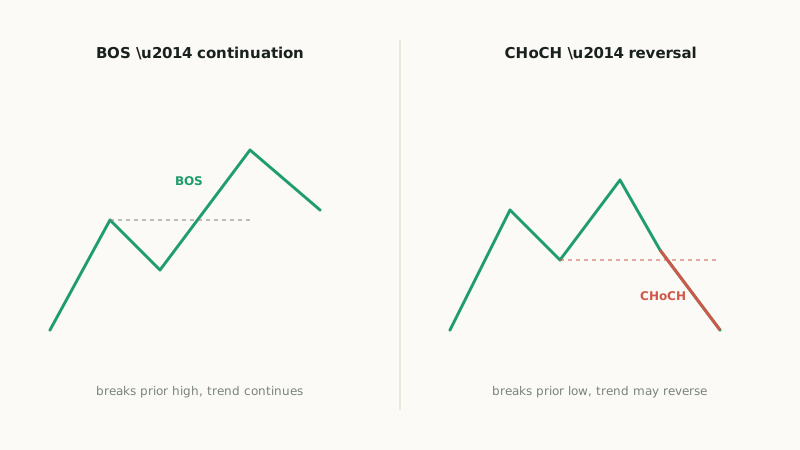
A break of structure occurs when price breaks the most recent significant swing point in the direction of the prevailing trend. In an uptrend, a BOS is price breaking above the most recent significant high — confirming that the higher-high, higher-low sequence is continuing and the uptrend is healthy. In a downtrend, a BOS is price breaking below the most recent significant low. The BOS is, in essence, the trend proving itself: each new break in the trend's direction is fresh evidence that the move has further to run.
For traders, a BOS is a continuation signal. It says the trend is intact and that pullbacks into order blocks or fair value gaps left by the move are candidates for entries in the trend's direction. A series of clean breaks of structure, each followed by a pullback and another break, is the structural picture of a strong, tradeable trend — and it is exactly the environment in which SMC's entry tools work best.
Change of character (CHoCH)
A change of character is the first break against the prevailing structure — the earliest structural sign that a trend may be ending. In an uptrend defined by higher highs and higher lows, the trend depends on those higher lows holding. The moment price breaks below the most recent higher low, the pattern has been violated for the first time: that break is the CHoCH. It does not guarantee a full reversal, but it is the first concrete, structural evidence that the buyers who had been defending each higher low have lost control.
The CHoCH is so valued in SMC because it is an early warning. Rather than waiting for an entire new downtrend to establish itself, the change of character flags the shift at its inception, often right after a liquidity sweep of the highs. A common SMC sequence is: price sweeps buy-side liquidity above the highs, then prints a CHoCH by breaking the most recent low, signalling that the move up was a liquidity grab and a reversal is underway. After the CHoCH, the trader reorients to the new potential direction and looks for order blocks and fair value gaps to trade it.
The same break can be a BOS or a CHoCH depending on context. A break in the trend's direction is a BOS (continuation); the first break against the trend is a CHoCH (potential reversal). The difference is not the break itself but which way it cuts relative to the established structure.
How BOS and CHoCH work together
In practice, BOS and CHoCH describe a complete cycle of a trend's life. A trend is born when a CHoCH breaks the old structure, confirmed as price begins making new highs and lows in the new direction. The trend then matures through a series of BOS events, each confirming continuation. Finally, the trend ages and dies when a fresh CHoCH breaks its structure in the opposite direction, beginning the cycle anew. Reading a chart through this lens turns the abstract idea of "trend" into a precise, event-driven sequence you can actually mark and act on.
This is also where multi-timeframe analysis becomes essential. A CHoCH on a low timeframe might be nothing more than a minor pullback within an intact higher-timeframe BOS sequence. SMC traders therefore read structure from the higher timeframe down — establishing the dominant trend through the higher-timeframe BOS pattern, then using lower-timeframe CHoCH signals to time entries within it. A lower-timeframe CHoCH that aligns with a higher-timeframe order block in a discount zone is the kind of nested, multi-layer setup the whole framework is built to produce.
Subjectivity and discipline
The honest caveat with structure reading is the same that runs through all of SMC: it depends on correctly identifying which swings are "significant," and that involves judgement. Two traders can mark structure slightly differently, and in choppy, rangebound conditions BOS and CHoCH signals can whipsaw and mislead. The defences are to anchor structure to clearly significant higher-timeframe swings, to require a decisive break (often a candle body close beyond the level, not just a wick), and to recognise that structure is cleanest in trending markets and least reliable in ranges.
Applied with that discipline, BOS and CHoCH are among the more objective and genuinely useful parts of Smart Money Concepts — a clear, repeatable language for trend and reversal that gives every other tool its context. Without them, an order block is just a candle and a fair value gap is just a space; with them, those tools finally point in a defined direction. As always, every read is held with a defined invalidation, within the broader framework set out in the SMC overview.
Internal structure versus swing structure
A refinement that resolves much of the confusion beginners have with BOS and CHoCH is the distinction between swing structure and internal structure. Swing structure is the major skeleton — the significant highs and lows that define the trend on the timeframe you are analysing. Internal structure is the smaller sequence of highs and lows that forms within a single swing leg. Both produce BOS and CHoCH signals, but at very different degrees of importance.
This matters because a CHoCH on the internal structure is often just a normal pullback within an intact swing trend, not a genuine reversal. A trader who treats every minor internal CHoCH as a trend change will be whipsawed constantly. The disciplined approach is to define the trend by swing structure, treat swing-level BOS and CHoCH as the meaningful trend signals, and use internal structure only for timing entries within the larger swing context. Distinguishing the two is, in effect, the same multi-timeframe discipline applied within a single chart — and it is what stops structure reading from dissolving into noise.
What counts as a valid break
Not every poke through a level is a real break, and defining "valid" in advance prevents a great deal of false signalling. Most disciplined SMC traders require a candle body close beyond the level rather than just a wick — a wick through a high that immediately rejects is far more likely to be a liquidity sweep than a genuine break of structure. Demanding a decisive close filters out exactly the spikes that liquidity grabs produce, which is useful because a wick-through-then-reject is often the prelude to a reversal rather than a continuation.
This creates a clean, practical decision tree at any significant level. If price closes decisively beyond it in the trend's direction, that is a BOS and the trend continues. If price merely wicks through and rejects, that is a likely liquidity sweep — watch for a change of character to confirm a reversal. If price closes decisively beyond a level against the trend, that is a CHoCH and a warning the trend may be turning. Holding to a consistent definition of a valid break, anchored to significant swing structure, is what makes BOS and CHoCH among the more objective tools in a framework that is otherwise often criticised for subjectivity.
A BOS breaks structure in the trend's direction (continuation); a CHoCH is the first break against it (potential reversal). Define the trend by major swing structure, not minor internal structure, and require a decisive body close — not just a wick — to count a break as valid. A wick-through-then-reject is usually a liquidity sweep, not a break.