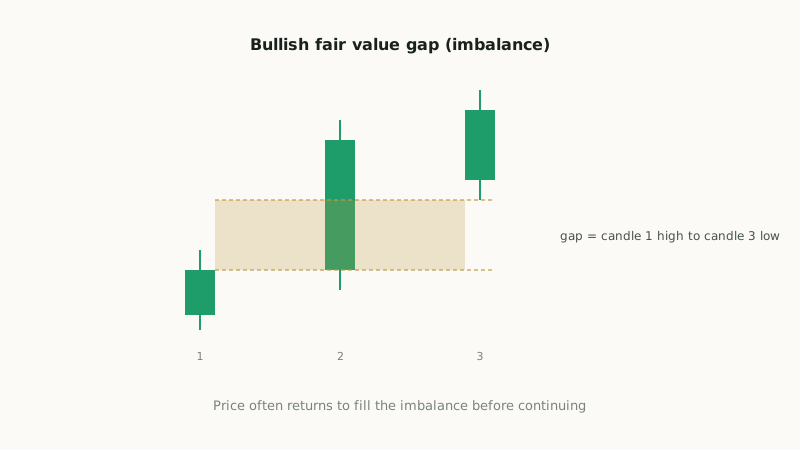
A fair value gap — FVG for short, also called an imbalance — is the footprint left behind when price moves too fast for the market to trade efficiently. When a sudden, powerful move tears through a level, it can leave a slice of price where almost no two-sided trading occurred: buyers were so aggressive (or sellers so absent) that price simply skipped through. Smart Money Concepts treats that slice as an inefficiency, and it holds that markets tend to return to rebalance such inefficiencies before continuing. That tendency makes the fair value gap one of SMC's most-used tools — simultaneously a magnet that price is drawn back to and a zone traders use for entries.
This guide sits within the broader Smart Money Concepts framework and pairs naturally with order blocks, the two often appearing together.
Key takeaways
Q: What is a fair value gap?
A: A fair value gap (FVG), or imbalance, is a three-candle pattern where price moves so quickly that the wick of the first candle and the wick of the third candle do not overlap, leaving an unfilled gap in the middle candle's range. SMC treats it as an inefficiency the market tends to return and rebalance.
Q: How do you identify a fair value gap?
A: Look at three consecutive candles during a strong move. If there is a gap between the high of the first candle and the low of the third (in a bullish move), that space is the fair value gap. The reverse defines a bearish FVG.
Q: Why does price return to fill a fair value gap?
A: SMC holds that a rapid move leaves unfilled orders behind, creating an inefficiency. Price tends to return to rebalance that inefficiency — filling the gap — before continuing, which is why FVGs act as both targets and potential entry zones.
The three-candle pattern
A fair value gap is defined across three consecutive candles. In a bullish FVG, you measure from the high of the first candle to the low of the third candle. If the third candle's low is above the first candle's high — meaning the two do not overlap — the space between them is the gap. It exists because the middle candle was so large and one-directional that price leapt past the level without trading back and forth through it. The bearish version is the mirror: a gap between the low of the first candle and the high of the third candle during a sharp decline.
The key word is imbalance. In normal, efficient trading, price moves through each level with buyers and sellers transacting on both sides. A fair value gap marks a level where that two-sided trading did not happen — one side overwhelmingly dominated. SMC interprets this as unfinished business: orders that would normally have been filled in that range were left behind, and the market is inclined to return and complete them.
Why price returns to fill it
The premise that price returns to "fill" or "rebalance" a fair value gap is central to how it is traded. The reasoning is that the rapid, one-sided move that created the gap left orders unfilled — buyers who wanted in at those prices but were skipped, or institutions whose orders were only partially executed. When price drifts back to the gap, that latent demand (in a bullish case) is met, the inefficiency is corrected, and price is then free to continue in its original direction.
In practice, fair value gaps are filled often enough that they function as reliable reference points, though not every gap fills and not always completely. Some are filled immediately on the next pullback; others linger for a long time before price returns; a few are never filled at all if the move was the start of a powerful, sustained trend. This is why an FVG is best treated as a tendency and a zone of interest rather than a certainty — a place to watch for a reaction, not a guarantee that price must return.
Trading the fair value gap
There are two main ways SMC traders use fair value gaps. The first is as a target: an unfilled FVG below current price (bullish) or above it (bearish) marks a level the market may be drawn back toward, which helps in setting profit objectives or anticipating pullbacks. The second is as an entry zone: when price returns into a fair value gap that aligns with the larger trend, traders look to enter in the trend's direction as the gap is filled, placing a stop beyond the far edge of the gap.
As with order blocks, the strongest setups come from confluence. A fair value gap that sits inside an order block, or that lines up with a Fibonacci retracement, or that forms right after a liquidity sweep, is far more compelling than a gap floating in isolation. Many SMC traders specifically look for an order block and the fair value gap created by the move away from it to overlap, treating the combined zone as a high-quality entry area. The gap also helps refine entries: rather than entering across a wide order block, a trader can wait for price to reach the more precise fair value gap within it.
A fair value gap is the chart's record of inefficiency — a level price skipped. Its power is that it works as both a magnet for targets and a zone for entries, and it is strongest when it overlaps an order block or a Fibonacci level rather than standing alone.
A note of realism
Fair value gaps invite the same honest caveats as the rest of Smart Money Concepts. On any active chart there are many small imbalances, and cherry-picking the one that happened to be filled is easy in hindsight. The concept becomes meaningful only when applied with filters: focusing on gaps left by genuinely significant, structure-breaking moves; favouring higher-timeframe gaps over the noise of low timeframes; and requiring confluence with other signals. A gap left by a major daily move carries far more weight than a tiny imbalance on a one-minute chart.
It is also worth recognising that the "unfilled orders" explanation is a narrative, not a measured fact — on decentralised spot forex there is no way to verify what orders rest where. What can be observed is the empirical tendency of price to revisit these levels often enough to be useful. Treating the fair value gap as a practical, observable pattern — rather than as literal proof of institutional behaviour — keeps its use grounded and avoids the overconfidence that trips up traders who take the SMC narrative too literally.
Fair value gaps on forex
Currency pairs, with their around-the-clock trading and frequent news-driven spikes, produce fair value gaps regularly — especially around session opens and economic releases, when price can move sharply in moments. The practical approach is to identify significant gaps on the higher timeframes, mark them as zones of interest, and use the lower timeframes to refine entries when price returns to them in line with the larger trend. Combined with order blocks, liquidity and structure from the wider SMC framework, and always held with a defined invalidation, the fair value gap gives traders a precise, repeatable way to locate where price is likely to react.
Inversion fair value gaps
Like order blocks, fair value gaps have a "failure" variant that flips their role, known as an inversion fair value gap (IFVG). It works like this: a bullish fair value gap is expected to act as support when price returns to it. But if price trades decisively through the gap instead of respecting it, the gap is considered violated — and it then inverts, becoming resistance on any subsequent return. The same logic applies in reverse for a bearish gap that gets broken and flips to support.
The inversion concept mirrors the classic principle that broken support becomes resistance, dressed in SMC vocabulary, and it has a practical use: a gap that fails is not simply discarded but watched for its inverted role. This also serves as a built-in confirmation tool — if price respects a fair value gap, the original read was right; if it inverts the gap, that failure is itself information, signalling that the expected continuation has not materialised and the structure may be shifting.
Which gaps to trust
The biggest practical challenge with fair value gaps is that there are simply too many of them. Every sharp candle on every timeframe leaves small imbalances, and treating them all as significant is a recipe for noise. A few filters separate the gaps worth watching from the rest. Timeframe matters most: a fair value gap on the daily or four-hour chart carries far more weight than one on the one-minute, because it was created by a more significant move. Size and context matter too: a gap left by a powerful, structure-breaking move is more meaningful than one inside choppy, rangebound price.
The strongest filter, as everywhere in SMC, is confluence. A fair value gap that overlaps an order block, sits within the discount or premium zone you would expect, and formed in the direction of the higher-timeframe trend is worth acting on. One that meets none of those conditions is best ignored. Applying these filters is what turns the fair value gap from an over-abundant curiosity into a precise, usable tool — and it is the discipline that distinguishes traders who use gaps well from those who drown in them.
A fair value gap is a three-candle imbalance price tends to return and fill, useful as both a target and an entry zone. A gap that gets violated inverts — flipping from support to resistance or vice versa. Filter ruthlessly: favour significant, higher-timeframe gaps with confluence, and treat the institutional explanation as narrative, not fact.