Of all the ideas in Smart Money Concepts, liquidity is the one that does the most to explain the market's most maddening habit: the way price so often spikes to the exact level where your stop sits, triggers it, and then immediately reverses in the direction you originally expected. SMC's answer is that those stops are the point — that price is drawn toward pools of resting orders because large players need them to fill their positions. Grasp where liquidity pools and how it gets swept, and a great deal of otherwise inexplicable price behaviour falls into a coherent pattern. This guide explains the concept and how to read it.
Liquidity is the engine that drives the structure-and-zones machinery described in Smart Money Concepts explained; this is the deeper look at how it works.
Key takeaways
Q: What is liquidity in trading?
A: In Smart Money Concepts, liquidity refers to the resting orders — mostly stop losses and pending orders — that pool at predictable price levels such as above highs and below lows. Large players are assumed to drive price toward this liquidity to fill their positions.
Q: What is a liquidity sweep?
A: A liquidity sweep, or grab, is a sharp move that pushes price through a level where stops rest — triggering them — and then quickly reverses. It is read as price collecting orders rather than making a genuine directional break.
Q: What is the difference between buy-side and sell-side liquidity?
A: Buy-side liquidity sits above highs, where short-sellers' stop losses (buy orders) rest. Sell-side liquidity sits below lows, where long traders' stop losses (sell orders) rest. Price is drawn toward both.
What liquidity means here
In everyday market terms, "liquidity" describes how easily an asset can be bought or sold without moving its price. Smart Money Concepts uses the word more specifically: liquidity is the resting orders sitting in the market waiting to be triggered — overwhelmingly stop-loss orders, along with pending orders and the like. These orders matter because they represent guaranteed transactions at known prices. When price reaches a cluster of stops, those orders fire automatically, providing a burst of buying or selling that a large player can trade against to fill a sizeable position without having to chase price.
This reframes the chart entirely. Instead of asking where price "wants" to go, SMC asks where the orders are — because that, in its view, is where price is incentivised to travel. The obvious highs and lows that retail traders watch and place stops around become not support and resistance to be defended, but targets to be hunted. It is a cynical lens, but a usefully clarifying one.
Where liquidity pools
Liquidity gathers in predictable places, because traders cluster their stops in predictable places. The two primary categories are:
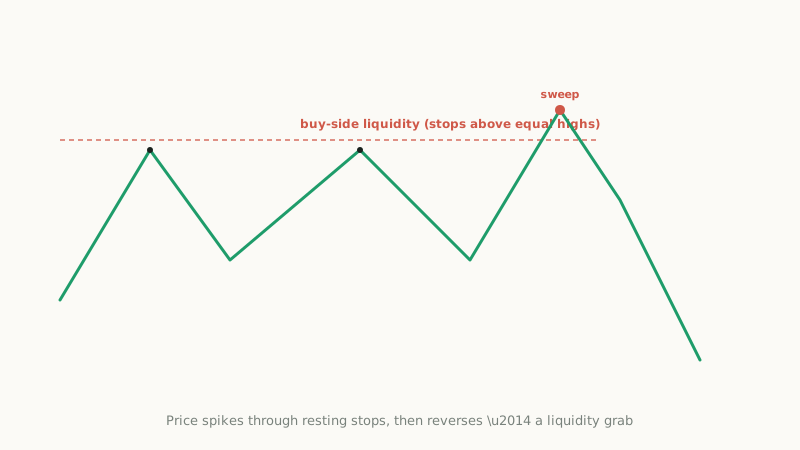
- Buy-side liquidity — rests above highs. Traders who are short place their stop losses above recent highs, and those stops are buy orders. A pool of buy-side liquidity therefore sits above obvious resistance, swing highs and equal highs.
- Sell-side liquidity — rests below lows. Traders who are long place their stops below recent lows, and those stops are sell orders. A pool of sell-side liquidity sits below obvious support, swing lows and equal lows.
Certain formations concentrate liquidity especially densely. Equal highs and equal lows — two or more highs or lows at almost the same price — are prime examples, because they look like obvious double tops or bottoms and attract a heavy cluster of stops just beyond them. Obvious trendlines do the same, as traders place stops on the far side of a line everyone is watching. SMC reads these tidy, obvious-looking levels not as strong barriers but as the most attractive liquidity targets precisely because they are so obvious.
The liquidity sweep
The moment liquidity is collected is called a liquidity sweep — also known as a liquidity grab, a stop hunt, or a stop raid. It is a sharp move that pushes price just far enough through a level to trigger the resting stops, followed by a swift reversal. The tell is the speed and the failure to follow through: price spikes beyond an obvious high or low, the stops fire, and then — rather than continuing — price snaps back the other way, as if the only purpose of the move was to collect the orders.
For an SMC trader, a liquidity sweep is one of the highest-value signals available, because it often marks a genuine turning point. A sweep of sell-side liquidity below an obvious low, immediately followed by a sharp recovery, suggests that the move down was about collecting sell orders before a reversal higher. The practical application is to wait for the sweep rather than to anticipate the break: instead of buying a breakout above equal highs (and being the liquidity that gets collected), the SMC trader watches for that breakout to fail as a sweep, and looks to trade the reversal that follows.
The obvious level is the trap. Equal highs, equal lows and clean trendlines are not strong barriers in SMC — they are liquidity targets, attractive precisely because so many traders have placed orders around them. Watch for the sweep, don't be the liquidity.
Internal and external liquidity
SMC further distinguishes between external and internal liquidity, which helps organise where price is likely to head next. External liquidity rests beyond the major swing points that define the larger range — above the range high and below the range low. Internal liquidity rests within the range, at the minor highs and lows and the fair value gaps and order blocks inside it. A common reading is that price oscillates between collecting internal liquidity and then reaching for external liquidity, alternating between the inefficiencies inside a range and the stops resting beyond its boundaries. Tracking which type of liquidity is the likely next target helps frame whether to expect price to stay within a range or break out of it.
Keeping it realistic
The liquidity concept is genuinely useful, but it benefits from the same honesty as the rest of SMC. The narrative that a specific institution is deliberately hunting your stop is unverifiable, and on decentralised spot forex there is no central record of where orders actually rest. What can be observed is that price frequently spikes through obvious levels and reverses — a real, repeatable pattern regardless of the precise mechanism behind it. Whether it is deliberate manipulation, the natural consequence of stops clustering at obvious points, or a mix of both, the practical lesson is the same: obvious levels are dangerous places to chase breakouts and useful places to watch for reversals.
Used with that grounding, liquidity reading improves trade location and timing without requiring belief in any particular conspiracy. It pairs especially well with the entry tools — a liquidity sweep that runs into an order block or fills a fair value gap is a far stronger signal than any of those elements alone, which is the confluence-first mindset that makes the whole framework work.
The types of liquidity to mark
Beyond the basic buy-side and sell-side distinction, it helps to know the specific formations that traders watch, because these are where liquidity concentrates most reliably:
- Equal highs and equal lows — two or more highs or lows at nearly the same price. They look like obvious double tops or bottoms, so stops pile up just beyond them, making them prime liquidity targets.
- Previous day, week and month highs and lows — widely-watched reference levels (often abbreviated PDH/PDL, PWH/PWL) that attract orders and frequently act as liquidity targets, especially around session opens.
- Session highs and lows — the extremes of the Asian, London and New York sessions. The Asian range in particular is often swept early in the London session as price reaches for the orders resting beyond it.
- Trendline liquidity — stops placed on the far side of an obvious trendline. Because so many traders draw and trade the same lines, the orders beyond them form a predictable pool.
Recognising which of these is the likely next target is a large part of reading where price is headed. A market grinding sideways beneath obvious equal highs, for instance, is often building toward a sweep of the buy-side liquidity resting above them.
How to mark liquidity on a chart
Marking liquidity is straightforward once you know what to look for. Start on a higher timeframe and draw horizontal lines at the obvious swing highs and lows, paying special attention to equal highs and lows and to the previous day's and week's extremes. These lines represent the pools price is most likely to reach for. Then watch how price interacts with them: does it sweep through and reverse (a liquidity grab, often a turning point), or does it break and hold beyond the level (a genuine continuation, frequently confirmed by a break of structure)?
The distinction between a sweep and a genuine break is the practical heart of liquidity reading, and it usually comes down to what happens immediately after price crosses the level. A fast spike through followed by an equally fast rejection is a sweep; a decisive break with a candle body closing beyond the level and follow-through is a real move. Pairing this read with the structure tools — a sweep followed by a change of character is a classic reversal signal — turns liquidity from an interesting idea into an actionable part of a trading plan.
Liquidity is the resting orders that pool above highs (buy-side) and below lows (sell-side), concentrated at equal highs/lows, previous day/week extremes, session ranges and obvious trendlines. Mark these levels, then read whether price sweeps and reverses or genuinely breaks and holds. Wait for the sweep instead of chasing the obvious breakout, and confirm with structure.