
Almost everything in technical analysis — trends, phases, confirmation, the very idea that price charts contain readable information — traces back to the newspaper editorials of one man. Charles Dow, co-founder of Dow Jones and The Wall Street Journal, never set out to create a trading system; he simply wrote, in the late 1800s, about what he observed in the market averages he had helped invent. After his death, followers gathered those observations into what we now call Dow Theory — the bedrock on which Elliott Wave, Wyckoff and modern charting were all subsequently built. This guide explains its principles and how they apply to the forex trader today.
Dow Theory is the eldest of the classical frameworks, and its descendants — Elliott Wave and the Wyckoff Method — each built directly on what Dow established.
Key takeaways
Q: What is Dow Theory?
A: Dow Theory is the foundational framework of technical analysis, drawn from the writings of Charles Dow. It holds that market averages discount all information, move in three kinds of trend through three phases, must confirm each other, are confirmed by volume, and that a trend persists until a clear reversal.
Q: Who created Dow Theory?
A: It is based on the editorials of Charles Dow, co-founder of Dow Jones and The Wall Street Journal, written in the late 1800s. Dow never formalised it himself; followers including William Hamilton and Robert Rhea assembled his ideas into the six tenets after his death.
Q: Is Dow Theory still useful today?
A: Its core principles — trends, phases, confirmation and the discounting of information — remain foundational and underpin Elliott Wave, Wyckoff and modern charting. Some specifics, like the two-average confirmation, are dated, but the framework's logic still informs how traders read markets.
Origins and influence
Charles Dow wrote his market observations as editorials, not as a unified theory, and he died in 1902 without ever formalising them. It fell to his successors — most notably William Peter Hamilton and later Robert Rhea — to assemble his scattered insights into the coherent set of principles known today. Rhea's formulation into six tenets is the version most commonly taught, and it is the structure this site follows.
The influence of these ideas is difficult to overstate. The notion that markets move in identifiable trends, that those trends have phases driven by different participants, that volume confirms price, and that one part of the market should confirm another — all of these originated with Dow and were inherited, refined and renamed by everyone who followed. When Ralph Nelson Elliott developed his wave principle, he was building on Dow's trend concept; when Richard Wyckoff described accumulation and distribution, he was elaborating Dow's phases. Understanding Dow Theory is therefore understanding the common root of the entire technical tradition.
The six tenets in brief
Dow Theory is usually expressed as six tenets, each examined in full in the six tenets of Dow Theory. In summary:
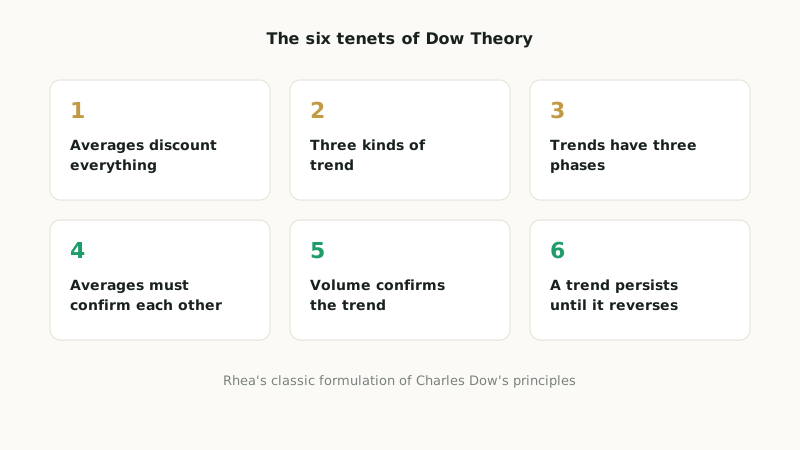
- The averages discount everything. All known information — every hope, fear and fact — is already reflected in market prices, so the price itself is the primary object of study.
- The market has three trends. A primary trend (the major tide), secondary reactions (waves against it), and minor fluctuations (ripples of daily noise).
- Primary trends have three phases. Accumulation, public participation, and distribution — each dominated by a different kind of participant.
- The averages must confirm each other. Dow held that a trend was only valid if more than one average confirmed it — originally the Industrials and the Rails.
- Volume confirms the trend. Volume should expand in the direction of the primary trend, validating the price move.
- A trend persists until a definitive reversal. Assume the existing trend continues until clear evidence proves it has turned.
The three trends
The second tenet — the classification of trends by scale — is in many ways the conceptual heart of the theory, and it directly anticipates the fractal thinking of later frameworks. Dow described the primary trend as the major direction of the market, lasting a year or more, which he likened to the tide. The secondary trend is an intermediate reaction against the primary, lasting weeks to months — the waves moving against the tide. The minor trend is short-term fluctuation lasting days, the ripples on the waves, which Dow regarded as largely noise.
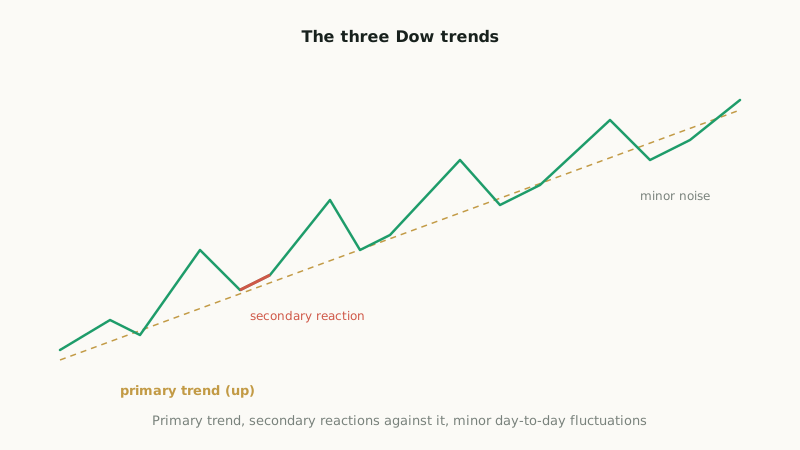
This tide-wave-ripple metaphor remains one of the clearest ways to think about market structure across timeframes, and it maps neatly onto the multi-timeframe analysis every modern trader uses. It is explored in detail in primary, secondary and minor trends.
The three phases
The third tenet describes how a primary trend unfolds through three phases, each driven by a different group of participants. In a bull market, the accumulation phase comes first, as informed money quietly buys from a pessimistic public near the lows. The public participation phase follows, the longest and steepest, as trend-followers recognise the rising market and pile in. Finally the distribution phase, as the informed money sells its holdings to an now-euphoric public near the top. A bear market mirrors this with distribution, public participation (panic), and despair.
Anyone who has read the Wyckoff cluster will recognise these phases immediately — Dow's accumulation and distribution are precisely what Wyckoff later elaborated into his detailed schematics, and the "informed money" of Dow's phases is the ancestor of Wyckoff's Composite Man and SMC's institutions. The phases are covered in Dow Theory market phases.
Dow Theory is less a trading system than the source code of technical analysis. Its trends became Elliott's waves; its phases became Wyckoff's schematics and SMC's institutional narrative. Learn Dow and you see the common ancestor beneath every modern framework.
The confirmation principle
One of Dow's most distinctive ideas is the fourth tenet: the requirement that the averages confirm each other. Dow watched two of his averages — the Industrials, representing companies that made goods, and the Rails (now Transportation), representing the companies that shipped them — and argued that a genuine trend should be visible in both. If industrials were rising but the railroads carrying their products were not, the rally was suspect; a healthy economy should see both advancing together. A new high in one average unconfirmed by the other was a warning of a possible turn.
This confirmation logic is elegant and was genuinely useful in Dow's industrial-era market, though its specific application is dated today. The principle survives in modern form whenever traders look for one instrument to confirm another — a stock index confirmed by its sector breadth, or a currency move confirmed by a related pair or by the dollar index. The deeper idea, that a trend is more trustworthy when corroborated by a related market, remains sound, as discussed in Dow Theory vs Elliott Wave and beyond.
Dow Theory on forex
Applying Dow Theory to currencies requires some adaptation, because forex has no direct equivalent of Dow's two stock averages. The trend, phase and persistence principles translate cleanly — currencies trend, those trends have phases, and the assumption that a trend continues until reversed is the basis of all trend-following. The confirmation tenet adapts through correlated instruments: a move in a currency pair can be checked against related pairs, the dollar index, or risk-sensitive markets, looking for corroboration rather than divergence.
The volume tenet runs into the familiar forex limitation — spot currencies have no true volume, only tick volume as an imperfect proxy — so volume confirmation is weaker on forex than on the centralised markets Dow studied. The sensible approach is to lean on the robust, price-based principles (trends, phases, persistence, cross-market confirmation) and treat volume as supporting evidence. Read that way, Dow Theory gives the forex trader the foundational framework from which all the others descend, and a clear-eyed understanding of where the modern methods came from.
Criticisms and limitations
An honest account of Dow Theory has to acknowledge its limitations, several of which its own followers concede. The most frequently cited is the lateness of its signals. Because the theory demands confirmation — a definitive reversal, agreement between averages — before declaring a change of trend, it inevitably identifies trends and reversals well after they have begun. A Dow follower will rarely catch a top or bottom; by the time the framework confirms a new primary trend, a meaningful portion of the move has already passed. Dow practitioners accept this as the price of reliability, but it is a genuine drawback for traders seeking early entries.
A second limitation is the subjectivity in distinguishing a secondary reaction from a primary reversal. The theory offers principles but no precise rule for telling, in real time, whether a sharp move against the trend is a temporary pullback or the start of a new primary trend — and this is precisely the judgement on which success or failure turns. Different analysts can read the same correction differently, which undercuts the theory's apparent objectivity.
Third, the specific two-average confirmation is widely regarded as dated, designed for an industrial economy in which production and rail transport were tightly coupled. Today's economy is not well represented by two such averages, and the precise Industrials-versus-Transports signal is less meaningful than it once was. Finally, like most classical frameworks, Dow Theory says little about risk management or position sizing — it describes how to read the market, not how to manage a portfolio or survive being wrong. These limitations do not invalidate the theory's foundational insights, but they explain why it functions today more as a conceptual bedrock than as a complete, standalone trading system.
Dow Theory is the foundation of technical analysis: six tenets covering the discounting of information, three trends (primary/secondary/minor), three phases (accumulation/participation/distribution), inter-average confirmation, volume, and trend persistence. Its trends became Elliott's waves and its phases became Wyckoff's schematics. It is robust but its signals are late, its two-average confirmation is dated, and it says little about risk — a bedrock to build on rather than a complete system. On forex, lean on the price-based principles and adapt confirmation through correlated markets.