A full century before anyone coined the phrase "smart money," Richard Wyckoff was teaching traders to do exactly what Smart Money Concepts now promises: read the market from the perspective of the large operators who move it. Working in the early 1900s, when the great stock operators of his era openly manipulated markets, Wyckoff studied their methods and distilled them into a coherent framework that remains, a century later, one of the most respected and influential approaches in all of technical analysis. This guide explains the Wyckoff Method — the Composite Man, the three laws, and the market cycle — and how it applies to the modern forex trader.
Wyckoff is a cornerstone of forex theory and a direct ancestor of much that came later, including Smart Money Concepts; it also makes an instructive contrast with Elliott Wave.
Key takeaways
Q: What is the Wyckoff Method?
A: The Wyckoff Method is a technical analysis framework developed by Richard Wyckoff in the early 20th century. It reads the market through the lens of a 'Composite Man' representing large operators, governed by three laws, moving through a repeating cycle of accumulation, markup, distribution and markdown.
Q: Is the Wyckoff Method still relevant?
A: Yes. Wyckoff's principles about supply and demand, accumulation and distribution, and the relationship between price and volume remain widely used, and much of modern Smart Money Concepts is built on the same foundations he laid a century ago.
Q: Does the Wyckoff Method work on forex?
A: Its price-structure principles apply well to forex, but Wyckoff relies heavily on volume, and spot forex has no centralised volume data. Traders use tick volume as an imperfect proxy, which is an important limitation to keep in mind.
The Composite Man
The conceptual heart of Wyckoff's method is a thought experiment he called the Composite Man. Wyckoff urged traders to imagine that all market activity — every tick, every range, every trend — was the deliberate work of a single, immensely wealthy operator. This Composite Man accumulates positions quietly when prices are low and pessimism is high, marks prices up, distributes his holdings to an eager public when prices are high and optimism abounds, and then steps aside as prices fall. By imagining the market this way, Wyckoff argued, a trader could anticipate its moves rather than merely react to them.
The Composite Man is not a literal claim that one person controls the market; it is a powerful interpretive device. It reframes confusing price action as the intentional campaign of a sophisticated operator, prompting the trader to ask at every turn: "If I were the Composite Man, what would I be doing here — accumulating, marking up, distributing, or marking down?" This is precisely the same mental move that Smart Money Concepts makes with its talk of institutions hunting liquidity. Wyckoff simply got there first, and arguably expressed it more elegantly.
The three laws
Wyckoff's method rests on three fundamental laws that govern how he believed markets behave. They are covered in depth in the Wyckoff laws explained, but in brief:
- The Law of Supply and Demand — the foundation of everything. When demand exceeds supply, price rises; when supply exceeds demand, price falls. All of Wyckoff's analysis is ultimately an attempt to read the shifting balance between the two.
- The Law of Cause and Effect — a period of accumulation or distribution (the cause) produces a proportional trend (the effect). The longer and broader the cause, the larger the resulting move, which lets Wyckoff traders estimate targets.
- The Law of Effort versus Result — the relationship between volume (effort) and price movement (result). When the two are in harmony, the trend is healthy; when they diverge, a change may be coming.
These three laws give the method its analytical engine. They are the lens through which every range, breakout and trend is interpreted, and they are remarkably durable — the law of effort versus result, in particular, anticipates the entire field of volume analysis that followed.
The market cycle
Wyckoff saw markets as moving through a repeating four-phase cycle, driven by the campaigns of the Composite Man. Understanding this cycle is the key to locating where you are at any given moment:
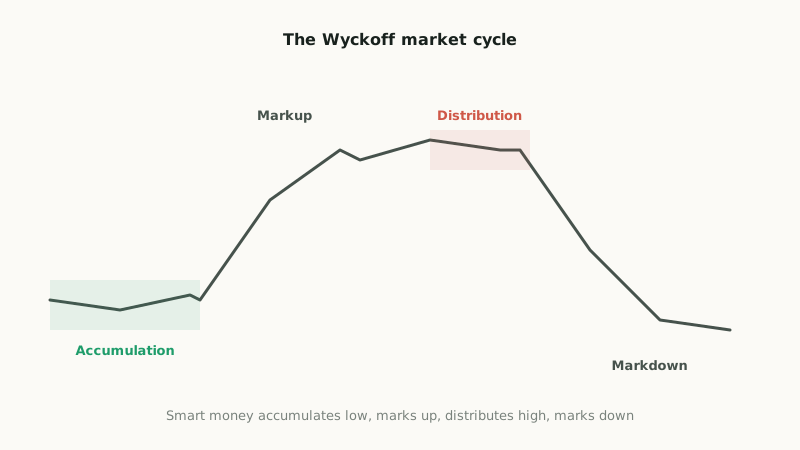
Accumulation comes first: a period of sideways range-bound trading at low prices, during which the Composite Man quietly buys from a discouraged public without driving the price up. Then comes markup, the uptrend, as accumulated demand overwhelms supply and price rises. At high prices, distribution follows: another sideways range, this time as the Composite Man sells his holdings to an enthusiastic public without crashing the price. Finally, markdown — the downtrend — as the selling overwhelms demand and price falls, returning eventually to levels where accumulation can begin anew.
This cycle is the master template of the entire method. The two ranges — accumulation and distribution — are where the important, hidden work happens, and reading them correctly is the core skill. The detailed structure of each is covered in accumulation and distribution.
The trends are the obvious part; the ranges are where the money is made. Accumulation and distribution — the sideways periods most traders find boring — are where the Composite Man builds and unloads positions. Learn to read those ranges and you anticipate the trends that follow.
The role of volume
What truly distinguishes the Wyckoff Method from purely price-based approaches is its central reliance on volume. Wyckoff read volume alongside price at every turn, using the law of effort versus result to judge whether a move was backed by genuine commitment or was hollow and likely to fail. A breakout on high volume signals real intent; the same breakout on low volume is suspect. A selling climax on enormous volume marks panic and potential exhaustion. Volume, for Wyckoff, was the footprint of the Composite Man, revealing his hidden activity beneath the surface of price.
This reliance on volume is also where forex traders must be careful. Spot forex is a decentralised market with no central exchange and therefore no true volume data. Traders substitute tick volume — the number of price changes in a period — as a proxy, and while it correlates reasonably with actual activity, it is an imperfect stand-in. This is a genuine limitation of applying Wyckoff to currencies, and an honest one to acknowledge: the method's volume-based confirmations are less reliable on forex than on centralised markets like stocks or futures, where real volume is available.
Wyckoff and modern trading
The most striking thing about studying Wyckoff today is how much of "modern" trading it anticipated. The institutional-perspective framing of Smart Money Concepts is the Composite Man in new clothes. The SMC spring — a dip below support that reverses — is functionally identical to the liquidity sweep that SMC describes, and Wyckoff named and explained it decades earlier. Accumulation and distribution ranges are where SMC says institutions build positions and hunt liquidity. Even the emphasis on supply and demand zones traces back to Wyckoff's foundational law.
This lineage is worth appreciating, because it puts the modern frameworks in perspective. Many of today's most-hyped concepts are refinements or rebrandings of ideas Wyckoff articulated a century ago, often with more rigour and intellectual honesty than their modern descendants. For the forex trader, learning Wyckoff is therefore not a detour into history but a way to understand the foundations on which the current crop of methods is built — and to read price with a framework that has endured precisely because it captures something real about how markets move.
A practical Wyckoff workflow
Pulling the pieces together, a working Wyckoff analysis proceeds top-down in a consistent sequence. First, locate the cycle phase: is the market trending (markup or markdown) or ranging (potential accumulation or distribution)? This single question orients everything that follows, because the ranges are where opportunity is built and the trends are where it pays out. A market in an extended range after a long decline is a candidate for accumulation; one ranging after a long advance is a candidate for distribution.
Second, once a range is identified, map the events onto it. Look for the climactic action that stops the prior trend (a selling or buying climax and the automatic reaction that follows), which establishes the range boundaries. Then watch the long middle phase as the cause is built, reading each test of support and resistance through the three laws — who is in control, and is the volume confirming or diverging? Third, wait for the decisive test: a spring in accumulation or an upthrust in distribution, the shakeout that precedes the real move.
Fourth, act on confirmation. In accumulation, a successful spring followed by a sign of strength and a last point of support gives a low-risk long entry, with a stop below the spring low and a target projected from the size of the range. In distribution, an upthrust followed by a sign of weakness gives the mirror-image short. The discipline is to wait for the structure to confirm rather than anticipating it — entering on the last point of support or supply, not guessing at the climax. Held with a defined invalidation and a range-proportional target, this workflow turns Wyckoff's concepts into a repeatable process for positioning ahead of trends rather than chasing them.
The Wyckoff Method reads the market as the campaign of a Composite Man, governed by three laws (supply/demand, cause/effect, effort/result) and moving through a cycle of accumulation, markup, distribution and markdown. Work top-down: locate the phase, map the events, wait for the spring or upthrust, act on confirmation with a defined invalidation. Volume is central — a genuine limitation on forex — and much of modern Smart Money Concepts is Wyckoff rediscovered.