Beneath the schematics, the springs and the Composite Man sits the analytical bedrock of the entire Wyckoff Method: three laws. Everything else in Wyckoff's framework — every event, every phase, every read of a range — is ultimately an application of these three principles. Learn the schematics without the laws and you are memorising shapes; learn the laws and the schematics become obvious, because you understand why each event means what it means. This guide explains the three Wyckoff laws — supply and demand, cause and effect, and effort versus result — which together form the reasoning engine of the method.
These laws underpin the cycle and schematics covered in the Wyckoff Method explained, accumulation and distribution.
Key takeaways
Q: What are the three Wyckoff laws?
A: The three Wyckoff laws are the Law of Supply and Demand (the balance between buyers and sellers drives price), the Law of Cause and Effect (a period of accumulation or distribution produces a proportional trend), and the Law of Effort versus Result (the relationship between volume and price reveals the health of a move).
Q: What is the law of effort versus result?
A: It examines the relationship between volume (effort) and price movement (result). When effort and result are in harmony, a trend is healthy. When they diverge — for example, high volume producing little price progress — it warns that a change may be coming.
Q: How is the law of cause and effect used?
A: It holds that the size of a trading range (the cause) determines the extent of the subsequent trend (the effect). Wyckoff traders historically used point-and-figure counts across the range to estimate proportional price targets for the move that follows.
The Law of Supply and Demand
The first and most fundamental law is deceptively simple: when demand exceeds supply, price rises; when supply exceeds demand, price falls; and when the two are in balance, price moves sideways. This is the foundation not just of Wyckoff but of all markets, and it sounds almost too obvious to state. Its power, however, lies in how Wyckoff applied it — not as an abstraction but as something to be read directly from the chart through the interaction of price and volume.
Every Wyckoff event is, at heart, a reading of supply and demand. A selling climax on huge volume is supply reaching exhaustion as the last panicked sellers are absorbed. A sign of strength is demand decisively overwhelming supply. The entire accumulation range is the process of supply being quietly absorbed until demand can take control. By framing analysis as a continuous question — "who is in control here, buyers or sellers, and is that balance shifting?" — the law of supply and demand turns the chart into a readable record of the ongoing struggle between the two forces. This is the same principle that underlies supply and demand trading, which descends directly from Wyckoff's thinking.
The Law of Cause and Effect
The second law introduces a predictive dimension: a period of accumulation or distribution (the cause) produces a proportional trend (the effect). The longer and broader the trading range — the more time the Composite Man spends building or unloading his position — the larger the move that follows. A brief, narrow range produces a modest trend; an extended, wide range produces a major one. The "cause" built within the range is paid out as the "effect" of the subsequent trend.
This law is what gives Wyckoff its ability to estimate targets rather than merely identify direction. Historically, Wyckoff traders used point-and-figure charts to measure the horizontal extent of a trading range and project a proportional price target for the ensuing move — the wider the range, the further the projected target. The specific counting technique is less important for the modern trader than the underlying principle: big ranges beget big moves, and the time spent consolidating is a rough measure of the energy that will be released. It is, in spirit, a close cousin of the idea that a long base produces a powerful breakout.
Cause and effect is why patience pays in Wyckoff analysis. A long, frustrating range is not dead time — it is the cause being built, and the longer it lasts, the larger the effect that follows. The most boring ranges often precede the biggest moves.
The Law of Effort versus Result
The third law is the most subtle and, in many ways, Wyckoff's most original contribution: the relationship between volume (effort) and price movement (result) reveals the health of a move. When effort and result are in harmony — rising volume accompanying rising price, for instance — the trend is healthy and likely to continue. When they diverge — high volume producing little price progress, or a new price extreme reached on conspicuously low volume — it is a warning that the move is running out of fuel and a change may be near.
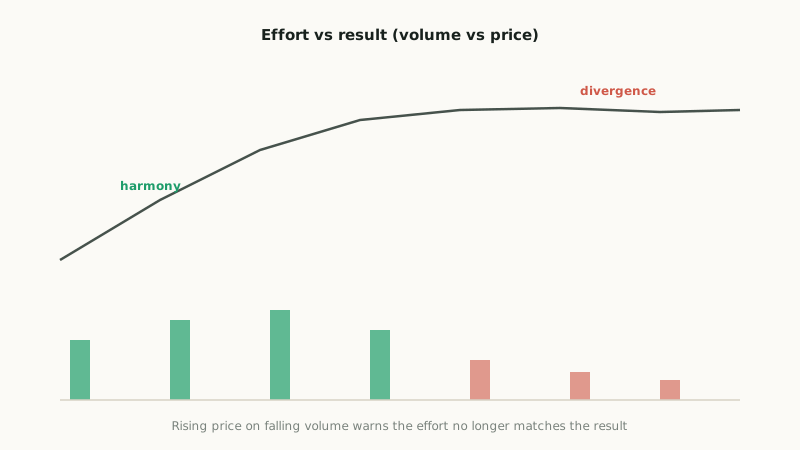
This law anticipated the entire modern field of volume analysis. The classic application is the divergence at the end of a trend: price grinds to a new high, but on steadily declining volume — the effort no longer matches the result, betraying that demand is drying up even as price ticks higher. Conversely, a huge spike in volume that fails to push price further (a high-effort, low-result bar) signals that one side is absorbing the other's pressure, often near a turning point. Reading effort against result is how Wyckoff traders judge whether to trust a move or suspect it.
How the laws work together
The three laws are not used in isolation; they interlock to produce a complete analysis. Supply and demand identifies who is in control at any moment. Cause and effect estimates how big the resulting move should be once control is established. Effort versus result confirms or questions whether what you are seeing is genuine. A Wyckoff trader reads all three at once: noting that demand is overwhelming supply (law one), that the range was long enough to fuel a substantial trend (law two), and that the breakout came on strong volume in harmony with the price move (law three). When all three align, confidence is high; when they conflict — a breakout on weak volume, say — caution is warranted.
This integrated reading is what makes the Wyckoff Method more than pattern recognition. The schematics and events are simply the visible manifestations of the three laws operating together, which is why understanding the laws makes the schematics intuitive rather than memorised. A trader who internalises the laws can read a range Wyckoff never drew a diagram for, because they understand the forces beneath the shapes.
The laws on forex
The three laws translate to forex with one important asterisk, and it is the same one that runs through all Wyckoff analysis on currencies: the law of effort versus result depends on volume, and spot forex has no true volume — only tick volume as a proxy. The laws of supply and demand and of cause and effect are essentially price-based and apply cleanly to currencies. Effort versus result still offers useful signals through tick volume, but those signals are less reliable than on centralised markets where real volume is recorded.
The sensible forex adaptation is to lean most heavily on supply and demand and cause and effect — reading control and projecting the scale of moves from range size — while treating effort-versus-result signals from tick volume as supporting evidence rather than decisive confirmation. Used that way, with honest awareness of the volume limitation, the three laws give the forex trader the same powerful reasoning framework that has made Wyckoff endure for a century, adapted sensibly to the realities of a decentralised market.
Counting the cause
The law of cause and effect is unusual among technical concepts in that it offers an actual method for projecting targets, and it is worth understanding how that works even if few traders use the original technique today. Wyckoff measured the "cause" built within a trading range using point-and-figure charts, which compress price into columns of Xs and Os and strip out time, making the horizontal extent of a congestion area directly measurable. The wider the congestion — the more columns the range occupies — the greater the cause, and the further the projected target for the move that follows.
The mechanics involved selecting a count line across the range, counting the number of columns, and multiplying by the chart's box size and reversal value to produce a projected price objective, measured from the count line. The precise arithmetic matters less for the modern trader than the underlying logic: the projection is proportional to the size of the cause, so a range twice as wide projects roughly twice as far. This gives Wyckoff a rare quantitative output — not just a direction, but an estimate of how far.
A simplified modern adaptation captures the spirit without the point-and-figure apparatus: treat the height or width of a well-defined range as a rough measure of the energy stored, and expect a proportional move once the range resolves. A large, long-developed base should produce a substantial trend; a small, brief one a modest move. Like all projections it is an estimate, not a guarantee, and it works best as a sanity check on targets derived from structure rather than as a precise prophecy. But it embodies the genuinely useful insight at the heart of the second law: the scale of what comes next is written in the scale of the consolidation that precedes it.
The three Wyckoff laws are supply and demand (who controls price), cause and effect (range size determines the trend that follows, historically counted on point-and-figure charts), and effort versus result (volume confirms or questions a move). They interlock into a complete analysis. On forex, the first two apply cleanly; the third leans on tick volume, so treat its signals as supporting rather than decisive.