Distribution is the mirror image of accumulation, and in many ways its more treacherous twin. Here, at the top of the cycle, the Composite Man does the opposite of what he did at the bottom: he sells his large position to an enthusiastic, optimistic public, unloading his holdings gradually without crashing the price and giving himself away. The public, convinced the uptrend will continue forever, happily buys what the operator is selling. When distribution is complete, the markdown begins, and those who misread the range as healthy consolidation are left holding positions into a falling market. This guide breaks down the distribution schematic so you can recognise a top while it forms.
It is the counterpart to Wyckoff accumulation, within the cycle described in the Wyckoff Method explained.
Key takeaways
Q: What is Wyckoff distribution?
A: Wyckoff distribution is the sideways trading range in which large operators sell their holdings to an enthusiastic public at high prices, before a markdown (downtrend) begins. It mirrors accumulation, unfolding through a schematic of phases and events that signal the shift from buying to selling.
Q: What is an upthrust in Wyckoff distribution?
A: An upthrust is a move above the resistance of the distribution range that quickly fails and reverses back inside. It traps breakout buyers and triggers stops, letting operators sell into the demand. The upthrust after distribution (UTAD) is its most significant form.
Q: What are the phases of Wyckoff distribution?
A: Distribution unfolds through five phases: Phase A (stopping the prior uptrend), Phase B (building the cause), Phase C (the test, often an upthrust/UTAD), Phase D (signs of weakness within the range), and Phase E (the markdown leaving the range).
The distribution schematic
Like accumulation, distribution follows a recognisable schematic bounded by support and resistance, but with the roles reversed. Instead of absorbing supply near a floor, the Composite Man is now feeding out his holdings near a ceiling, meeting the public's demand with his selling. The range looks superficially similar to accumulation — sideways, choppy, indecisive — which is exactly what makes distribution dangerous: it can masquerade as a healthy pause in an uptrend right up until the moment the markdown begins.
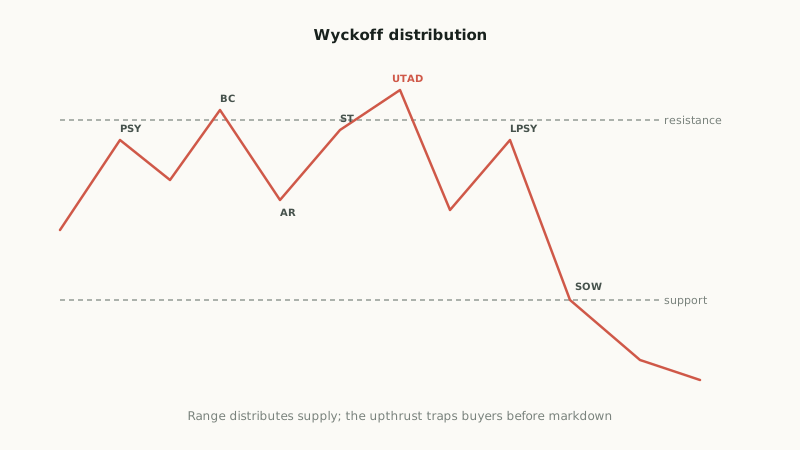
The schematic's job, again, is to turn an ambiguous range into a readable sequence. The events of distribution carry the opposite meaning to those of accumulation, and reading them in order tells you how far the operator has progressed in unloading — and how close the downtrend may be. The asymmetry to remember is that distribution often unfolds faster and more violently than accumulation, because fear works more quickly than greed.
The key events
Distribution proceeds through its own named events, mirroring accumulation's:
- Preliminary Supply (PSY) — the first significant selling that begins to slow the uptrend, hinting that supply is appearing.
- Buying Climax (BC) — a sharp, high-volume surge as euphoria peaks and the public buys aggressively. This is where the Composite Man sells heavily into the demand, often marking the high of the range.
- Automatic Reaction (AR) — the sell-off that follows once buying exhausts itself, defining the lower boundary of the range.
- Secondary Test (ST) — price returns toward the climax high to test whether buying demand remains. A weak test fails to make a new high.
- Upthrust (UT) and Upthrust After Distribution (UTAD) — a move above resistance that fails and reverses, trapping breakout buyers. The UTAD is the most significant, often marking the final high.
- Sign of Weakness (SOW) — a decline that breaks below the range's support on rising volume, confirming supply is now in control.
- Last Point of Supply (LPSY) — a feeble lower-high rally after the sign of weakness, the final low-risk entry for shorts before the markdown accelerates.
As with accumulation, not every event appears in every distribution, but the vocabulary lets a trader narrate the top as it develops.
The five phases
The five-phase structure mirrors accumulation. Phase A stops the prior uptrend, with preliminary supply, a buying climax and an automatic reaction establishing the range. Phase B is the long cause-building period where the operator distributes his position through repeated swings while the public remains bullish. Phase C is the test — typically an upthrust or UTAD, where price pokes above resistance to trap buyers and trigger the last wave of demand before reversing.
Phase D is where weakness becomes evident: the sign of weakness and the last point of supply appear as price begins to break down. Phase E is the markdown proper, as price leaves the range to the downside and the downtrend takes hold. The progression through these phases is the map for anticipating a top: a UTAD in Phase C followed by a sign of weakness in Phase D is the classic sequence that signals distribution is complete and markdown is beginning.
Distribution is dangerous precisely because it looks like healthy consolidation. The tell is the upthrust — a failed breakout above resistance that traps eager buyers. When a UTAD is followed by a sign of weakness, the "pause in the uptrend" is revealed as a top, and the markdown is near.
The upthrust as a liquidity grab
Just as the spring in accumulation is a liquidity grab below support, the upthrust in distribution is a liquidity grab above resistance. Price pushes above the obvious ceiling of the range, triggering the buy-stop orders and breakout-buyer entries resting there — the buy-side liquidity — and then fails and reverses, leaving those buyers trapped as the Composite Man sells into their demand. It is the exact counterpart of the spring, and the same phenomenon Smart Money Concepts calls a liquidity sweep of the highs.
This symmetry is one of the most elegant aspects of Wyckoff's framework: the spring and the upthrust are the same manoeuvre executed at opposite ends of the cycle, both exploiting the predictable clustering of stops around obvious levels. Recognising them as such ties the accumulation and distribution schematics together and connects both directly to the liquidity concepts of modern trading. Both are examined in detail in springs and upthrusts.
Trading distribution on forex
For the forex trader, distribution analysis is primarily a tool for spotting tops and avoiding the trap of buying into a market that is secretly being unloaded. The practical approach is to grow suspicious when an extended uptrend stalls into a sideways range, to watch for a buying climax and automatic reaction, and to treat an upthrust or UTAD followed by a sign of weakness as strong evidence that the top is in. A short entry on the last point of supply, with a stop above the upthrust high, offers favourable risk-to-reward at the start of a markdown.
The same volume caveat applies, and arguably matters more here: distribution's confirmations rely heavily on reading volume at the climax and the sign of weakness, and spot forex offers only tick volume as a proxy. Lean on the price structure — the sequence of events and especially the upthrust — as primary evidence, and treat tick volume as supporting rather than decisive. With that adaptation and a defined invalidation, distribution analysis gives forex traders a structured way to recognise a top before the crowd does, which is among the most valuable skills a trader can develop.
Redistribution and the ambiguity problem
Just as accumulation has its mid-trend counterpart in reaccumulation, distribution has redistribution: a range that forms partway through a downtrend, in which the Composite Man distributes additional supply before driving price lower, rather than topping out a completed advance. A redistribution range pauses a markdown and then resolves downward, looking structurally similar to a distribution top but occurring mid-decline.
This creates the same ambiguity in reverse. A range forming after a substantial decline could be redistribution (a pause before more downside) or accumulation (a bottom before a reversal). While it forms, the two can be nearly indistinguishable, which is why bottom-picking is as hazardous as top-picking. The clues favouring accumulation are a strong spring that holds, signs of strength on good volume, and a failure to make new lows; the clues favouring redistribution are weak rallies, failing springs, and continued signs of weakness. Context matters too — the character of the prior trend and where the range sits within the larger structure.
The lesson is the one that runs through all of Wyckoff: a range is ambiguous until it resolves, and honesty about that ambiguity is a feature of good analysis, not a weakness. Rather than insisting a range "must" be one thing, the disciplined approach reads the evidence as it accumulates, leans on the resolution — a confirmed sign of strength or weakness breaking the range — and accepts that some ranges will not declare themselves until late. Trading the confirmed break with a defined invalidation, rather than predicting the range's nature in advance, is what keeps Wyckoff analysis grounded rather than speculative.
Wyckoff distribution is the range where operators sell to the public before markdown, mirroring accumulation through events (PSY, BC, AR, ST, UT/UTAD, SOW, LPSY) across five phases. A similar range mid-downtrend is redistribution — often indistinguishable from accumulation until it resolves. The upthrust is a liquidity grab above resistance, the twin of the spring. Trade the confirmed break, not the guess; structure translates to forex, volume confirmations less so.