Of all the events in the Wyckoff schematics, two stand out as the most actionable and the most revealing: the spring and the upthrust. They are, in essence, the same trick performed at opposite ends of the market cycle — a deliberate-looking fake breakout that traps the crowd at exactly the wrong moment before price reverses hard in the other direction. For the trader who recognises them, they mark some of the highest-probability turning points the market offers. And they are the clearest bridge between Wyckoff's century-old framework and the liquidity concepts at the heart of modern trading.
These events appear within the schematics covered in accumulation and distribution; this guide examines them in their own right.
Key takeaways
Q: What is a Wyckoff spring?
A: A Wyckoff spring is a brief move below the support of an accumulation range that quickly reverses back inside. It shakes out remaining sellers and triggers stop-loss orders, allowing operators to absorb the last supply before a markup begins. It often marks the final low of the range.
Q: What is a Wyckoff upthrust?
A: An upthrust is a move above the resistance of a distribution range that fails and reverses back inside, trapping breakout buyers and triggering stops. The upthrust after distribution (UTAD) is its most significant form and often marks the final high before a markdown.
Q: Are springs and upthrusts the same as liquidity grabs?
A: Functionally, yes. A spring sweeps the sell-side liquidity below support and an upthrust sweeps the buy-side liquidity above resistance. Wyckoff described these shakeouts a century before Smart Money Concepts renamed them liquidity grabs or sweeps.
The spring
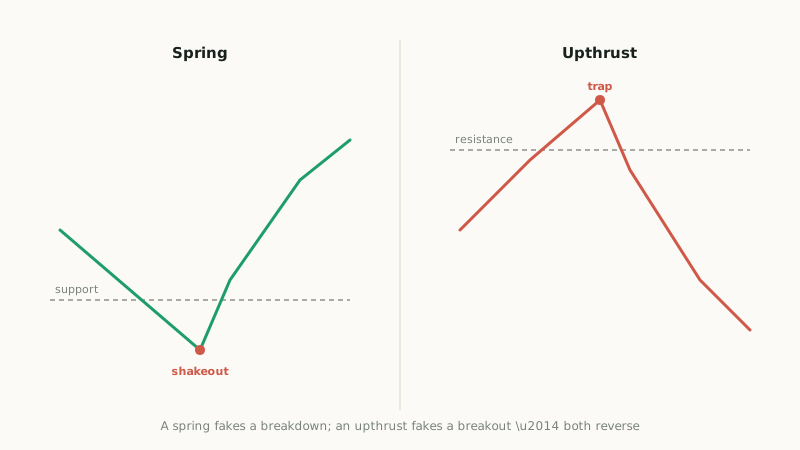
A spring occurs near the end of an accumulation range. After price has spent time consolidating above a support level, it suddenly dips below that support — appearing, to most observers, to be breaking down into a new decline. But the breakdown fails almost immediately: price snaps back up into the range, leaving a brief, sharp wick below support and trapping everyone who sold or shorted the apparent breakdown. That failed breakdown is the spring.
Wyckoff's explanation is that the spring is a deliberate shakeout. The obvious support level has accumulated a cluster of stop-loss orders just beneath it, along with eager short-sellers waiting for a breakdown. By pushing price below support, the Composite Man triggers all of those orders — absorbing the resulting flood of selling as cheap supply — and shakes out the last weak holders before reversing. Having cleared out the sellers at the lowest possible prices, the operator is free to mark price up. This is why a successful spring so often marks the final low of the entire range and presents one of the best long entries in the Wyckoff playbook.
The upthrust
The upthrust is the spring's mirror image, occurring near the end of a distribution range. After price has consolidated below a resistance level, it suddenly pushes above that resistance — appearing to break out into a new uptrend. Breakout buyers pile in, stops above resistance are triggered, and optimism surges. Then the breakout fails: price reverses back down into the range, trapping every buyer who chased the move. That failed breakout is the upthrust, and its most significant form, occurring late in distribution, is the upthrust after distribution (UTAD).
The logic is the exact inverse of the spring. The obvious resistance level has accumulated buy-stop orders and breakout-buyer interest just above it — a pool of demand. By pushing price above resistance, the Composite Man triggers that demand and sells his remaining holdings into it at the highest possible prices, before letting price collapse. Having distributed the last of his position to trapped buyers, the operator is free to mark price down. A clear UTAD therefore often marks the final high of the range and offers one of the best short entries in distribution.
The elegant symmetry
What makes the spring and upthrust so instructive is their perfect symmetry. Both exploit the same predictable human behaviour: traders place stops at obvious levels and chase obvious breakouts. Both use a fake move through that obvious level to trigger those orders and trap the crowd. Both reverse hard once the trapped traders have provided the liquidity the operator needed. The spring does this at the bottom to enable markup; the upthrust does it at the top to enable markdown. They are two expressions of a single, timeless market manoeuvre.
This symmetry also makes them practical to trade, because the playbook is mirrored. In both cases the signal is a failed breakout — a move beyond an obvious level that does not hold. The entry comes on the reversal back inside the range, the stop sits just beyond the extreme of the fake move (below the spring low or above the upthrust high), and the favourable risk-to-reward comes from entering right at the turning point with a tightly defined invalidation. Recognising a failed breakout at the edge of a long range, rather than chasing the breakout itself, is the entire skill.
The crowd's instinct — sell the breakdown, buy the breakout — is exactly what the spring and upthrust exploit. The Wyckoff trader does the opposite: they wait for the obvious breakout to fail, then trade the reversal. The fake move is not noise; it is the signal.
The bridge to modern liquidity trading
If the spring and upthrust sound exactly like what Smart Money Concepts calls liquidity sweeps, that is because they are the same phenomenon. The stops resting below support are sell-side liquidity; the spring sweeps them. The stops resting above resistance are buy-side liquidity; the upthrust sweeps them. The SMC description of price spiking through an obvious level to "grab liquidity" before reversing is a direct restatement of what Wyckoff described and named a century earlier, as explored in liquidity in trading explained.
Appreciating this connection is genuinely useful rather than merely academic. It means the deep, well-developed Wyckoff literature on identifying and trading springs and upthrusts — the role of volume, the importance of the range that precedes them, the confirmation that should follow — applies directly to trading what SMC calls liquidity grabs. A trader who understands the Wyckoff spring understands the SMC liquidity sweep at a deeper level than the modern vocabulary alone provides. The concepts converge because they describe the same enduring reality: markets hunt obvious levels to trap the crowd before they move.
Springs and upthrusts on forex
On currency pairs, springs and upthrusts are among the most reliable Wyckoff signals to apply, because they are primarily price-structure events rather than volume-dependent ones. A spring below an obvious support level on a forex pair, or an upthrust above obvious resistance, is readable from price action alone, and the cleaner the failed breakout and the sharper the reversal, the stronger the signal. Tick volume can add confirmation — a high-volume spike on the fake move followed by the reversal is ideal — but the structure is the primary evidence.
The practical approach mirrors the rest of disciplined trading: identify a significant range, watch the obvious support and resistance for a failed breakout, enter on the reversal back inside with a stop just beyond the fake move's extreme, and target the opposite side of the range or beyond. Because these events combine a clear signal with a tight, well-defined invalidation, they offer some of the most favourable risk-to-reward setups available — the reason both Wyckoff traders and SMC traders prize them so highly, under whichever name they happen to use.
Types of spring — and when it fails
Not all springs are equal, and Wyckoff analysts traditionally grade them by how much supply they reveal. A spring that penetrates support deeply, on wide spread and high volume shows that significant supply still exists — the shakeout uncovered real selling — and such a spring is the weakest, often requiring further testing before markup can begin. A spring that penetrates only marginally, on low volume, shows that little supply remains to be shaken out, and is the strongest and most bullish, because it demonstrates that sellers are nearly exhausted. Between these sits the moderate case. The principle is counterintuitive but sound: the less dramatic the spring, the more bullish it often is, because it reveals how little selling pressure is left.
A related event is the terminal shakeout — a more violent, deeper plunge below support that clears out supply in one decisive sweep rather than a gentle probe. Terminal shakeouts are dramatic and can be unnerving, but a sharp recovery from one carries the same meaning: the final supply has been flushed and the path is clear for markup. The volume and the speed of the recovery are the keys to reading which kind of shakeout has occurred.
Crucially, a spring is only a spring if price reverses and holds. If price breaks below support and keeps falling, it was never a spring — it was a genuine breakdown, and the accumulation thesis was wrong. This is why a defined invalidation is essential: the stop below the spring low is not a formality but the line that distinguishes a successful shakeout from a failed read. A "failed spring" that continues lower is simply the market telling you the supply was real and the range was distribution or reaccumulation in disguise. The same logic applies in reverse to upthrusts: an upthrust that holds above resistance and continues higher was a genuine breakout, not a trap. Respecting that invalidation is what keeps the spring-and-upthrust playbook honest rather than a recipe for catching falling knives.
A spring is a failed breakdown below support that shakes out sellers before markup; an upthrust (and UTAD) is a failed breakout above resistance that traps buyers before markdown. Springs are graded by the supply they reveal — a shallow, low-volume spring is the most bullish. A spring is only valid if price reverses and holds; if it keeps falling, it was a real breakdown. Trade the failed breakout, not the breakout, with a stop just beyond the fake move.