Elliott Wave and the Wyckoff method are two of the most enduring frameworks in technical analysis, and they are often pitched as rivals. In truth they are trying to answer the same question — what is the larger, better-informed money doing, and where are we in its campaign? — but they speak completely different languages to get there. Elliott Wave reads the shape of price into repeating patterns; Wyckoff reads the relationship between price and volume to infer intent. Understanding how they differ, and where they overlap, makes both more useful.
This comparison assumes a working knowledge of Elliott Wave theory; the Wyckoff side is summarised here for contrast.
Key takeaways
Q: What is the difference between Elliott Wave and Wyckoff?
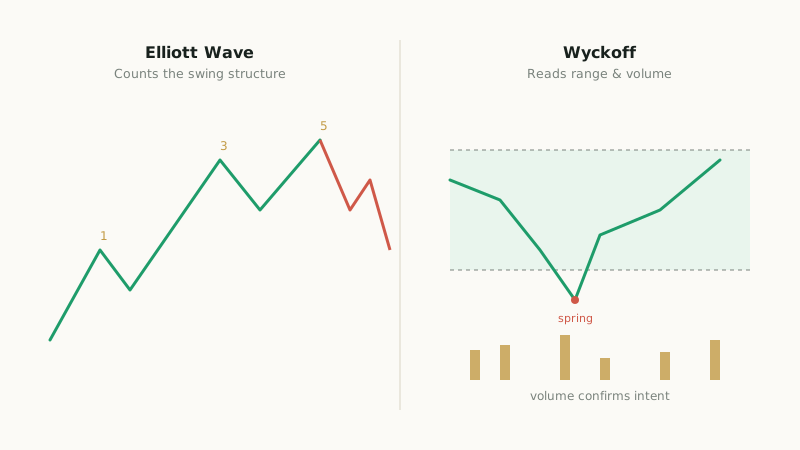
A: Elliott Wave classifies price into repeating five-wave and three-wave patterns based on crowd psychology. The Wyckoff method reads the relationship between price and volume within trading ranges to infer what large operators are doing. One counts structure; the other reads intent through volume.
Q: Can you use Elliott Wave and Wyckoff together?
A: Yes. Many traders use Wyckoff to identify accumulation or distribution and the likely start of a move, then Elliott Wave to map and project the structure of the move that follows. They are complementary rather than competing.
Q: Which is better for forex?
A: Neither is strictly better. Wyckoff's reliance on volume is harder on decentralised spot forex, where true volume is unavailable, while Elliott Wave needs no volume but is more subjective. The right choice depends on the trader.
What Elliott Wave does
Elliott Wave is fundamentally a structural framework. It claims that markets move in repeating, fractal patterns — five waves with the trend, three against it — driven by the swings of crowd psychology. The analyst's job is to label the current structure, respect the three unbreakable rules, and project where the pattern is likely to go and where it would be invalidated. It requires no volume data at all; everything is derived from the shape of price itself.
What Wyckoff does
The Wyckoff method, developed by Richard Wyckoff in the early twentieth century, is fundamentally a behavioural framework built on the relationship between price and volume. It models the market as a campaign run by a large operator — the "composite man" — who accumulates positions quietly before a markup and distributes them before a markdown. Wyckoff traders read trading ranges for tell-tale events such as the spring, the test, and signs of strength, using volume to judge whether the operator is buying or selling. Where Elliott counts swings, Wyckoff interrogates effort versus result.
The core differences
| Dimension | Elliott Wave | Wyckoff |
|---|---|---|
| Primary input | Price shape | Price and volume together |
| Core idea | Fractal 5-3 patterns of crowd psychology | Accumulation and distribution by large operators |
| Key tools | Wave counts, the three rules, Fibonacci | Schematics, springs, tests, effort vs result |
| Needs volume? | No | Yes (central to the method) |
| Main weakness | Subjectivity of the count | Volume is unreliable on spot forex |
| Best at | Projecting structure and targets | Spotting where a move begins |
The starkest practical difference for currency traders is volume. Spot forex is decentralised, so there is no single, true volume figure — only tick volume or broker-specific data as a proxy. That handicaps a method built around volume like Wyckoff, while Elliott Wave, needing none, is unaffected. On the other hand, Elliott Wave's flexibility is its own weakness: two analysts can label the same chart differently, a subjectivity Wyckoff's volume evidence partly disciplines.
Elliott Wave tells you the likely shape and destination of a move. Wyckoff tells you whether and where a move is likely to begin. They answer different halves of the same question.
Using them together
Because they emphasise different things, the two frameworks combine more naturally than their rivalry suggests. A common workflow uses Wyckoff to identify a trading range as accumulation — spotting the selling climax, the spring and the test that mark a likely bottom — and then switches to Elliott Wave to map the impulsive markup that follows, projecting targets with Fibonacci once the five-wave structure begins. Wyckoff answers "is a move starting here?"; Elliott Wave answers "how far might it run, and where am I wrong?"
The conceptual overlap is real, too. Wyckoff's spring — a dip below support that traps sellers before a reversal — often corresponds to the end of a corrective wave in Elliott terms. Both frameworks are, at bottom, attempts to read the same institutional footprints; they simply trace them with different instruments.
Which should you learn?
For a forex trader with no volume data, Elliott Wave and pure price-action structure tend to be the more natural starting point, with Wyckoff's logic adopted conceptually rather than through strict volume reading. A trader on markets with reliable centralised volume — futures, for instance — can apply Wyckoff in its full form. Many experienced analysts ultimately borrow from both: the structural discipline of waves and the behavioural intuition of Wyckoff. Neither framework is a complete trading system on its own, and both reward the same underlying habit — defining, in advance, the price at which the idea is wrong.
For the structural half of that toolkit, the natural next step is the mechanics of labelling: how to count Elliott waves, and the difference between the move types in impulse versus corrective waves.
Shared roots, different instruments
It is easy to forget that both frameworks emerged from the same era and the same intellectual soil. Richard Wyckoff was working in the early twentieth century, studying the great operators of his day to reverse-engineer how they moved markets. Ralph Nelson Elliott, formulating his wave principle in the 1930s, drew on Charles Dow's earlier observations about trends and phases. Both men were trying to make the apparent chaos of price legible — to show that beneath the noise sat a repeatable logic of human and institutional behaviour. They simply chose different instruments to measure it: Wyckoff reached for volume and the effort-versus-result relationship, Elliott for the geometry of the swings themselves.
That common ancestry is why the two so often describe the same event in different words. A Wyckoff selling climax and spring at the bottom of a range frequently coincides with the completion of a corrective wave in Elliott terms. Neither is "right"; they are two coordinate systems pointed at the same turning point.
Where each is strong and weak
Honest use of either framework means knowing its failure modes. Elliott Wave's great strength is that it provides structure and projection from price alone, with hard rules that supply objective invalidation. Its weakness is subjectivity: the same chart can support more than one valid count, and analysts can fall in love with a forecast. Wyckoff's strength is that volume evidence disciplines interpretation — it is harder to argue with effort-versus-result than with a wave label — and it excels at pinpointing where a move is likely to begin. Its weakness, on spot forex especially, is its dependence on volume data that simply does not exist in a clean, centralised form.
This is why the choice is rarely about which framework is "better" in the abstract and almost always about the market and data available. The trader who understands both can lean on whichever is better suited to the instrument in front of them.
A combined workflow in practice
Consider how the two might cooperate on a single trade idea. Price has fallen for weeks and then stalls, carving out a sideways range. A Wyckoff-minded trader watches that range for the signature of accumulation: a selling climax on heavy volume, an automatic rally, a secondary test, and finally a spring that dips below support and recovers on lighter volume — the operator shaking out the last sellers. That sequence is the cue that a bottom is likely in.
At that point an Elliott Wave lens takes over. As price breaks up out of the range, the trader looks to label the developing advance as a five-wave impulse, projecting targets with Fibonacci once waves 1 and 2 are in place and trading primarily in the direction of the powerful third wave. Wyckoff answered where the move began and whether to trust it; Elliott Wave answers how far it might run and where the idea is invalidated. Used this way, the supposed rivals form a single, coherent process.
Elliott Wave counts structure from price alone; Wyckoff reads intent from price and volume. They share the same goal and often the same turning points — use Wyckoff to find where a move begins, Elliott Wave to map how far it runs.