
Of all the corrective patterns Elliott catalogued, the zigzag is the one most likely to deceive. It is sharp, steep and strongly directional — so much so that traders routinely mistake its first leg for the start of a brand-new trend, only to be caught out when the correction completes and the original trend resumes. Learning to recognise a zigzag for what it is — a correction, not a reversal — is one of the most valuable defensive skills in wave analysis.
This guide assumes familiarity with the broader framework set out in Elliott Wave theory explained and the distinction drawn in impulse versus corrective waves.
Key takeaways
Q: What is a zigzag in Elliott Wave theory?
A: A zigzag is a sharp, corrective three-wave pattern labelled A-B-C that subdivides 5-3-5 — wave A is a five, wave B is a three, and wave C is a five. It moves steeply against the larger trend.
Q: How is a zigzag different from a flat?
A: A zigzag is sharp and deep, subdividing 5-3-5, with a shallow B wave. A flat is sideways and choppy, subdividing 3-3-5, with a B wave that returns close to the start of A. The B-wave depth and overall steepness are the main tells.
Q: Where does a zigzag usually appear?
A: Zigzags most commonly appear in the wave 2 position of an impulse, and can also form wave A of a larger correction. They can chain into double and triple zigzags in deeper corrections.
The 5-3-5 structure
A zigzag is a three-wave corrective pattern, labelled A-B-C, with a very specific internal structure: wave A subdivides into five sub-waves, wave B into three, and wave C into five. This 5-3-5 fingerprint is what defines it and what separates it from the other corrective forms. The five-wave count inside wave A is precisely why a zigzag's opening leg looks so convincingly like the start of a new impulse — because, at a smaller degree, it is a five-wave move.
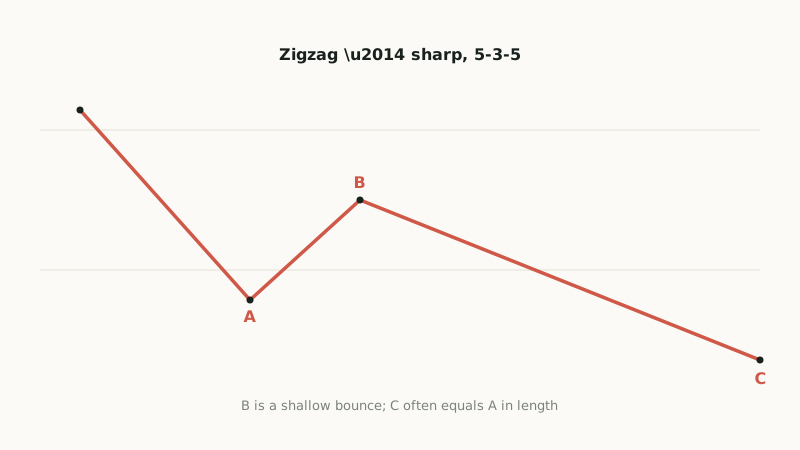
The overall shape is steep and directional. Wave A drops (in a downward correction), wave B bounces back only partially, and wave C drives down again, usually to a new low beyond the end of wave A. The pattern moves decisively against the larger trend, which is exactly what makes it feel like a reversal in the moment.
The shallow B wave is the tell
The single most reliable way to distinguish a zigzag from the other main corrective pattern — the flat — is the depth of the B wave. In a zigzag, wave B is shallow: it retraces only part of wave A, commonly somewhere between 38.2% and 61.8%, occasionally a little more, but it does not approach the start of wave A. That shallow bounce is what gives the zigzag its sharp, slanting profile rather than the sideways look of a flat.
Wave C, by contrast, is typically strong. It very often runs to roughly the same length as wave A, a relationship traders use to project where the correction is likely to end. When wave B is shallow and wave C is reaching toward equality with wave A, you are almost certainly looking at a zigzag rather than a flat or a triangle.
Read the B wave first. A shallow B that fails to return near the start of A means a sharp zigzag is in play; a deep B that nearly retraces all of A points to a flat instead. The B wave decides the pattern.
Where zigzags appear
Zigzags show up most often in the wave 2 position of an impulse — the deep, convincing pullback that tempts traders into believing the prior trend has resumed before wave 3 takes off. They can also form wave A of a larger, more complex correction, and they appear within the legs of triangles and combinations. Because the guideline of alternation tends to make wave 2 and wave 4 corrections differ in character, a sharp zigzag in wave 2 often hints that wave 4 will be a shallower, more sideways flat or triangle instead.
Double and triple zigzags
When a single zigzag does not consume enough time or price to complete a correction, two or three zigzags can join together, connected by intervening linking waves (labelled with an X). These are called double zigzags (W-X-Y) and triple zigzags (W-X-Y-X-Z). They retain the sharp, directional character of a single zigzag but cover more ground, and they appear in deeper corrections where the market needs longer to rebalance. The practical caution is the same as with any complex correction: the additional structure multiplies the ways a count can go wrong, so it pays to let the pattern resolve rather than predicting each sub-leg.
Trading the zigzag on forex
For currency traders, the zigzag's danger and its opportunity are two sides of the same coin. The danger is treating wave A as a trend reversal and positioning against the dominant trend, only to be run over when wave C completes and the larger trend reasserts itself. The opportunity is the reverse: once a zigzag is recognised as a correction within a trend — a shallow B, a wave C reaching toward equality with A — its completion marks a high-probability point to rejoin the original trend in the direction of the next impulse.
The cleanest way to use it is to wait for evidence that wave C is ending near the projected A=C zone, rather than trying to catch a falling knife mid-correction. As always, the discipline is to define the invalidation level in advance: if price keeps extending well beyond where the zigzag should have completed, the corrective read was wrong and the structure is something larger. The companion pattern, with its very different sideways character, is covered in the flat correction, and the live counting workflow in how to count Elliott waves.
Fibonacci relationships in a zigzag
Zigzags respect Fibonacci proportions closely enough that the ratios become a practical confirmation tool. Three relationships matter most. Wave B typically retraces between 38.2% and 61.8% of wave A — the shallow bounce that defines the pattern; a B wave that retraces much more than this is pointing toward a flat instead. Wave C most often runs to roughly equality with wave A (a 1:1 relationship), which is the single most useful projection for estimating where the correction will end. In stronger corrections, wave C can extend to 1.272 or 1.618 times the length of wave A.
Putting these together gives a workable plan: once wave A and the shallow wave B are in place, projecting C as equal to A — and noting the 1.272 and 1.618 extensions as deeper alternatives — frames a zone where the zigzag is likely to complete. When that projected zone also lines up with a prior support level or a higher-degree wave boundary, the confluence makes the read considerably stronger. This is the same confluence principle that runs through all of Elliott Wave's interaction with Fibonacci proportions.
Telling a zigzag apart from its cousins
Three quick comparisons keep the zigzag distinct from the patterns it is most often confused with:
- Versus a flat — the zigzag subdivides 5-3-5 with a shallow B; the flat subdivides 3-3-5 with a deep B that returns near the start of A. Depth of B is the fastest tell, as covered in the flat correction.
- Versus an impulse — a zigzag is a three-wave correction against the trend, even though its A and C legs each contain a five. An impulse is a five-wave move with the trend. Context — whether the move runs with or against the higher-degree trend — settles it.
- Versus a triangle — triangles are sideways, converging and built from five overlapping legs; zigzags are sharp, directional and built from three. They rarely look alike once the slope is considered.
Zigzags and alternation
The guideline of alternation gives the zigzag predictive value beyond its own boundaries. Because corrections within a single impulse tend to alternate in form, a sharp zigzag in the wave 2 position is itself a hint that the eventual wave 4 will not be a zigzag — more likely a sideways flat or triangle. So spotting a zigzag early does double duty: it tells you how the current correction is likely to behave, and it sets your expectation for the character of the next one. That kind of forward expectation, grounded in structure rather than guesswork, is exactly what makes the corrective patterns worth learning despite their reputation for difficulty.
A zigzag is a sharp 5-3-5 A-B-C correction with a shallow B wave (38.2–61.8% of A) and a C that often equals A. It is the correction most often mistaken for a new trend — read the shallow B to confirm it, project C from A with Fibonacci, and let alternation tell you the next correction will likely differ.