
Where the zigzag is sharp and directional, the flat is sideways and grinding. It is the correction that chops back and forth within a range, repeatedly tempting traders into breakouts that fail, before finally resolving. Flats are extremely common — the expanded flat in particular shows up constantly on forex charts — and they are responsible for a large share of the frustration traders feel during corrective phases. Learning their structure and variations turns that frustration into recognition.
This guide pairs with the zigzag pattern; together the two cover the most common corrective shapes within the framework laid out in Elliott Wave theory explained.
Key takeaways
Q: What is a flat correction in Elliott Wave theory?
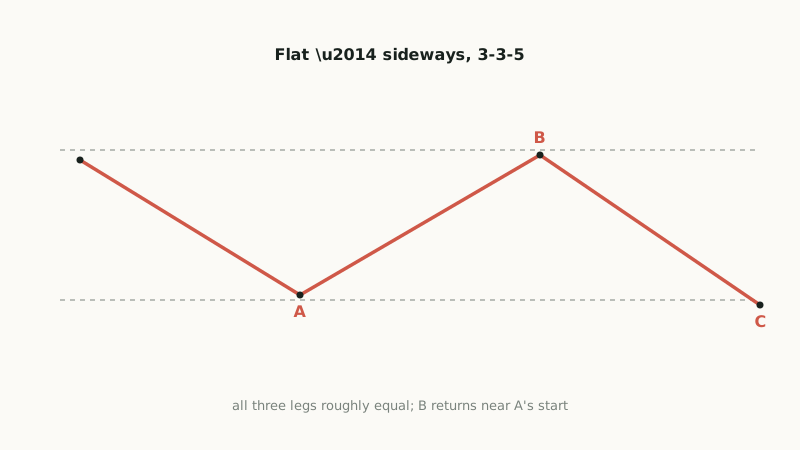
A: A flat is a sideways, three-wave corrective pattern labelled A-B-C that subdivides 3-3-5 — wave A is a three, wave B is a three, and wave C is a five. Its three legs are roughly equal, giving it a choppy, range-bound look.
Q: What is an expanded flat?
A: An expanded flat is the most common variation, in which wave B pushes beyond the start of wave A (making a new extreme) and wave C then extends beyond the end of wave A. It is a frequent and tricky structure on forex charts.
Q: How is a flat different from a zigzag?
A: A flat is sideways and subdivides 3-3-5 with a deep B wave that returns near the start of A. A zigzag is sharp and subdivides 5-3-5 with a shallow B wave. The B-wave depth is the clearest difference.
The 3-3-5 structure
A flat is a three-wave correction, labelled A-B-C, with an internal structure of 3-3-5: wave A subdivides into three sub-waves, wave B into three, and wave C into five. That opening three-wave A is the first thing distinguishing a flat from a zigzag, whose wave A is a five. Because wave A is itself corrective in structure, a flat signals from the outset that the market is consolidating sideways rather than reversing sharply.
The overall look is broadly horizontal. The three legs tend to be roughly equal in length, and price ends up oscillating within a band rather than travelling far in either direction. This sideways, choppy character is the flat's signature, and it is what makes the pattern so effective at trapping traders who keep expecting a clean breakout.
The deep B wave
Just as the shallow B wave defines the zigzag, a deep B wave defines the flat. In a flat, wave B retraces almost all of wave A, returning close to — or in some variations beyond — the point where wave A began. That deep retracement is what flattens the structure out and removes the steep slant of a zigzag. If you are unsure which corrective pattern is forming, the depth of the B wave is the fastest way to decide: shallow points to a zigzag, deep points to a flat.
The B wave is the diagnostic. A B wave that returns near (or past) the start of A means a sideways flat; a B wave that bounces only partway means a sharp zigzag. Read B before anything else.
The three variations
Flats come in three forms, distinguished by how far waves B and C travel:
- Regular flat — wave B retraces roughly 100% of wave A, returning to its start, and wave C ends slightly beyond the end of wave A. The textbook, balanced version.
- Expanded flat — the most common of all. Wave B pushes beyond the start of wave A, making a new extreme that looks like the trend continuing, before wave C reverses and extends beyond the end of wave A. The false new high or low in wave B is a classic trap.
- Running flat — wave B again exceeds the start of A, but wave C falls short of A's end, so the correction "runs" in the direction of the larger trend. It signals an especially strong underlying trend and is the rarest of the three.
The expanded flat deserves particular attention because it is so frequent and so deceptive. In an uptrend correction, the expanded flat's wave B makes a fresh high above the prior peak — convincing trend-followers the advance is resuming — before wave C drops below the start of the move. Traders who chased that wave B high are left offside. Recognising the expanded flat for what it is turns that trap into a setup, because the completion of wave C marks a high-probability point for the larger trend to resume.
Where flats appear
Flats most often appear in the wave 4 position of an impulse and in the wave B position of larger corrections. Their sideways character fits the guideline of alternation neatly: if wave 2 was a sharp zigzag, wave 4 will frequently be a sideways flat or triangle instead, and vice versa. So a sharp, deep wave 2 is itself a hint to expect a shallower, more horizontal wave 4 — often a flat.
Trading flats on forex
For currency traders, flats are both a hazard and an edge. The hazard is the expanded flat's false breakout: wave B's new extreme lures breakout traders in precisely before the reversal. The edge is that, once recognised, a flat's sideways resolution offers a high-probability re-entry in the trend's direction as wave C completes. The practical approach is to be sceptical of breakouts during an obvious sideways correction, to watch for the deep B wave that signals a flat, and to wait for wave C to finish near the projected zone rather than acting on the misleading B-wave move.
As always, the protective discipline is a pre-defined invalidation: a level beyond which the flat interpretation no longer holds and the structure must be re-read. Combined with its sharp counterpart in the zigzag, the flat completes the core corrective toolkit; the live labelling process is in how to count Elliott waves.
Fibonacci relationships in a flat
Flats have their own characteristic proportions, and they differ from a zigzag's in revealing ways. In a regular flat, wave B retraces close to 100% of wave A, and wave C is roughly equal to wave A, ending just past it. In the far more common expanded flat, wave B typically extends to between 105% and 138% of wave A — overshooting the start of A to make a false new extreme — and wave C then commonly reaches around 161.8% of wave A as it reverses. Those numbers explain the expanded flat's deceptive power: the B-wave overshoot looks like trend continuation, while the long C wave that follows punishes anyone who chased it.
Knowing these ratios converts the trap into a plan. When you see a sideways correction whose B wave has pushed past the prior extreme, the expanded-flat template tells you to expect a wave C extending toward 1.618 of A in the opposite direction — a projection you can mark in advance and watch for completion, rather than reacting to the misleading B-wave move.
Why expanded flats dominate
It is worth dwelling on why the expanded flat is so common, because the reason is instructive. An expanded flat reflects a market with a strong underlying trend that is correcting only reluctantly. The B wave's push to a new extreme is the trend trying to reassert itself; the failure of that push, and the sharp C wave that follows, is the correction finally taking hold before the trend resumes. In other words, expanded flats tend to appear precisely when the larger trend is robust — which is also when traders are most eager to chase continuation and therefore most exposed to the B-wave trap. The pattern's frequency and its danger spring from the same source.
A recognition checklist
When a sideways correction is forming and you are trying to decide whether it is a flat, run through a short mental checklist:
- Is wave A a three rather than a five? A three-wave A rules out a zigzag and points to a flat.
- Is wave B deep, returning near or beyond the start of wave A? Depth is the defining flat signature.
- Did wave B make a false new extreme beyond the prior high or low? If so, you are likely in an expanded flat — the most common variety.
- Is the overall move broadly horizontal rather than steeply slanted? Sideways character confirms a flat over a zigzag.
If most of those answers point the same way, you can label the structure as a flat with reasonable confidence and project wave C accordingly. As ever, the read is held with a defined invalidation level, and combined with its sharp counterpart in the zigzag it completes the core corrective toolkit a wave trader needs.
A flat is a sideways 3-3-5 A-B-C correction with a deep B wave and roughly equal legs. The expanded flat — B overshooting to ~105–138% of A before C extends to ~161.8% of A — is the most common and most deceptive, and it tends to appear when the underlying trend is strong. Read the deep B, project C with Fibonacci, and treat completion as a point to rejoin the trend.