
Elliott Wave only really clicks when you watch it applied to a real pair, end to end. This is a worked, illustrative walkthrough of counting a five-wave impulse on EUR/USD — the most liquid currency pair in the world and a natural fit for a theory built on crowd psychology. The numbers here are illustrative and rounded for clarity; the point is the process, not a forecast. Nothing in this guide is a trading signal or financial advice.
If the underlying concepts are unfamiliar, read Elliott Wave theory explained and how to count Elliott waves first; this walkthrough assumes them.
Key takeaways
Q: How do you apply Elliott Wave to EUR/USD?
A: Start on the higher timeframe to establish the trend, identify a clean five-wave impulse anchored on an obvious third wave, label the structure, then verify it against the three rules and Fibonacci proportions before defining an invalidation level.
Q: What Fibonacci levels confirm an Elliott Wave count on EUR/USD?
A: Common confirmations include wave 2 retracing around 50-61.8% of wave 1, wave 4 holding near 38.2% of wave 3, and wave 3 extending to roughly 161.8% of wave 1. When the labels and ratios agree, confidence rises.
Q: Is this a trading signal?
A: No. This is an illustrative, educational walkthrough of how a count is built and tested. It is not financial advice or a recommendation to trade EUR/USD.
Step 1: establish the higher-timeframe context
The count always starts from the top down. Suppose EUR/USD has been grinding higher on the daily chart over several weeks, making higher highs and higher lows after bottoming near a round number such as 1.0500. That higher-timeframe uptrend is the frame: it tells us we are looking for a bullish five-wave impulse, not trying to pick a top. Establishing this context first is what keeps the rest of the count honest — every lower-timeframe label has to fit inside this bigger picture.
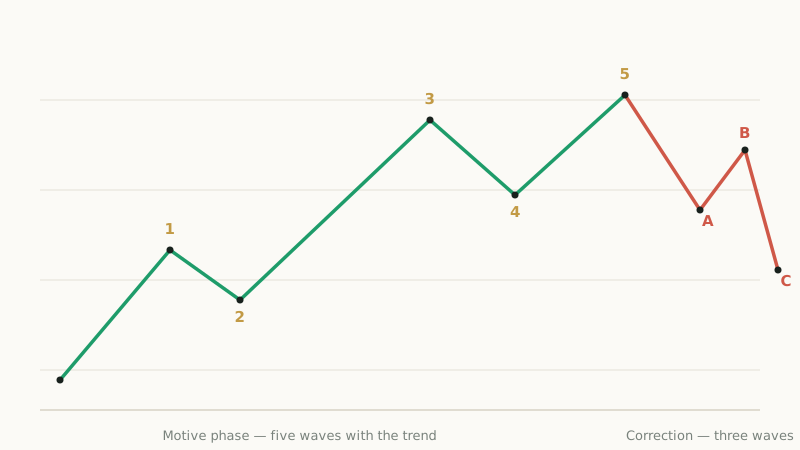
Step 2: anchor on the obvious third wave
Dropping to the four-hour chart, the most striking feature is a long, fast advance — say a run from around 1.0700 up to 1.1050 — that travelled further and quicker than anything around it. That is our anchor: a textbook candidate for wave 3, the strongest and usually longest leg. With wave 3 provisionally placed, the structure organises itself:
- Wave 1 — the initial move up off the 1.0500 low to roughly 1.0700.
- Wave 2 — the pullback toward 1.0600 before the big advance.
- Wave 3 — the powerful run to about 1.1050.
- Wave 4 — a shallow, sideways pullback toward 1.0950.
- Wave 5 — a final push to a new high near 1.1150.
Step 3: test it against the three rules
Before trusting the labels, every one is checked against the unbreakable rules:
| Rule | Check on this count | Pass? |
|---|---|---|
| Wave 2 < 100% of wave 1 | Wave 2 held at 1.0600, above the 1.0500 start of wave 1 | Yes |
| Wave 3 not the shortest | Wave 3 (350 pips) is longer than waves 1 and 5 | Yes |
| Wave 4 no overlap with wave 1 | Wave 4 held at 1.0950, well above wave 1's high of 1.0700 | Yes |
All three rules pass, so the count is structurally valid. Had wave 4 dipped below 1.0700 into wave 1's territory, the impulse interpretation would have failed on the spot — and we would have had to consider whether we were instead looking at a diagonal or a correction, as covered in the rules and guidelines.
Step 4: confirm with Fibonacci
Structurally valid is good; proportionally typical is better. Measuring the count:
- Wave 2 (1.0700 down to 1.0600) retraced roughly half of wave 1 — squarely in the typical 50–61.8% zone for a second wave.
- Wave 4's shallow pullback held near the 38.2% retracement of wave 3 — a classic fourth-wave depth, and notably shallower than wave 2, satisfying the guideline of alternation.
- Wave 3, at about 350 pips against wave 1's 200, ran close to the 1.618 extension — the hallmark of a healthy extended third wave, discussed in Elliott Wave extensions.
The labels and the ratios agree, which is exactly what we want. When structure and proportion line up like this, confidence in the count rises from "possible" to "probable."
A count earns trust when two independent checks agree: the three rules say it is valid, and the Fibonacci proportions say it is typical. Either alone is weak; together they are persuasive.
Step 5: define the invalidation
The most important output of the whole exercise is not the target — it is the price at which the idea is wrong. With wave 5 complete near 1.1150, the theory anticipates a three-wave correction against the advance, very often retracing back toward the territory of wave 4 around 1.0950. The invalidation for the bullish impulse interpretation would be a decisive break back below the start of the move at 1.0500, which would say the entire count was mistaken. Defining that level before acting is what converts wave analysis from a prediction exercise into a risk-managed one.
Step 6: read the correction that follows
After the five-wave advance, attention shifts to the correction. Is the pullback from 1.1150 sharp and deep, with a shallow bounce — a zigzag? Or is it sideways and choppy, with a deep B wave — a flat? Reading which corrective form is unfolding tells us where the correction is likely to end and where the next impulse, in the direction of the larger daily uptrend, might begin. This is the rhythm the whole framework is built to track: five up, three back toward the old fourth wave, then potentially five up again.
What the walkthrough teaches
The value of working through a count like this is the discipline it imposes. We started with context, anchored on the clearest wave, tested against objective rules, confirmed with proportion, and defined invalidation before anything else. At no point did we need the count to be "right" in some absolute sense — we needed it to be valid, typical, and falsifiable. That is the entire practical contribution of Elliott Wave: not prophecy, but a structured way to know where you are, where you might be going, and exactly where you would be proven wrong.
Step 7: hold an alternate count
A disciplined analyst never carries only one interpretation, and our EUR/USD count is no exception. Two credible alternates deserve to sit alongside the primary. First, what we labelled as the complete five-wave advance to 1.1150 might instead be only wave 3 of a larger impulse that is still unfolding — in which case the pullback toward 1.0950 would be a larger wave 4, and a further push to new highs (a larger wave 5) would still be ahead. Second, if the advance had shown heavy overlap between its legs, we would have to consider whether it was a leading diagonal rather than a clean impulse, which carries different implications for what follows.
Each alternate has its own invalidation. The "wave 3 of a larger impulse" scenario stays alive as long as price holds above the wave 4 low; a decisive break below it would favour the original "five complete" primary. By writing both down in advance, with their respective triggers, we remove the need to improvise when price does something unexpected — we simply promote whichever count the market confirms. This habit, more than any single count, is what separates durable wave analysis from hopeful line-drawing.
Step 8: check timeframe confluence
Before trusting the count, it is worth confirming that the timeframes agree. The daily chart gave us the bullish context; the four-hour chart gave us the five-wave structure; the one-hour chart should show the sub-waves nesting cleanly inside that structure — each four-hour wave resolving into a sensible lower-degree pattern. When all three tell a compatible story, the count carries real weight. When they conflict — say the one-hour refuses to resolve into clean sub-waves that fit the four-hour labels — that disagreement is a warning that the higher-timeframe count may be wrong, and it should lower our conviction accordingly.
For EUR/USD specifically, this multi-timeframe check also helps filter out the session-driven noise that can distort a single timeframe. A spike during the London open or a lull through the Asian session can make one chart look messier than the underlying structure really is; confirming the count across timeframes smooths over those local distortions and keeps the focus on the genuine wave structure rather than the intraday churn.
Context first, anchor on wave 3, test the three rules, confirm with Fibonacci, define invalidation, hold an alternate count, and check that the daily, four-hour and one-hour timeframes agree. The illustrative EUR/USD numbers matter far less than the repeatable process — and none of it is a trade recommendation.