Look at almost any clean impulse and one feature jumps out: the legs are not equal. One of the three motive waves — wave 1, wave 3 or wave 5 — is dramatically longer than the others, and when you zoom in, that elongated leg subdivides into a clear five-wave structure of its own. That is an extension, and it is one of the most useful and reliable phenomena in Elliott Wave theory. Understanding which wave is extending, and what that implies for the waves around it, turns a vague count into something you can actually plan around.
This guide builds on the foundations in Elliott Wave theory explained and assumes you already understand the basic five-wave impulse.
Key takeaways
Q: What is an extension in Elliott Wave theory?
A: An extension is an elongated motive wave that is substantially longer than the others and subdivides visibly into its own five-wave structure. Typically only one of the three motive waves — 1, 3 or 5 — extends in a given impulse.
Q: Which Elliott wave usually extends?
A: Wave 3 extends most often, especially in liquid markets like forex. Wave 5 extensions produce blow-off tops, and wave 1 extensions are comparatively rare.
Q: How do you project an extended wave with Fibonacci?
A: An extended wave 3 commonly reaches 1.618 or 2.618 times the length of wave 1. When wave 3 extends, waves 1 and 5 tend toward equality, giving a practical target for wave 5.
What an extension actually is
An extension is not simply a long wave — it is an elongated motive wave that itself breaks down into five sub-waves so clearly that, at a glance, the impulse can appear to have many more than five legs. In a typical five-wave move, two of the three motive waves are roughly normal in size while the third stretches out and dominates the whole structure. Because the extended wave subdivides visibly, a single impulse with an extended third wave can look, on a lower timeframe, like a nine-wave advance. Recognising that the extra legs belong to one extended wave — rather than miscounting them as separate impulses — is the core skill here.
Crucially, Elliott observed that only one of the three motive waves normally extends in any given impulse. This is a guideline rather than an unbreakable rule, but it holds often enough to be genuinely useful: if you have already identified a clearly extended wave 3, you should not expect wave 1 or wave 5 to extend as well. That single expectation shapes how you project the rest of the move.
Which wave extends?
The extended wave is most commonly the third. In strongly trending, liquid markets — and the major forex pairs qualify — wave 3 is where conviction peaks, momentum expands and the bulk of the move occurs, so it is the natural candidate to stretch. A powerfully extended third wave, running far beyond wave 1 and subdividing cleanly, is the signature of a healthy, high-momentum trend.
The other possibilities each carry their own meaning:
- Extended wave 3 — by far the most common. Signals a robust, momentum-driven trend. The safest and most tradeable scenario.
- Extended wave 5 — produces a blow-off, often on euphoric sentiment and fading underlying momentum. These finishes tend to be followed by especially sharp reversals, so a fifth-wave extension is a warning as much as an opportunity.
- Extended wave 1 — comparatively rare. When it happens, the subsequent waves are often more subdued, and the structure can be harder to read.
Projecting extensions with Fibonacci
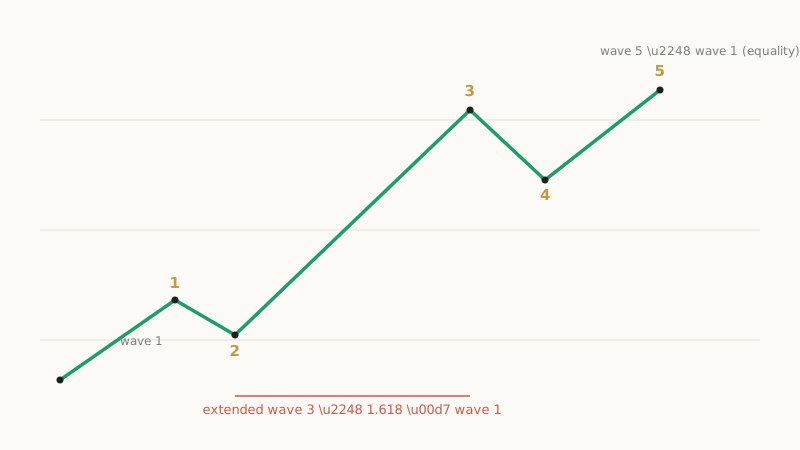
Extensions are where Elliott Wave and Fibonacci work together most productively. An extended third wave commonly reaches a Fibonacci multiple of the first wave's length — most often 1.618, and in especially strong trends 2.618. Measuring wave 1 and projecting those ratios from the end of wave 2 gives a reasoned zone for where the extended third wave may run out of steam.
The most practically valuable relationship, though, is the link between extension and the guideline of equality. When wave 3 is the extended wave, waves 1 and 5 tend toward equality — they finish up roughly the same length, or in a clean Fibonacci proportion to one another. This means that once wave 3 has extended and wave 4 has formed, you can project a likely wave 5 target simply by replicating the length of wave 1 from the end of wave 4. It is one of the cleanest forecasts the framework offers.
Identify the extended wave early and the rest of the structure becomes far more predictable. An extended wave 3 tells you to expect a wave 5 roughly equal to wave 1 — a concrete, measurable target rather than a guess.
Double and triple extensions
Occasionally, an impulse will show more than one extension — a so-called double or triple extension, where, for instance, wave 3 extends and then wave 5 of that extended wave 3 also extends within it. These are most common in powerful, parabolic moves and in the most heavily traded markets. They are harder to count in real time precisely because the nesting of fives within fives multiplies the number of visible legs. The practical defence is the same as always: work from the higher timeframe down, and lean on the rules and Fibonacci proportions to keep the count honest rather than trying to label every wiggle by eye.
Extensions on forex charts
For currency traders, the dominance of third-wave extensions is a gift, because it aligns the highest-probability part of the wave structure with the leg that is easiest to identify and most rewarding to trade. The classic approach is to wait for waves 1 and 2 to form, confirm the structure with the rules, and then position for the extended third wave — the part of the move where momentum, breakouts and follow-through all tend to cooperate. The invalidation is clean: a decisive move below the start of wave 1 (rule 1) says the count is wrong.
A fifth-wave extension deserves more caution. Because it signals exhaustion rather than strength, chasing a blow-off fifth wave on a major pair is how traders get caught at the very top of a move, just before a violent corrective reversal. Treat an extended fifth as a cue to tighten risk and watch for reversal signals, not as an invitation to add. The mechanics of spotting these structures live in time are covered in how to count Elliott waves, and the broader set of proportional tendencies in the rules and guidelines.
How an extension reshapes the whole count
An extension does more than lengthen one leg — it changes how the entire impulse looks and how it must be counted. Because the extended wave subdivides so clearly into its own five sub-waves, a single five-wave impulse with an extended third can present as many as nine distinct swings on a lower timeframe: the five sub-waves of the extended third, plus waves 1, 2, 4 and 5 of the larger degree. To an untrained eye that looks like a chaotic series of advances and pullbacks; to a wave analyst who has identified the extension, it is a single, coherent structure.
This is why pinpointing the extended wave early is so valuable. Once you know wave 3 is extending, you can mentally collapse its internal five sub-waves into a single leg of the higher degree, and the larger 1-2-3-4-5 snaps back into focus. Skip that step and the lower-timeframe noise becomes impossible to organise — which is the root of most extension-related confusion.
The most common extension error
By far the most frequent mistake traders make with extensions is miscounting the sub-waves of the extended wave as the primary impulse. Picture an extended third wave that subdivides into its own (i)-(ii)-(iii)-(iv)-(v). A trader who has not recognised the extension may label those five sub-waves as the main waves 1 through 5, conclude the impulse is complete, and start positioning for a reversal — just as the larger wave 3 finishes and the genuine waves 4 and 5 are still to come. The result is a perfectly valid-looking count that is wrong by an entire degree, and a trade taken in exactly the wrong direction.
The defences are the ones that recur throughout wave analysis. Count from the higher timeframe down so the degree of each wave is anchored before you zoom in. Use the proportions: if your "wave 3" is barely longer than your "wave 1," you may actually be looking at sub-waves of a larger extended wave rather than the real thing. And cross-check with momentum — a genuine larger-degree top usually shows clear momentum divergence, which the mid-point of an extension does not. These checks, applied consistently, keep the count anchored at the right degree and turn extensions from a source of error into a source of edge.
One wave extends, usually the third. An extended wave subdivides into its own clear five. Project it with the 1.618 and 2.618 ratios, expect waves 1 and 5 to be roughly equal when wave 3 extends, and never mistake the sub-waves of an extended wave for the primary impulse — count top down to keep the degree right.