Most of Elliott Wave's structure is governed by the three unbreakable rules, and the strictest of them says wave 4 can never trade into wave 1's price territory. The diagonal is the single, well-defined exception — a wedge-shaped five-wave structure whose sub-waves are permitted to overlap. Because diagonals appear at the very start or the very end of a move, they are among the most actionable patterns in the whole framework: spot one correctly and you have a strong clue about whether a trend is just beginning or about to collapse.
This is a more advanced pattern; if the basic impulse and the three rules are not yet second nature, start with Elliott Wave theory explained and the rules and guidelines first.
Key takeaways
Q: What is a diagonal in Elliott Wave theory?
A: A diagonal is a wedge-shaped, five-wave motive structure whose sub-waves are allowed to overlap — the one exception to the rule that wave 4 cannot enter wave 1's territory. It appears either at the start of a move (leading diagonal) or at its end (ending diagonal).
Q: What is the difference between a leading and ending diagonal?
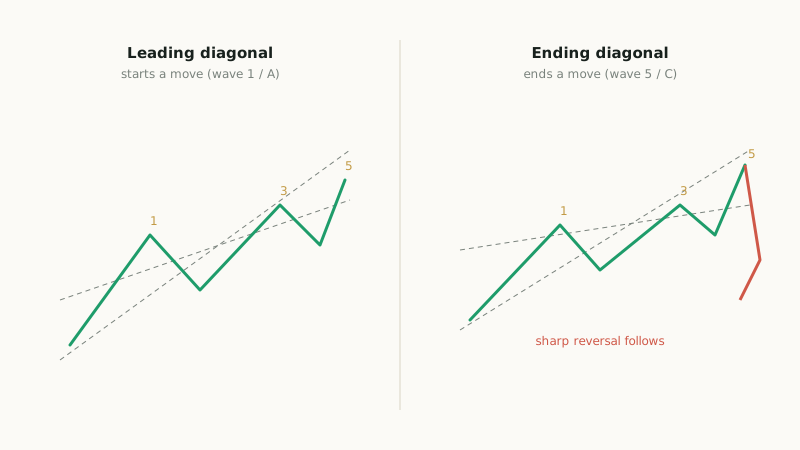
A: A leading diagonal appears in a wave 1 or wave A position and signals the start of a new move. An ending diagonal appears in a wave 5 or wave C position and signals exhaustion, usually followed by a sharp reversal back to where it began.
Q: What does an ending diagonal signal?
A: An ending diagonal warns that a trend is nearly complete even while price is still making new highs. It is typically followed by a swift, deep retracement back toward the start of the diagonal.
The wedge shape and why overlap is allowed
A diagonal is, visually, a wedge — its trendlines converge (in the common contracting form) as the move runs out of room. It still has five sub-waves, labelled 1 through 5, but unlike a standard impulse those sub-waves overlap: wave 4 trades back into the price territory of wave 1. In any other context that overlap would invalidate the count outright. Inside a diagonal it is expected, because the pattern represents a market that is moving directionally but with diminishing force, each push struggling a little more than the last.
In the contracting diagonal, the legs progressively shorten — wave 3 is shorter than wave 1, and wave 5 is shorter than wave 3 — producing the narrowing wedge. The sub-waves themselves typically subdivide into threes rather than fives, another tell that distinguishes a diagonal from a normal impulse. A less common expanding variety widens instead of narrows, but the contracting form is what you will meet most often.
The leading diagonal
A leading diagonal appears at the start of a directional move — in the wave 1 position of an impulse, or the wave A position of a zigzag. It signals that a new move is getting underway, but in a hesitant, overlapping fashion rather than with a clean, powerful first thrust. For a trader, a leading diagonal is an early heads-up that the prior trend may be over and a new one beginning, though the messy structure means confirmation should be sought before committing heavily.
Because it sits at the beginning, a leading diagonal is usually followed by a deeper-than-average wave 2 retracement and then, often, a strong third wave once the new trend finds its feet. The pattern's value is in flagging the turn early; its risk is that overlapping, wedge-like price action can also belong to a correction, so it must be read in the context of the higher-timeframe structure.
The ending diagonal
The ending diagonal is the more famous and, for many traders, the more valuable of the two. It appears at the end of a move — in the wave 5 position of an impulse, or the wave C position of a correction — and it is a sign of exhaustion. After a long trend, the final push struggles to make progress, overlapping and narrowing into a wedge as buyers (in an uptrend) run out of conviction even as price grinds to new highs.
What makes the ending diagonal so useful is what comes after it: a sharp, fast reversal, typically retracing all the way back to where the diagonal began, and often further. The pattern frequently terminates with a brief throw-over — a short spike beyond the upper trendline that traps the last breakout buyers — immediately before the reversal. An ending diagonal is therefore one of the strongest structural warnings available that a trend is on its last legs, delivered while the crowd is still bullish.
A leading diagonal whispers that a move is starting; an ending diagonal shouts that one is finishing. The ending diagonal's reward is its aftermath — a swift retracement back to its origin — which is why traders prize it as a reversal signal.
How the rules adapt inside a diagonal
Diagonals follow modified guardrails rather than the standard impulse rules:
- Wave 4 overlaps wave 1 — this is the defining exception to rule 3 and the feature that confirms you are looking at a diagonal, not an impulse.
- Wave 3 is still never the shortest motive wave.
- Wave 2 still does not retrace beyond the start of wave 1.
- In a contracting diagonal, each motive wave is shorter than the one before, and the boundary lines converge.
The practical upshot is that overlap should never be dismissed. When you see wave 4 trading into wave 1's range, the right question is not "is my count wrong?" but "is this a diagonal?" — because the answer determines whether you are at the start or the end of a move, which could not matter more for a trade.
Trading diagonals on forex
On currency pairs, the ending diagonal is the pattern most worth watching for, because it offers an early read on trend exhaustion before conventional momentum signals confirm it. A wedge forming after an extended trend, with overlapping legs and a possible throw-over, is a cue to tighten risk on trend-following positions and watch for the reversal the pattern so often precedes. The natural invalidation comes from the diagonal's own boundaries: once price reverses back through the lower trendline (in a rising wedge), the structure has done what it tends to do.
Leading diagonals, by contrast, are best used as confirmation that a suspected trend change has begun, to be combined with the broader count rather than traded in isolation. As with every wave pattern, the discipline that matters most is defining the invalidation price in advance — the level at which the diagonal interpretation is simply wrong. The full counting process is in how to count Elliott waves, and extensions, which sit at the opposite end of the momentum spectrum, are covered in Elliott Wave extensions.
Contracting and expanding diagonals
Diagonals come in two geometric forms. The contracting diagonal is by far the more common: its boundary lines converge as the move progresses, because each motive wave is shorter than the one before. Wave 3 is shorter than wave 1, wave 5 shorter than wave 3, and the structure narrows to a point — a visual picture of a trend running out of fuel. The much rarer expanding diagonal does the opposite, with each wave longer than the last and the boundary lines diverging, giving a megaphone shape. Expanding diagonals are unusual enough that, in practice, the contracting form is what you should expect to see and the default you reach for when a wedge appears.
In both forms the sub-waves typically subdivide into threes rather than the fives of a true impulse. That three-based internal structure, combined with the overlap of wave 4 into wave 1, is the combination that confirms you are looking at a diagonal and not a standard motive wave that has simply gone slightly wrong.
The throw-over and the reversal
Ending diagonals frequently finish with a throw-over — a brief, sharp spike of wave 5 beyond the upper boundary line of the wedge (in a rising diagonal). The throw-over is a final trap: it pulls in breakout traders who read the move beyond the trendline as a fresh bullish signal, precisely at the moment the structure is exhausting. When the throw-over fails and price snaps back inside the wedge, it is often the trigger for the rapid reversal the ending diagonal is known for. Watching for a throw-over that fails to hold is therefore one of the more precise timing tools the pattern offers, though it should always be read alongside the broader count rather than traded on its own.
The reversal that follows an ending diagonal tends to be fast and to retrace a large portion of the entire structure that the diagonal terminated — not merely the diagonal itself. That is what makes correctly identifying an ending diagonal so valuable: it warns of an outsized move in the opposite direction while the prevailing sentiment is still pointing the other way.
Diagonal versus triangle
Diagonals are sometimes confused with triangles, since both are converging, wedge-like shapes. The distinction matters because they mean opposite things. A triangle is a corrective, sideways pattern of five overlapping legs (A-B-C-D-E) that appears in a wave 4 or wave B position and signals a pause before the trend continues. A diagonal is a directional, motive-type pattern of five legs that appears at the start (leading) or end (ending) of a move. Position is the giveaway: a wedge in the middle of a structure, going sideways, is most likely a triangle; a wedge at the very beginning or very end of a directional move is a diagonal. Reading that context correctly tells you whether to expect continuation or reversal.
Diagonals are wedge-shaped fives where wave 4 may overlap wave 1 — the one exception to rule 3. Leading diagonals start moves; ending diagonals finish them, often with a failed throw-over, and are followed by sharp reversals. Most are contracting; and a wedge's position distinguishes a diagonal from a corrective triangle.