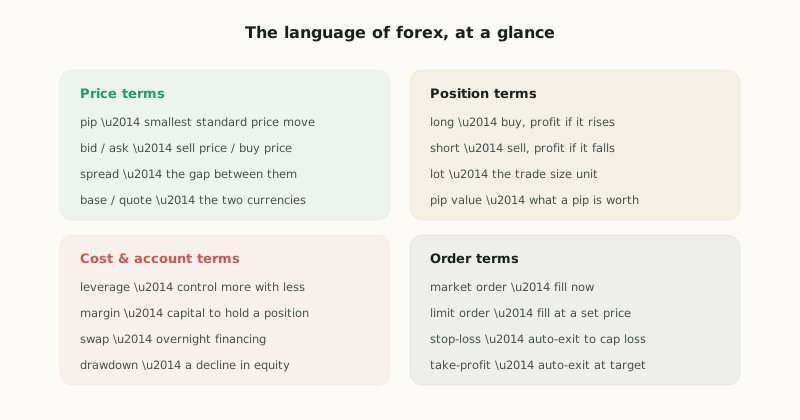
Every field has its jargon, and forex has plenty — pips, spreads, lots, leverage, swaps. For a beginner, the unfamiliar vocabulary can make trading seem more complicated than it is. This glossary defines the essential forex terms in plain English, grouped into categories so you can build a clear mental map of how the pieces fit together: the terms describing price, those describing your position, those describing costs and your account, and those describing orders. Each is explained simply here and, where it deserves more depth, covered in its own dedicated guide. Keep this page bookmarked as a quick reference as you learn.
It complements the foundational what is forex trading, reading a quote and pips, lots and leverage guides, which go deeper on the key concepts.
Key takeaways
Q: What is a pip in forex?
A: A pip is the smallest standard unit of price movement in a currency pair. For most pairs it is the fourth decimal place (0.0001); for pairs involving the Japanese yen it is the second decimal place (0.01). Pips are how traders measure price changes, gains and losses.
Q: What is the difference between bid and ask?
A: The bid is the price at which you can sell a currency pair; the ask (or offer) is the price at which you can buy it. The ask is slightly higher than the bid, and the difference between them is called the spread — effectively a cost of trading.
Q: What does going long or short mean?
A: Going long means buying a pair, expecting it to rise (you profit if the price goes up). Going short means selling a pair, expecting it to fall (you profit if the price goes down). In forex you can profit from both rising and falling markets.
The essential terms
If you learn only a handful of terms to begin with, make it these — the words you will meet in almost every discussion of forex.
Core terms quick reference
| Term | Plain-English meaning |
|---|---|
| Pip | Smallest standard price move (usually the 4th decimal) |
| Spread | The gap between the buy and sell price — a cost |
| Lot | The unit of trade size |
| Leverage | Controlling a larger position with less capital |
| Margin | The capital required to hold a leveraged position |
| Long / Short | Buying (bet it rises) / selling (bet it falls) |
| Stop-loss | An order that auto-exits to cap a loss |
Price and quote terms
These describe how prices are shown and measured. A currency pair is the thing you trade — two currencies quoted against each other, such as EUR/USD. The first currency is the base currency and the second is the quote (or counter) currency; the price tells you how much of the quote currency one unit of the base is worth (the full mechanics are in the reading-a-quote guide). The exchange rate (or quote) is that price. A pip is the smallest standard unit of price movement — for most pairs the fourth decimal place (0.0001), and for pairs involving the Japanese yen the second decimal place (0.01); pips are how price changes, gains and losses are measured. A pipette (or fractional pip) is a tenth of a pip, the fifth decimal place, shown by some brokers for finer pricing.
Every quote has two prices. The bid is the price at which you can sell the pair; the ask (or offer) is the price at which you can buy it. The ask is always slightly higher than the bid, and the difference between them is the spread — which, because you buy at the higher ask and sell at the lower bid, is effectively a cost you pay on every trade (covered in the cost-of-trading guide). Related terms you'll hear: volatility (how much and how fast a price moves — high volatility means large, rapid swings), and liquidity (how easily a pair can be traded without moving its price — major pairs are highly liquid, exotic ones less so). Together these price terms let you read and discuss what a currency is doing.
Position and size terms
These describe the trade you take and its size. To go long is to buy a pair, expecting (and profiting if) it rises; to go short is to sell a pair, expecting (and profiting if) it falls. A key feature of forex is that you can profit from both rising and falling markets — long when you're bullish, short when you're bearish. A position is simply an open trade you currently hold; your entry is the price at which you opened it and your exit the price at which you close it.
Trade size is measured in lots. A standard lot is 100,000 units of the base currency; a mini lot is 10,000 units; a micro lot is 1,000 units; and some brokers offer even smaller sizes (the account-types guide covers these tiers). Smaller lot sizes let beginners trade with less capital and smaller risk. The pip value is how much one pip of movement is worth in money for your position — it depends on your lot size (a larger position means each pip is worth more), and it's what turns a price move in pips into a profit or loss in pounds or dollars. Understanding lots and pip value is the basis of position sizing — deciding how large a trade to take for a given risk. The spread (defined above) and these position terms together describe what you're trading and how big.
Cost, account and order terms
The final groups cover the costs and account mechanics, and the order types you'll use. On costs and account: leverage is the ability to control a larger position than your capital alone would allow, expressed as a ratio (e.g. 1:100 means controlling a position 100 times your capital) — it amplifies both gains and losses, and its excess (overleverage) is a major danger. Margin is the capital your broker requires you to put up to open and hold a leveraged position (a deposit against the trade), and a margin call is the broker's demand for more funds (or automatic closure of positions) when your account equity falls too low to support your open trades — both covered in the margin guide. Swap (or rollover) is the small overnight financing charge or credit applied to positions held past the daily rollover time, based on the interest-rate difference between the two currencies (the cost-of-trading guide explains it). Drawdown is a decline in your account equity from a peak — a normal part of trading that the risk and psychology sections address. A bull market is a rising one and a bear market a falling one.
On orders (the full detail is in the order-types guide): a market order executes immediately at the current available price; a limit order executes only at a specified price better than the current one (e.g. buy lower, or sell higher, than now); a stop order executes when the price reaches a specified level. The most important order for risk management is the stop-loss — an order that automatically closes a losing trade at a predetermined level to cap your loss — paired often with a take-profit, which automatically closes a winning trade at your target. These order types are the tools you use to enter, exit and protect trades. With these four groups of terms — price, position, cost/account and orders — you have the essential vocabulary of forex, enough to read the guides across this site and follow any discussion of trading. As you progress, each term's dedicated guide will deepen your understanding, but this glossary gives you the map; refer back to it whenever a word trips you up, and the language of forex will quickly become second nature.
More terms worth knowing
Beyond the core vocabulary, a handful of further terms come up constantly and are worth knowing as you progress. On analysis: technical analysis is studying price charts and patterns to inform trades, while fundamental analysis is studying economic factors (interest rates, data, central banks) that drive currency value — the two main approaches, each with its own section on this site. Support is a price level where falling prices have tended to stop and bounce; resistance is a level where rising prices have tended to stall — key reference levels in technical analysis. A trend is a sustained directional move (up or down); a range is sideways movement between support and resistance; a breakout is price moving decisively out of a range or through a level.
On your account: balance is your account's cash before open trades are counted; equity is your balance plus or minus the running profit/loss of open positions (your real-time account value); free margin is the equity available to open new positions after the margin used by current ones. On trading styles (each covered in the strategies section): scalping means very short-term trades for tiny profits; day trading means trades opened and closed within a day; swing trading means holding for days to weeks; position trading means holding for weeks to months. A few more: hedging is holding offsetting positions to reduce risk; risk-reward ratio compares a trade's potential profit to its potential loss; expectancy is the average result you can expect per trade over many trades; and risk management — controlling how much you can lose — is the discipline that underpins everything. You won't need every term at once, and each has a fuller guide elsewhere on the site; but recognising them removes the last of the jargon barrier, letting you read and learn freely. Return to this glossary whenever an unfamiliar word appears, and the vocabulary will steadily become your own.
The core forex vocabulary falls into four groups. Price: currency pair (base/quote), pip (smallest standard move), bid (sell) and ask (buy), spread (the gap — a cost), volatility, liquidity. Position: long (buy, bet it rises), short (sell, bet it falls), lot (size unit: standard 100k, mini 10k, micro 1k), pip value. Cost/account: leverage (control more with less), margin (capital to hold a position), margin call, swap (overnight financing), balance/equity/free margin, drawdown. Orders: market (fill now), limit (fill at a set better price), stop-loss (auto-exit to cap loss), take-profit. Plus analysis terms (technical/fundamental, support/resistance, trend, range, breakout) and style terms (scalping, day, swing, position trading). Bookmark this and refer back — the jargon becomes second nature fast.