Knowing what to trade is only half the battle; knowing how to enter and exit is the other half, and it comes down to order types. An order is an instruction to your broker to buy or sell, and the different types control different things — some control the price you get, some control the timing of execution, and some manage your exit. Using the right order for the situation is the difference between a plan cleanly executed and one missed or mis-filled. This guide explains the main order types — market, limit and stop orders — along with stop-losses, take-profits and trailing stops, and when to use each.
This builds on the mechanics in how a forex trade works and underpins the risk management of setting a stop-loss.
Key takeaways
Q: What are the main forex order types?
A: The main order types are market orders (execute immediately at the current price), limit orders (execute at a specified price or better), and stop orders (trigger at a specified level, used for breakouts or as stop-losses). Stop-loss and take-profit orders close positions at preset loss or profit levels.
Q: What is the difference between a limit order and a stop order?
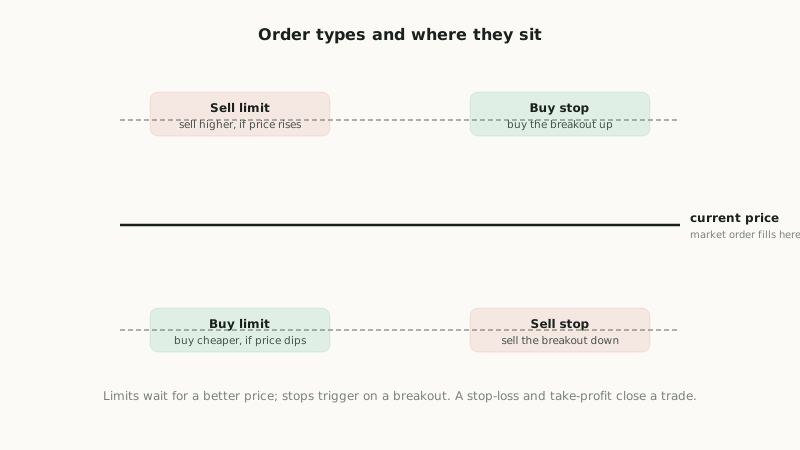
A: A limit order seeks a better price: a buy limit sits below the current price, a sell limit above. A stop order triggers on momentum: a buy stop sits above the current price (to catch an upside breakout), a sell stop below. Limits wait for a better price; stops trigger as price moves through a level.
Q: What is a stop-loss order?
A: A stop-loss is an order that automatically closes a position once it reaches a specified loss level, capping the loss on a trade. It is a fundamental risk-management tool that removes the need to watch a position constantly and enforces a predefined exit if the trade goes wrong.
Market orders
A market order is the simplest order type: an instruction to buy or sell immediately at the best available current price. When you place a market order, you are prioritising execution — getting into or out of the trade right now — over controlling the exact price. The trade fills almost instantly at whatever the current market price is.
The trade-off is that you accept the prevailing price, whatever it happens to be, including any slippage — the small difference between the price you saw and the price you actually got, which can occur in fast-moving markets or thin liquidity. Market orders are ideal when getting filled now matters more than getting a precise price: entering a trade you want immediately, or exiting a position quickly. For most straightforward entries and exits in liquid conditions, the market order is the workhorse — fast, simple, and certain to fill, at the cost of accepting the current price. The key understanding is that a market order controls execution (you will get filled) but not price (you take what the market offers).
Limit orders
A limit order flips the priority: it controls the price at the cost of certain execution. A limit order is an instruction to buy or sell at a specified price or better — it will only fill at your chosen price or one more favourable, never worse. This lets you wait for a better price than the current one, rather than accepting whatever is on offer now.
The placement depends on direction. A buy limit is placed below the current price — you want to buy, but cheaper, so the order waits for price to dip to your level. A sell limit is placed above the current price — you want to sell, but higher, so it waits for price to rise to your level. Limit orders are used to enter at favourable prices — for instance, a trend follower placing a buy limit at a support level to catch a pullback, getting a better entry than buying at market. The trade-off is that a limit order is not guaranteed to fill: if price never reaches your level, the order simply never executes, and you miss the trade. So a limit order controls price (you get your price or better) but not execution (it may never fill). It is the order of patience, waiting for the market to come to you.
Stop orders
A stop order (or stop-entry order) triggers a trade when price reaches a specified level, and it is placed in the opposite configuration to a limit order — which often confuses beginners. A buy stop is placed above the current price, and a sell stop below it. When price reaches the stop level, the order triggers (typically becoming a market order) and executes.
Why buy above the current price or sell below it? Because stop orders are designed for breakouts and momentum. A buy stop above price says "buy if price rises to this level" — used to enter an upside breakout, joining the move once price has confirmed it by breaking through. A sell stop below says "sell if price falls to this level" — to enter a downside breakout. This is the opposite logic to limit orders: where a limit waits to buy a dip (a better price), a stop waits to buy a breakout (confirmation of strength). Breakout traders use stop orders to enter automatically as price clears a level, capturing the move without having to watch and react manually. A stop order thus triggers on momentum through a level, the natural tool for breakout entries described in the breakout strategies guide.
The three entry orders control different things: a market order controls execution (fills now, any price), a limit controls price (your price or better, may not fill), and a stop triggers on a breakout through a level. Limits sit on the "better price" side (buy below, sell above); stops sit on the "breakout" side (buy above, sell below). Mixing them up is a classic beginner error.
Stop-loss and take-profit
Two special order types manage your exit, and they are essential for disciplined trading. A stop-loss order automatically closes your position once it reaches a specified loss level, capping how much you can lose on the trade. It is, mechanically, a stop order placed against your position — a sell stop below a long position, or a buy stop above a short. The stop-loss is the cornerstone of risk management: it predefines and enforces your exit if the trade goes wrong, removing the need to watch constantly and, crucially, removing the emotional temptation to "give it more room" as a loss grows. Setting stop-losses properly is covered in depth in the dedicated guide.
A take-profit order is the mirror: it automatically closes your position once it reaches a specified profit level, locking in your target gain. Mechanically it is a limit order placed against your position. Together, a stop-loss and a take-profit let you define both your exits in advance when you enter — your maximum loss and your profit target — so the trade is fully planned and can manage itself without your constant attention. This pairing embodies the risk-reward thinking from the risk management section: you know your potential loss (to the stop) and potential gain (to the take-profit) before you enter, and can ensure the reward justifies the risk. Setting both on entry is a hallmark of disciplined, planned trading.
Trailing stops and combinations
A trailing stop is a dynamic stop-loss that follows price at a set distance as the trade moves in your favour, locking in profit while leaving room to run. In a long position, the trailing stop ratchets up as price rises (but never moves down), so a rising trade continually protects more profit; it only closes the position when price reverses by the trailing distance. The trailing stop is the key tool for riding a trend described in the trend-following guide — it lets winners run while automatically protecting accumulating gains, embodying "cut losses short, let winners run" in a single order.
Brokers also offer order combinations and conditions worth knowing. An OCO (one-cancels-other) pairs two orders so that if one fills, the other cancels — useful for bracketing a position with both a stop-loss and a take-profit. Time conditions like GTC (good-till-cancelled) keep an order active until you cancel it, while others expire at day's end. The full set of order types gives you precise control over entries, exits and risk: market orders for immediate execution, limits for better entry prices, stops for breakouts, stop-losses and take-profits to define exits, and trailing stops to ride trends. Mastering them turns your trading plan into precise, executable instructions — and using the right order at the right moment is a foundational practical skill that lets you implement everything else this site teaches.
Common order-type mistakes
A few order-type mistakes catch beginners repeatedly, and knowing them helps you avoid expensive errors. The most common is confusing limit and stop orders — placing a buy limit when you meant a buy stop, or vice versa. Because they sit on opposite sides of the current price (limit buys below, stop buys above), mixing them up produces the opposite of what you intended: you might end up buying a breakout you meant to fade, or waiting for a dip when you meant to catch a breakout. The fix is to remember the logic: limits seek a better price (buy lower, sell higher), stops trigger on a breakout (buy higher, sell lower).
A second, more serious mistake is trading without a stop-loss — opening a position with no predefined exit if it goes wrong. This violates the most basic risk-management discipline and leaves you exposed to large, uncontrolled losses and the emotional paralysis of watching a loss grow while you hope for a reversal. Setting a stop-loss on every trade, ideally when you enter, is non-negotiable. A related error is relying on a mental stop ("I'll close it if it hits X") rather than an actual stop-loss order — mental stops are routinely abandoned under emotional pressure, which is exactly when you need them.
Finally, beginners sometimes misuse market orders in thin or fast markets, getting unexpectedly poor fills from slippage — for instance, placing a market order right as major news hits, when spreads blow out and prices gap. In such conditions, the certainty of a market-order fill comes at the cost of a potentially bad price. Awareness of when slippage is likely (illiquid hours, around news) helps you choose orders wisely. None of these mistakes is complicated to avoid; they simply require understanding what each order does and applying the risk discipline the rest of the site teaches — especially the iron rule of always using a real stop-loss.
Market orders fill immediately at the current price (control execution, not price). Limit orders seek a better entry — buy limit below, sell limit above (control price, may not fill). Stop orders trigger on a breakout — buy stop above, sell stop below. A stop-loss closes a losing trade at a preset level (essential and non-negotiable); a take-profit locks in a target; a trailing stop rides a trend. Avoid the classic errors: confusing limits and stops, trading without a real stop-loss, and market orders in thin or news-driven markets.