You have opened a broker account and you are looking at a price for EUR/USD. What actually happens when you click "buy" — and how do you end up with a profit or a loss? This guide walks through the mechanics of a forex trade from start to finish: choosing a direction, the prices you trade at, how your profit or loss is calculated, and a clear worked example. Along the way we will cover the feature that most surprises newcomers: in forex, you can profit just as easily when the market falls as when it rises.
This builds directly on the foundations in what is forex trading, and uses the units explained in pips, lots and leverage.
Key takeaways
Q: How does a forex trade make money?
A: A forex trade profits from a change in the exchange rate in your favour. If you buy a pair and it rises, or sell a pair and it falls, you profit by the size of the move multiplied by your position size. If it moves against you, you lose by the same calculation.
Q: What does going long or short mean in forex?
A: Going long means buying a pair because you expect the base currency to strengthen against the quote currency. Going short means selling a pair because you expect the base currency to weaken. In forex, shorting is as natural as buying, so you can profit in either direction.
Q: What is the bid-ask spread?
A: The bid is the price at which you can sell a pair and the ask is the price at which you can buy it. The ask is always slightly higher than the bid, and the difference — the spread — is a cost of trading that you pay on entering a position.
Choosing a direction: long or short
Every forex trade starts with a choice of direction, because every pair can be traded two ways. If you expect the pair to rise — the base currency to strengthen against the quote currency — you go long, which simply means you buy. If you expect the pair to fall — the base currency to weaken — you go short, which means you sell. Going long on EUR/USD is a bet that the euro will gain on the dollar; going short is a bet that it will lose ground.
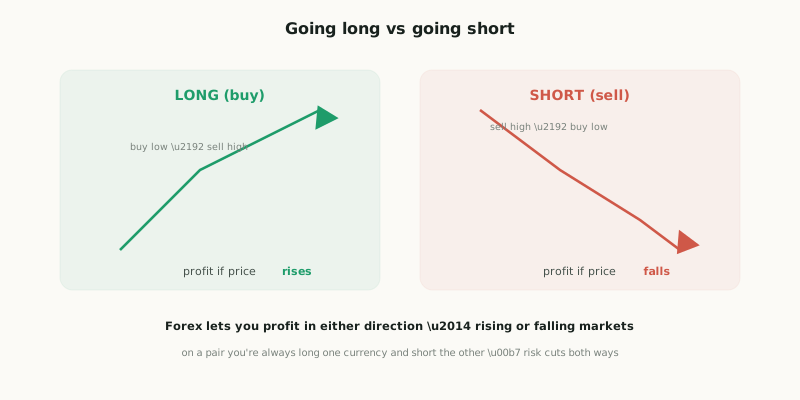
The ability to go short as naturally as going long is one of forex's most useful features, and a point of confusion for those new to markets. "How can I sell something I don't own?" is the common question. The answer is that, because every trade is an exchange of one currency for another, selling a pair is simply buying the quote currency with the base currency — a perfectly natural transaction. Practically, your broker lets you open a short position with a click, and you profit if the pair falls: you are effectively selling high and aiming to buy back lower. This means a forex trader is never stuck waiting for rising markets — there is opportunity whether currencies are climbing or falling.
The bid, the ask and the spread
When you look at a forex price, you will actually see two prices, very close together: the bid and the ask. The bid is the price at which you can sell the pair (the price the broker will buy it from you), and the ask (sometimes called the offer) is the price at which you can buy the pair (the price the broker will sell it to you). The ask is always slightly higher than the bid — you buy at the higher price and sell at the lower one.
The difference between the bid and ask is the spread, and it is one of the main costs of trading. Because you enter a long trade at the ask (higher) and would exit at the bid (lower), you start every trade at a tiny disadvantage equal to the spread — the price has to move in your favour by at least the spread just for you to break even. On liquid major pairs the spread is very small (often a fraction of a pip to a pip or two), which is one reason beginners are steered toward the majors. The spread is how many brokers are compensated, and minimising it is part of why broker choice matters, as covered in how to choose a forex broker.
How profit and loss are calculated
Your profit or loss on a trade is determined by three things: the direction you chose, the distance the price moved, and the size of your position. The distance is measured in pips (the standard unit of price movement), and the value of each pip depends on your position size in lots, as detailed in the pips and lots guide. The basic principle is simply: profit or loss = the number of pips the price moved in your favour (or against you) × the value per pip of your position.
For a long trade, you profit if the price rises (you bought low and the pair is now worth more) and lose if it falls. For a short trade, the reverse: you profit if the price falls and lose if it rises. The further the price moves in your direction, the larger the profit; the further against you, the larger the loss — which is precisely why a pre-defined stop loss is essential, to cap that loss at a known amount. The position size (your lot size) acts as a multiplier on everything: the same 50-pip move is worth far more on a standard lot than on a micro lot, which is why position sizing is the heart of risk management.
You always buy at the ask and sell at the bid, so every trade begins fractionally in the red by the size of the spread. The market must move in your favour by at least the spread just to reach breakeven — a small but real reason to favour liquid pairs with tight spreads.
A worked example
Let us walk through a complete long trade. You believe the euro will strengthen against the dollar, so you decide to go long EUR/USD. The current quote is bid 1.0849 / ask 1.0851, so you buy at the ask: 1.0851. Suppose you trade one mini lot (10,000 units), where each pip is worth roughly $1.
Now two scenarios. In the winning scenario, the euro strengthens as you expected, and the pair rises to a bid of 1.0901. You close your long by selling at the bid, 1.0901. The price moved from your entry of 1.0851 to 1.0901 — a gain of 50 pips — so at roughly $1 per pip on a mini lot, you have made about $50. In the losing scenario, the euro weakens instead, and the pair falls to a bid of 1.0801. If your stop loss is there, you exit at 1.0801, a move of 50 pips against you, for a loss of about $50. The mechanics are identical in both directions: the pips moved, multiplied by the pip value, gives the result — positive when price moves your way, negative when it moves against you. A short trade works exactly the same way in reverse: you would sell at the bid to open and buy at the ask to close, profiting if the price fell.
Opening and closing positions
In practice, you manage all of this through your broker's platform. To enter, you can use a market order (execute immediately at the current price) or a limit/pending order (execute only when price reaches a level you specify). Once in a trade, you typically attach a stop-loss order (which closes the trade automatically at a predetermined loss level, capping your risk) and often a take-profit order (which closes it automatically at your target). These orders let you pre-define your exit points — the pre-commitment that is so vital both to risk management and to trading psychology.
A position remains open, its profit or loss fluctuating with the live price, until it is closed — either by you manually, by your stop or take-profit being hit, or (for longer holds) affected by small overnight financing adjustments called swap. When the position closes, the profit or loss is realised and reflected in your account balance. That is the full life cycle of a trade: choose a direction, enter at the bid or ask, manage the position with stop and target orders, and close for a realised profit or loss. Everything else on this site — the analysis, the strategies, the risk and psychology — is ultimately about making that simple cycle profitable over many repetitions.
Common beginner mistakes
Understanding the mechanics of a trade is one thing; avoiding the errors that sink most beginners is another. A few mistakes recur so reliably that naming them is worthwhile. The first and most damaging is trading without a stop loss — entering a position with no predefined exit, leaving the loss open-ended. A single trade left to run against you can erase a large part of an account; every trade should have a stop decided before entry, as covered throughout the risk management section.
The second is oversizing — taking a position too large for the account, usually by overusing leverage, so that a normal adverse move inflicts an outsized loss. The disciplined fix is to risk only a small, fixed fraction (commonly 1%) of the account per trade and size the position accordingly, rather than trading as large as the leverage allows. The third is ignoring the spread and costs, especially by trading very frequently or on illiquid pairs where wide spreads quietly erode results; favouring liquid major pairs and trading selectively keeps costs in check.
The fourth is emotional: chasing losses by immediately trying to win back a loss with a larger, impulsive trade — the revenge-trading spiral that destroys accounts faster than any single bad trade. After a loss, the right response is to step away, not to double down. None of these mistakes is about market analysis; all are about discipline and risk control, which is precisely why the risk management and trading psychology sections of this site matter as much as the analytical ones. A beginner who simply avoids these four errors — always uses a stop, never oversizes, respects costs, and never chases — is already ahead of the majority.
Go long (buy) if you expect a pair to rise, or short (sell) if you expect it to fall — in forex, profiting from a fall is as natural as from a rise. You buy at the ask and sell at the bid; the gap between them, the spread, is a cost you pay on entry. Profit or loss = pips moved × pip value (set by your lot size). Use stop-loss and take-profit orders to pre-define exits, and avoid the classic beginner mistakes: no stop, oversizing, ignoring costs, and chasing losses.