Your broker holds your money and executes every trade you make, which makes choosing one more consequential than almost any other early decision a trader faces. A good broker is a reliable, well-regulated gateway to the market; a bad one can cost you through poor execution, hidden charges, or — in the worst cases — by simply being untrustworthy with your funds. Yet many beginners pick a broker based on a flashy advert or a generous-sounding bonus, which is exactly the wrong basis. This guide explains what actually matters, starting with the one factor that outweighs all the others, and the red flags that signal a broker to avoid.
This is the practical first step toward trading the market described in what is forex trading, and it connects to the cost considerations in how a forex trade works. Note that this guide is educational and does not recommend any specific broker.
Key takeaways
Q: What is the most important factor in choosing a forex broker?
A: Regulation is the most important factor. A broker regulated by a reputable authority is required to follow rules that protect clients, such as keeping client funds in segregated accounts. An unregulated broker offers no such protections, so regulation should be the first thing you check.
Q: What should I look for in a forex broker?
A: Look for strong regulation first, then competitive and transparent spreads and fees, reliable fast execution, a solid trading platform, suitable account types and minimum deposits, and easy deposits and withdrawals. Good customer support and a demo account are valuable too.
Q: What are red flags when choosing a forex broker?
A: Warning signs include no credible regulation, offshore-only registration, promises of extremely high leverage, 'guaranteed' returns or large bonuses with restrictive conditions, difficulty withdrawing funds, and pressure to deposit quickly. These suggest a broker to avoid.
Regulation comes first
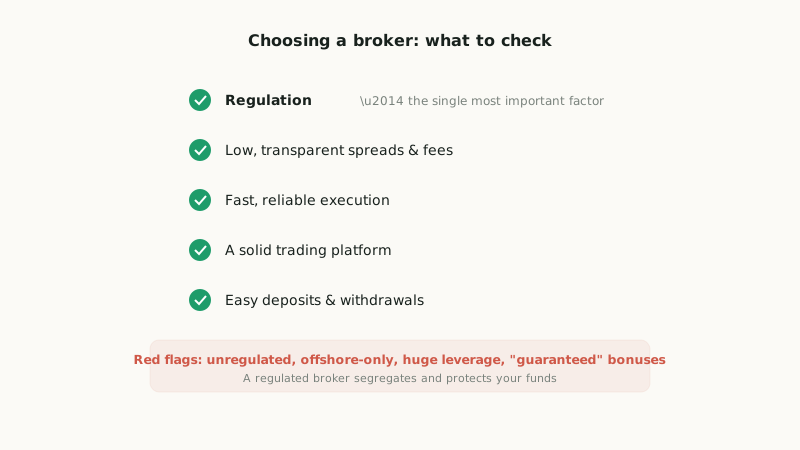
Before anything else — before spreads, platforms, or features — check that a broker is regulated by a reputable authority. This is the single most important factor, because regulation is what protects your money. Regulated brokers are required to follow rules designed to safeguard clients: most importantly, keeping client funds in segregated accounts (separate from the firm's own money, so your funds are protected if the broker fails), maintaining adequate capital, and adhering to fair-dealing and transparency standards. An unregulated broker is bound by none of this, and entrusting your money to one is a serious risk no potential benefit can justify.
Reputable regulators include bodies such as the FCA in the United Kingdom, ASIC in Australia, CySEC in Cyprus (within the EU framework), and the NFA and CFTC in the United States, among others. A trustworthy broker will state its regulation clearly and verifiably, and you can confirm registration on the regulator's own website. Be aware that some brokers are regulated only in lightly-supervised offshore jurisdictions, which offers far weaker protection than a top-tier regulator. The rule for beginners is simple and non-negotiable: only consider brokers regulated by a credible authority, ideally a well-known one, and verify it yourself rather than taking the broker's word for it. Everything else is secondary to this.
Spreads, commissions and costs
Once regulation is established, trading costs are the next major consideration, because they are paid on every single trade and compound significantly over time. The main cost is usually the spread — the gap between the bid and ask prices — and tighter spreads mean lower costs. Some brokers offer very tight or zero spreads but charge a separate commission per trade instead; others build their entire fee into a wider spread with no separate commission. Neither model is inherently better; what matters is the total cost of trading, combining spread and any commission.
Look also for transparency in costs: a good broker is clear about its spreads, commissions, and any other charges, while a poor one obscures them. Watch for less-obvious costs too, such as overnight financing (swap) charges on positions held overnight, inactivity fees, and deposit or withdrawal charges. For a beginner trading major pairs, competitive and transparent spreads on those pairs are the priority. Because costs directly erode your results, comparing the genuine all-in cost of trading across regulated brokers is well worth the effort — but always as a secondary filter after regulation, never as a reason to choose an unregulated broker with tempting spreads.
Execution and platform
Execution quality — how reliably and quickly your orders are filled at the prices you expect — is the next factor. Poor execution shows up as frequent slippage (orders filled at worse prices than requested), requotes, or delays, all of which cost money and frustration, especially in fast markets. A good broker offers fast, reliable execution with minimal slippage under normal conditions. This is harder to assess in advance than costs, but reviews, a demo account, and the broker's reputation among established traders give useful signals.
The trading platform is the software you will use every day, so it should be stable, capable and comfortable for you. Many brokers offer well-known third-party platforms such as MetaTrader 4 or 5, or cTrader, while others provide their own proprietary platforms; some offer several. Consider whether the platform has the charting tools, order types and reliability you need, and whether it is available on the devices you use (desktop, web, mobile). A demo account — which most reputable brokers offer — lets you test both the platform and the broker's general experience risk-free with virtual money, and using one is strongly advisable before committing real funds, both to evaluate the broker and to practise trading.
Sort the factors in the right order: regulation is a pass/fail gate — fail it and nothing else matters, however attractive. Only among properly regulated brokers do costs, execution and platform become the deciding factors. A great spread at an unregulated broker is not a bargain; it is bait.
Accounts, funding and support
Several practical factors round out the decision. Account types and minimum deposit matter for matching a broker to your situation — some require substantial minimums, while others allow small starting deposits and micro-lot trading, which suits beginners wanting to start small. Check the leverage offered, bearing in mind that regulated brokers in many regions cap retail leverage (often at 30:1 on majors) precisely for your protection; extremely high leverage is a feature to be wary of rather than to seek out.
Deposits and withdrawals should be straightforward, with reasonable methods, fees and processing times — and crucially, withdrawing your money should be easy. Difficulty withdrawing funds is one of the most serious warning signs about a broker. Finally, responsive customer support is valuable, particularly when you are new and may have account or platform questions; test it before committing if you can. None of these factors should override regulation, but among well-regulated brokers they help you find the one that best fits how you intend to trade.
Red flags to avoid
Just as important as knowing what to look for is recognising what to avoid. Several red flags reliably signal a broker to steer clear of. The first is no credible regulation, or regulation only in an obscure offshore jurisdiction — by far the most serious warning. The second is the promise of extremely high leverage (hundreds-to-one), which appeals to inexperience while exposing traders to ruin. The third is "guaranteed" returns or large bonuses, often with restrictive conditions attached; legitimate brokers do not guarantee profits, and aggressive bonus offers frequently come with strings that trap your deposit.
Further warning signs include difficulty or delays withdrawing funds (a classic sign of trouble), high-pressure tactics urging you to deposit quickly or deposit more, opaque or hidden fees, and a general lack of transparency about who the company is and where it is regulated. If a broker exhibits these, no spread or feature is worth the risk. The safest approach for a beginner is conservative: choose a well-established, top-tier-regulated broker with transparent costs and a solid platform, test it with a demo account and a small initial deposit, and treat any red flag as a reason to walk away. Your broker is the foundation everything else is built on — it is worth getting right.
Dealing desk and no-dealing-desk brokers
As you compare brokers you may encounter terms describing how they execute trades, and a basic grasp helps you understand what you are dealing with — though for a beginner at a well-regulated broker, it is a secondary concern. Brokers broadly fall into two execution models. A dealing desk broker (often called a market maker) takes the other side of your trades itself, effectively creating the market for you rather than passing your order to the wider market. A no-dealing-desk broker (often described as STP or ECN) instead routes your orders through to external liquidity providers — banks and other institutions — rather than taking the opposite position itself.
The distinction is sometimes presented as a stark ethical divide, but the reality is more measured. A market maker has a potential conflict of interest, since it may profit when clients lose; however, reputable, well-regulated market makers manage this fairly and offer perfectly good service, often with fixed spreads and reliable fills on small accounts. No-dealing-desk brokers avoid that particular conflict and typically offer variable spreads that can be very tight in liquid conditions, usually with a separate commission. Neither model is universally "better" — each has trade-offs in spreads, commissions and execution.
For a beginner, the practical takeaway is reassuring: regulation matters far more than execution model. A well-regulated broker of either type, with transparent costs and reliable execution, is a sound choice, while an unregulated broker is to be avoided regardless of how it claims to execute trades. As you gain experience and your priorities sharpen — perhaps wanting the tightest possible variable spreads, or preferring fixed spreads for predictability — the execution model becomes a more meaningful factor to weigh. Early on, treat it as useful background rather than a decisive criterion, and keep regulation, total cost and reliability at the front of your decision.
Choose a broker in the right order: regulation by a credible authority first (it protects your funds) — a pass/fail gate. Then compare total trading costs (spreads plus commissions), execution quality, the platform, account types, leverage, and ease of deposits and withdrawals, testing with a demo. Execution models (dealing desk/market maker vs no-dealing-desk STP/ECN) are useful background but secondary to regulation for beginners. Avoid the red flags: no real regulation, sky-high leverage, "guaranteed" returns, withdrawal problems and pressure tactics. This guide is educational, not a recommendation of any specific broker.