Here is the uncomfortable truth that every lasting trader eventually internalises: you cannot control whether a trade wins. The market will do what it does, and even the best analysis is wrong a great deal of the time. What you can control — completely — is how much you lose when a trade goes against you. That single distinction is the entire foundation of risk management, and mastering it matters more than any entry signal, any pattern, any theory covered elsewhere on this site. This guide explains why risk management is the most important skill in trading, and the core principles that make it work.
Every strategy and pattern across this site has ended with the same refrain — "with a defined stop and sensible position size." This is the cluster that explains what that actually means and why it is non-negotiable.
Key takeaways
Q: What is risk management in trading?
A: Risk management is the practice of controlling how much you can lose on any trade and across your account, through position sizing, stop losses and risk-reward planning. Its goal is capital preservation — ensuring no single trade or losing streak can end your ability to keep trading.
Q: Why is risk management more important than strategy?
A: Because you cannot control whether any individual trade wins, but you can control how much you lose when it doesn't. A strong strategy with poor risk management can blow up an account, while a modest strategy with strong risk management survives — and only survivors get to compound.
Q: What is the 1% rule in trading?
A: The 1% rule is a common risk management guideline: risk no more than 1% (some use up to 2%) of your account on any single trade. It ensures that even a long losing streak causes only a manageable drawdown rather than a catastrophic loss.
Why it matters more than anything else
It is natural for new traders to obsess over entries — the perfect signal, the ideal pattern, the winning strategy — and to treat risk management as a boring afterthought. This is exactly backwards. The reason is simple: trading outcomes are probabilistic. No strategy wins every time; losing trades and losing streaks are not failures of analysis but an inevitable, statistical feature of trading. Given that losses are guaranteed to occur, the question that actually determines your survival is not "how often do I win?" but "how much do I lose when I lose, and can I survive a bad run?"
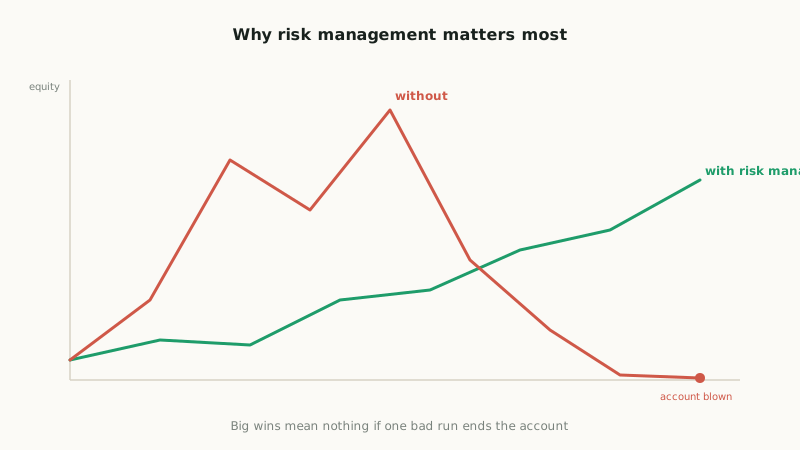
This is why a trader with a brilliant strategy and poor risk management can blow up an account, while a trader with a mediocre strategy and excellent risk management survives and slowly grows. The market is littered with traders who found good setups and still went broke, because a few oversized losses or one undisciplined losing streak wiped out months of gains. Risk management is what keeps you in the game long enough for your edge — whatever it is — to play out, and only those who stay in the game get to compound their returns.
Capital preservation first
The governing principle of risk management is capital preservation — protecting your trading capital above all else. The logic is mathematical and unforgiving: you cannot trade with money you have lost, and you cannot compound a blown account. A trader who preserves capital through the inevitable rough patches lives to deploy it when conditions improve; a trader who risks too much and suffers a catastrophic loss is simply finished, regardless of how good their analysis was.
This principle reframes the entire goal of trading. The objective is not to maximise the gain on any single trade — it is to stay in business, to ensure that no single trade and no realistic losing streak can end your ability to keep trading. Once survival is secured, growth follows from a positive edge applied consistently over many trades. But survival comes first, always. "How do I make the most on this trade?" is the wrong question; "how do I make sure no trade can take me out?" is the right one. Everything else in risk management flows from this priority.
The core tools
Risk management is implemented through a handful of concrete tools, each covered in its own guide. The first is position sizing: determining how large a trade to take so that a loss costs only a small, predetermined fraction of your account. This is the single most powerful risk control, explored in position sizing explained. The second is the stop loss: a predefined exit that caps the loss on a trade at a known amount, covered in how to set a stop loss.
The third is the risk-reward ratio: ensuring that the potential reward on a trade justifies the risk, so that your winners outweigh your losers over time, explained in the risk-reward ratio. Together, these three — size the position, define the stop, demand a worthwhile reward — form the practical core of risk management. Underlying them all is an understanding of the math of drawdowns, covered in the math of drawdowns, which reveals why avoiding large losses is so disproportionately important.
Entries decide whether a trade wins; risk management decides whether you win. You can be wrong more than half the time and still profit with sound risk management — and right more than half the time and still go broke without it. Spend your effort accordingly.
The 1% rule
The most widely cited risk management guideline is the 1% rule: risk no more than 1% of your account on any single trade (some traders use up to 2%, but 1% is the conservative standard). If your account is $10,000, you risk no more than $100 on a trade — meaning that if your stop is hit, you lose $100, full stop. This is enforced through position sizing: you choose how large a position to take precisely so that the distance to your stop equals 1% of your account.
The power of this rule lies in what it does to losing streaks. Risking just 1% per trade, even ten consecutive losses — a thoroughly bad run — costs only about 10% of the account, a setback that is entirely recoverable. By contrast, a trader risking 10% per trade would be devastated by the same losing streak, down to a fraction of their capital and facing the brutal recovery math that large losses demand. The 1% rule transforms the inevitable losing streaks from account-ending catastrophes into routine, survivable drawdowns. It is the simplest, most effective risk discipline a trader can adopt.
A word on leverage
Forex deserves a specific warning about leverage, because it is where many currency traders come to grief. Forex brokers offer high leverage, allowing traders to control large positions with small capital, and this is seductive — it magnifies gains. But leverage magnifies losses in exactly the same proportion, and it is the mechanism by which traders most often violate sound position sizing without realising it. High leverage makes it dangerously easy to take a position far larger than risk management would permit, turning a normal adverse move into an account-threatening loss.
The disciplined view is that leverage is a tool to be used sparingly and consciously, never as a way to take outsized positions. Sound position sizing — risking a small fixed fraction per trade — automatically constrains how much leverage you actually use, regardless of how much the broker offers. The trader who sizes positions by risk rather than by available leverage sidesteps the danger entirely. Treating leverage with caution, and letting position sizing rather than the broker's limits dictate trade size, is essential to surviving in the leveraged forex market.
Putting it together on forex
For a forex trader, sound risk management comes together as a consistent routine applied to every trade. Before entering, you define where the stop goes (the level that invalidates the idea), you decide what fraction of your account to risk (typically 1%), and you size the position so that the distance to the stop equals that risk amount. You ensure the potential reward justifies the risk (a sensible risk-reward ratio), and you accept the loss without hesitation if the stop is hit. Across many trades, this discipline ensures that no single loss hurts much, losing streaks remain survivable, and your edge has room to compound.
None of this is glamorous, and none of it predicts the market — which is precisely the point. Risk management is not about being right; it is about ensuring that being wrong, which is inevitable, never costs more than you can afford. It is the unsexy discipline that underlies every lasting trading career, and the reason the same phrase has closed every strategy article on this site. Master it, and you give whatever edge you have the chance to work; neglect it, and no edge in the world will save you. The detailed mechanics are covered across this cluster, but the principle is this simple: protect the capital first, and the rest becomes possible.
Risk management is a mindset
Beyond the specific tools, risk management is ultimately a mindset — a way of relating to the market that prioritises process over outcome and survival over excitement. The risk-managed trader has internalised that they cannot control results, only their exposure, and so they measure themselves not by whether a given trade won but by whether they followed their plan, sized correctly, and honoured their stop. A trade that loses money while following the process is a good trade; a trade that makes money by breaking the rules (oversizing, moving a stop, abandoning the plan) is a bad one, however profitable, because the habit it reinforces will eventually be ruinous.
This mindset also includes a simple but vital boundary: only ever risk money you can genuinely afford to lose. Trading with rent money, borrowed money, or funds you need for life creates emotional pressure that destroys discipline — the fear of losing essential capital makes calm, rule-following trading nearly impossible, and pushes traders into exactly the panicked, oversized, stop-moving behaviour that risk management exists to prevent. Capital you can afford to lose lets you follow the process dispassionately, which is the only way the process works. Sound risk management, in the end, is less a set of formulas than a disciplined, process-focused temperament — and that temperament is something any trader can cultivate, regardless of their analytical skill.
Risk management matters more than any entry, because you control losses, not wins. Capital preservation comes first — you cannot compound a blown account. Implement it through position sizing, stop losses and risk-reward, anchored by the 1% rule. On forex, treat leverage with great caution. Above all it is a mindset: judge trades by whether you followed the process, only risk money you can afford to lose, and let discipline — not excitement — govern every decision.