A stop loss is the price at which you admit the trade was wrong — and the whole point is to decide that in advance, when you are calm and objective, rather than in the heat of a mounting loss when fear and hope cloud judgement. The stop is what makes every other risk control possible: it defines the exact amount you can lose, which is what lets you size the position and assess risk-reward. Placing it well is part science (where does structure say the idea fails?) and part discipline (will you actually honour it?). This guide explains how to set a stop loss properly, and the cardinal rules around it.
The stop is the foundation that position sizing and risk-reward are built on, within the discipline of risk management.
Key takeaways
Q: How do you set a stop loss?
A: Place the stop at the price level that would prove your trade idea wrong — typically just beyond a structural level such as a swing high or low, a support or resistance level, or a pattern's invalidation point. The stop should be close enough to limit the loss but far enough to survive normal market noise.
Q: Where should a stop loss go on a long trade?
A: On a long trade, the stop typically goes just below a relevant structural level — the swing low, the support level, or the bottom of the pattern you are trading. A decisive break below that level means the bullish idea has failed, which is exactly when you want to be out.
Q: Should you ever move a stop loss?
A: You can move a stop in your favour to lock in profit (a trailing stop), but you should never move it further away to avoid being stopped out. Widening a stop to give a losing trade 'more room' is one of the most destructive habits in trading.
What a stop is for
The stop loss has one job: to cap your loss on a trade at a known, predetermined amount by exiting automatically if price reaches a level that proves your idea wrong. Its value is both financial and psychological. Financially, it converts an open-ended risk (a losing trade that could keep losing) into a fixed, bounded one. Psychologically, it removes the in-the-moment decision — the agonising "should I cut it or give it more room?" — that traders almost always get wrong under the stress of a loss, because hope and fear push them to hold losers far too long.
This is why the stop must be decided before entering the trade, as part of the plan, not improvised once the position is open and emotions are running. A stop set in advance reflects clear analysis: "if price reaches here, my reason for the trade no longer holds." A "stop" decided in the moment is just a panic exit. The discipline of pre-defining the stop, and then honouring it without renegotiation, is what separates traders who control their losses from those whose losses control them.
Structure-based placement
The soundest way to place a stop is based on market structure — putting it at the level that would genuinely invalidate your trade idea. The principle is that your stop should sit just beyond the point where, if price reached it, your reason for the trade would be proven wrong. For a long trade, this is typically just below a relevant structural level: the swing low you are buying above, the support level you expect to hold, or the bottom of the pattern you are trading. A decisive break below that level means the bullish thesis has failed — which is precisely when you want to be out, not hoping for a recovery.
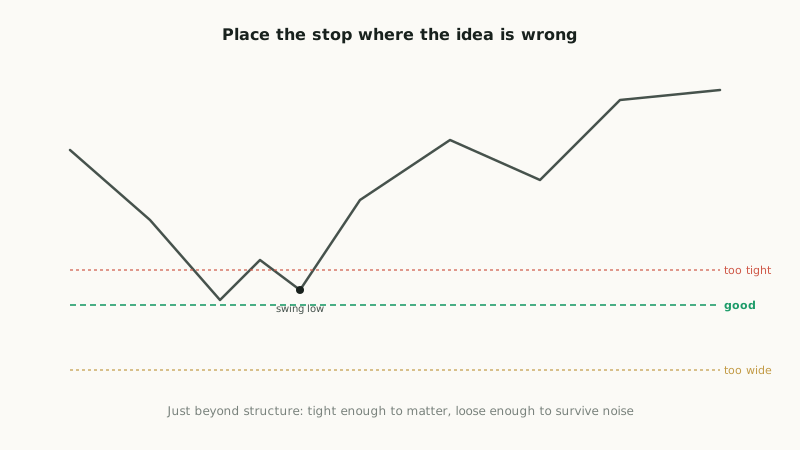
The logic of structure-based stops is that they tie the exit to the trade's reasoning rather than to an arbitrary dollar amount or a round number of pips. If you are long because price held a support level, the trade is wrong when that support decisively breaks — so that is where the stop belongs, just beyond it. This approach also means your stop placement and your entry reasoning are consistent: the same structure that justified the trade defines where it fails. Placing the stop a little beyond the exact level (rather than right at it) gives room for the minor overshoots and wicks that often probe a level before it holds.
Volatility-based placement
A complementary approach is to place stops based on volatility — how much the market typically moves — often measured with an indicator like the Average True Range (ATR). The idea is to set the stop far enough away that normal, routine price fluctuation will not trigger it, while still keeping the risk bounded. A stop placed within the market's normal noise will be hit constantly by random movement, stopping you out of trades that would have worked; a stop placed with reference to typical volatility avoids this.
The best stop placement usually combines structure and volatility: put the stop just beyond a structural level, but check that this placement also sits outside the market's normal noise. If a structural level is so close that the stop would sit within typical fluctuation, the trade may be too risky to take at that entry, or may call for a different entry. Volatility-based thinking is the safeguard against the most common stop error — placing stops too tight — which we turn to next.
Not too tight, not too wide
Stop placement is a Goldilocks problem: too tight and you get stopped out by noise; too wide and you risk too much. A stop placed too tight — just a few pips from entry, inside the market's normal wiggle — will be triggered by random fluctuation again and again, generating a stream of small losses on trades that would have worked, a deeply frustrating and account-eroding pattern. The instinct to use tight stops to "limit risk" backfires, because it converts the trade's natural noise into repeated stop-outs.
A stop placed too wide — far beyond any relevant level — has the opposite problem: it gives the trade plenty of room but risks a large amount if hit, and (via position sizing) forces such a small position that the trade is barely worth taking, or tempts the trader to risk more than they should. The right stop sits in between: just beyond the structural level that invalidates the idea, outside the normal noise, but no further. And remember the interaction with position sizing — a wider stop does not mean more risk, it means a smaller position; the dollar risk stays fixed regardless of stop distance. The stop distance and position size flex together to keep risk constant.
The cardinal rule: you may move a stop to lock in profit, but never move it further away to avoid being hit. Widening a stop on a losing trade — giving it "more room" — is how a small, planned loss becomes a catastrophic one. The moment you move a stop against yourself, you have abandoned your risk management entirely.
The cardinal rule and trailing stops
The single most important rule about stops deserves its own emphasis: never move a stop further away to avoid being stopped out. This is the most destructive habit in trading. It begins innocently — "the level will hold, I'll just give it a little more room" — and ends with a small, planned 1% loss metastasising into a 5%, 10% or account-threatening loss as the trader keeps widening the stop and hoping. The whole purpose of the stop is to enforce the loss you pre-committed to; moving it away destroys that purpose and, with it, your capital preservation.
Moving a stop in the favourable direction, however, is not only allowed but encouraged: this is a trailing stop, where you move the stop to follow price as a trade moves into profit, locking in gains and reducing risk. As a long trade rises, you raise the stop behind it — perhaps to breakeven once it has moved enough, then trailing it up to protect accumulating profit. The asymmetry is the entire point: stops move only one way, in your favour, never against you. One final note — a hard stop (an actual order placed with the broker) is generally safer than a mental stop (an intention to exit), because the hard stop executes automatically and removes the temptation to hesitate when the moment comes.
Stops on forex
On currencies, all of this applies directly. Place stops just beyond structural levels — swing highs and lows, support and resistance, pattern invalidation points — while ensuring they sit outside the pair's normal volatility (forex pairs vary widely in their typical range, so what counts as "noise" differs between, say, a major and a volatile cross). Use hard stops placed with the broker rather than mental stops, especially given that the 24-hour forex market can move sharply while you are away from the screen. And honour the cardinal rule absolutely: the stop, once set, moves only in your favour.
Above all, remember that the stop is what makes the rest of risk management function. Without a defined stop, you cannot size the position (there is no fixed risk to size against), you cannot assess risk-reward (there is no 1R), and you cannot preserve capital (the loss is open-ended). The stop is the keystone. Set it where the idea is wrong, keep it outside the noise, size the position so the loss is a small fixed fraction, and never, ever move it against you. Do that consistently, and the inevitable losing trades become the small, routine, survivable events they are meant to be.
Set the stop in advance, at the structural level that would prove your idea wrong (just below a swing low for a long), outside the market's normal noise — not too tight, not too wide. A wider stop means a smaller position, not more risk. The cardinal rule: move a stop only in your favour (a trailing stop to lock profit), never further away to avoid being hit. Use hard stops with the broker, and honour them without renegotiation.