Here is the single most important piece of arithmetic in all of trading, and the one that justifies everything else in risk management: a loss requires a larger percentage gain to recover from than the loss itself. Lose 10% and you need about 11% to get back. Lose 50% and you need a 100% gain — you must double your money just to break even. Lose 90% and you need a barely-imaginable 900%. This brutal asymmetry is why avoiding large losses matters so disproportionately, and why "capital preservation first" is not a platitude but a mathematical necessity. This guide explains the math of drawdowns and what it means for how you trade.
This is the mathematical bedrock beneath the entire risk management discipline — the reason position sizing and the 1% rule matter so much.
Key takeaways
Q: Why does a loss need a bigger gain to recover?
A: Because the gain is calculated on a smaller remaining balance. If you lose 50%, your remaining capital is half, so you need to double it — a 100% gain — just to get back to where you started. The deeper the loss, the disproportionately larger the gain required.
Q: What gain do you need to recover a 50% loss?
A: A 100% gain. After losing half your capital, you must double the remainder to break even. This asymmetry worsens rapidly: a 75% loss needs a 300% gain to recover, and a 90% loss needs a 900% gain.
Q: What is risk of ruin?
A: Risk of ruin is the probability that a series of losses reduces your account to the point where you can no longer trade effectively. It rises sharply as you risk more per trade and as your edge shrinks, which is why small position sizes are so important.
The asymmetry of losses
The asymmetry arises from a simple fact: a percentage gain is calculated on your remaining balance, which is smaller after a loss. If you have $100 and lose 50%, you are left with $50. To get back to $100, you must now gain $50 — but $50 on a $50 base is a 100% gain, not 50%. The loss was calculated on the original $100; the recovery must be earned on the reduced $50. The bigger the loss, the smaller the base you are recovering from, and the more dramatic the gain required.
This relationship is not linear — it accelerates viciously as losses deepen. A modest loss needs only a slightly larger gain to recover, but past a certain point the required gains become almost impossible:
- A 10% loss needs about an 11% gain to recover — manageable.
- A 25% loss needs a 33% gain — noticeably harder.
- A 50% loss needs a 100% gain — you must double your money.
- A 75% loss needs a 300% gain — you must quadruple it.
- A 90% loss needs a 900% gain — a tenfold return just to break even.
What this means for trading
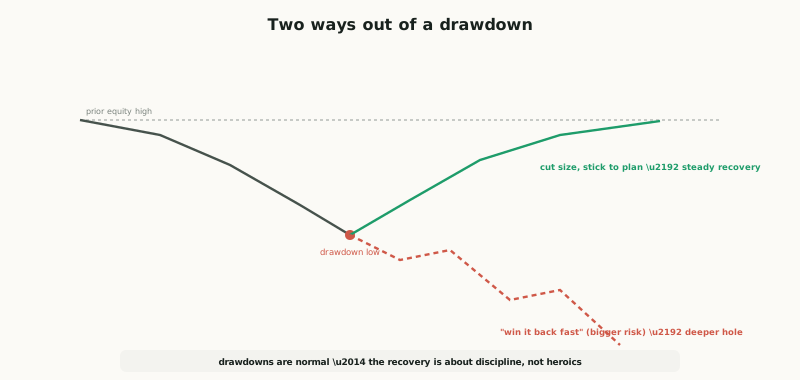
The practical implication of this asymmetry is profound: avoiding large losses is far more valuable than capturing large gains. A trader who keeps losses small — staying in the shallow, easily-recoverable end of the drawdown table — can recover from setbacks routinely and keep compounding. A trader who suffers a deep drawdown faces a recovery so daunting that it may be practically impossible, even with a genuine edge. Two traders with identical strategies can have utterly different outcomes based solely on whether they let losses run deep.
This is the mathematical justification for the 1% rule and disciplined position sizing. Risking just 1% per trade keeps you firmly in the shallow end: even a string of ten losses is only about a 10% drawdown, needing a recoverable ~11% to undo. By contrast, risking large amounts can plunge you into the steep end of the curve, where recovery becomes a desperate, often hopeless task. The math does not care how good your analysis is — it dictates that the trader who protects against deep drawdowns has an enormous structural advantage over one who does not, regardless of edge.
The most important consequence of the drawdown math: a defensive trader who never takes a deep loss beats a brilliant analyst who occasionally does. Avoiding the steep end of the recovery curve matters more than any winning streak, because a single trip to the steep end can end the game.
Risk of ruin
The drawdown math connects to a deeper concept: risk of ruin — the probability that a run of losses reduces your account to the point where you can no longer trade effectively (or are wiped out entirely). Risk of ruin is not just about a single catastrophic trade; it is about the cumulative danger of a losing streak, which is a normal statistical occurrence even with a positive edge. The question risk of ruin answers is: given how much I risk per trade and how reliable my edge is, what is the chance a bad-but-realistic streak destroys me?
Two factors drive risk of ruin, and both point to the same conclusion. The first is how much you risk per trade: the more you risk, the deeper any losing streak cuts, and the higher the chance of ruin — this is why small, fixed position sizing is so protective. The second is the size of your edge (your expectancy and win rate): a thinner edge means more frequent and longer losing streaks, raising the risk. The practical takeaway is unambiguous: keeping risk per trade small dramatically reduces risk of ruin, turning even a difficult losing streak into a survivable drawdown rather than an account-ending event. Small position sizes are, mathematically, the most powerful ruin-avoidance tool available.
Why capital preservation comes first
All of this is why capital preservation is the first principle of risk management, not merely good advice. The drawdown math shows that deep losses are disproportionately, sometimes fatally, hard to recover from; risk of ruin shows that taking large risks invites exactly such losses through normal losing streaks. The conclusion is inescapable: protecting capital — keeping every loss small and staying out of the steep end of the recovery curve — is the precondition for everything else. You cannot compound, cannot let your edge work, cannot even keep trading, if you have suffered a drawdown deep enough to maim or destroy your account.
This reframes the trader's goal one final time. The aim is not to maximise returns on any trade or even any month; it is to stay in the shallow end of the drawdown curve, indefinitely, so that a positive edge applied over many trades can compound. Spectacular gains are worthless if accompanied by the deep drawdowns that eventually arrive from oversized risk; modest, consistent gains with shallow drawdowns compound into substantial wealth over time. The math of drawdowns is, in the end, the mathematical proof of why slow, disciplined, capital-preserving trading beats the aggressive pursuit of big wins — and why every other risk control on this site exists.
Drawdowns on forex
On currencies, the drawdown math is especially relevant because of leverage. The high leverage available in forex makes it easy to take oversized positions that can produce exactly the deep, hard-to-recover drawdowns this article warns against — a leveraged position that moves sharply against you can inflict a loss that lands you in the steep end of the curve with frightening speed. This is the mathematical reason for the caution around leverage emphasised throughout this cluster: leverage is the mechanism by which forex traders most often inflict catastrophic, asymmetric losses on themselves.
The defence is the same defence that the whole cluster describes: risk a small fixed fraction (1%) per trade, size positions by risk rather than by available leverage, define stops in advance, and honour them. Do this, and you confine yourself to the shallow, recoverable end of the drawdown curve, where losing streaks are routine setbacks rather than existential threats. Understand the math of drawdowns deeply enough, and disciplined risk management stops feeling like a constraint and starts feeling like what it is — the only rational response to the unforgiving arithmetic of loss.
Losing streaks are normal
A crucial companion to the drawdown math is understanding that losing streaks are a statistical certainty, not a sign that something is wrong. Even a genuinely good system with, say, a 50% win rate will produce long runs of consecutive losses purely by chance — just as a fair coin will sometimes land tails five or six times in a row. Over hundreds of trades, runs of five, six, even eight or more consecutive losses are not anomalies; they are expected, and they will happen to every trader who trades long enough, regardless of skill.
This has two important consequences. First, it means you must size your risk to survive the streaks you will inevitably hit, not the typical trade. If a run of eight losses is realistic for your system, then risking 1% per trade (an ~8% drawdown from such a run) is survivable, while risking 5% per trade (a ~40% drawdown, needing a punishing ~67% gain to recover) is not. The position size must be small enough that a normal-but-bad losing streak remains a shallow, recoverable drawdown rather than a deep, dangerous one.
Second, it reframes how you experience losses emotionally. A trader who understands that streaks are normal does not panic during one, does not conclude their system is broken, and crucially does not abandon their rules or start increasing size to "win it back" — the very reactions that turn a normal streak into ruin. The streak is weathered with the same discipline as any other period, because it was anticipated and the position sizing was built to absorb it. Combining the asymmetry of the drawdown curve with the certainty of losing streaks leads to one unavoidable conclusion: keep risk per trade small, so that the streaks you are guaranteed to face never carry you into the steep, hard-to-recover end of the curve.
A loss needs a larger gain to recover (50% lost needs 100% back; 75% needs 300%; 90% needs 900%), and the asymmetry accelerates viciously — so avoiding large losses beats chasing large gains. Losing streaks are a statistical certainty even with a good system, so size risk to survive them: small position sizes (the 1% rule) keep you in the shallow, recoverable end and slash risk of ruin. On forex, this is the mathematical reason to treat leverage with extreme caution.