
One idea, properly understood, frees a trader from the tyranny of needing to be right: if you risk one to make three, you can lose most of your trades and still come out ahead. That is the power of the risk-reward ratio, and grasping how it combines with win rate is what turns trading from a guessing game about prediction into a numbers game about edge. A trader who understands this stops asking "was I right?" and starts asking "does my system make money over many trades?" — a far more useful question. This guide explains the risk-reward ratio, how it interacts with win rate, and the concept of expectancy that ties them together.
It is the third pillar of the discipline in risk management in trading, alongside position sizing and stop placement.
Key takeaways
Q: What is the risk-reward ratio?
A: The risk-reward ratio compares the potential loss on a trade (the risk) to the potential profit (the reward). A 1:3 ratio means risking one unit to potentially make three. A higher reward relative to risk means you can be profitable even with a lower win rate.
Q: What win rate do you need for a 1:2 risk-reward ratio?
A: With a 1:2 risk-reward ratio you break even at a win rate of about 33%, so any win rate above one in three is profitable. The breakeven win rate is 1 divided by (1 plus the reward multiple) — 1:1 needs over 50%, 1:2 needs over 33%, 1:3 needs over 25%.
Q: What is expectancy in trading?
A: Expectancy is the average amount you can expect to win or lose per trade, combining win rate and risk-reward. It equals (win rate times average win) minus (loss rate times average loss). A positive expectancy means the system makes money over many trades.
What the ratio is
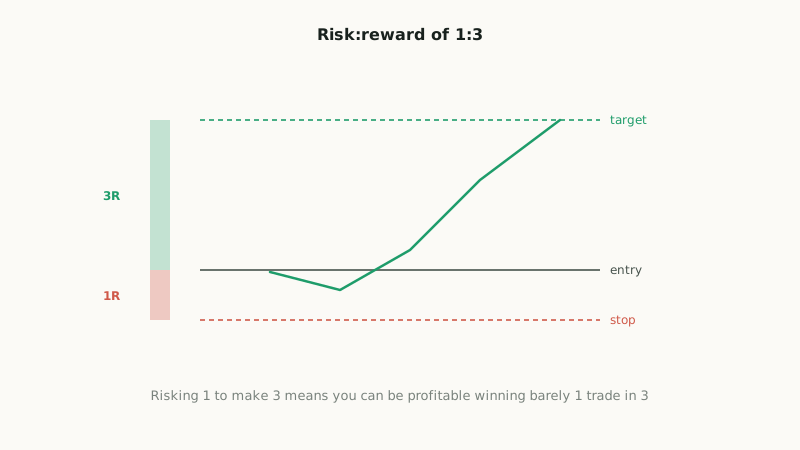
The risk-reward ratio compares the amount you stand to lose on a trade (the risk, the distance from entry to stop) against the amount you stand to gain (the reward, the distance from entry to target). It is usually expressed as a ratio like 1:3, meaning you are risking one unit to potentially make three. The "unit" is conveniently expressed as R — one R is the amount you are risking — so a 1:3 trade risks 1R to make 3R, and traders often describe results in R terms ("that trade made 2R").
Thinking in R has a clarifying effect. It standardises every trade to the same scale regardless of position size or account value: a winning trade is "+2R," a loss is "-1R," and your performance becomes a stream of R multiples you can simply add up. This abstraction strips away the dollar amounts and focuses attention on what actually matters — the ratio of reward to risk on each trade, and how often you win. Combined with disciplined position sizing (which keeps 1R constant at a small fraction of the account), thinking in R turns trading into a measurable, manageable numbers game.
The relationship with win rate
The crucial insight is that risk-reward and win rate are two halves of a single equation, and neither means anything alone. A high win rate sounds great, but if your losers are much larger than your winners (a poor risk-reward ratio), you can win most trades and still lose money. Conversely, a low win rate sounds alarming, but if your winners are much larger than your losers (a strong risk-reward ratio), you can lose most trades and still profit handsomely. The two must always be considered together.
This is mathematically precise. For any risk-reward ratio, there is a breakeven win rate — the win rate at which the system exactly breaks even — given by the formula: breakeven win rate = 1 ÷ (1 + reward multiple). The implications are striking:
- At 1:1 (risk 1 to make 1), you need to win more than 50% of trades to profit.
- At 1:2, you need to win more than about 33% — just one in three.
- At 1:3, you need to win more than 25% — one in four.
So a trader using a 1:3 ratio can be wrong three times out of four and still break even, and profitable winning just slightly more than one in four. This is why favourable risk-reward is so prized: it dramatically lowers the win rate you need, which means you do not have to predict the market accurately — you just have to let your winners outrun your losers.
Expectancy: the bottom line
The concept that ties win rate and risk-reward together into a single verdict is expectancy — the average amount you can expect to win or lose per trade over many trades. Its essence is captured by: expectancy = (win rate × average win) − (loss rate × average loss). A positive expectancy means that, on average, each trade adds to your account over the long run; a negative expectancy means each trade, on average, costs you, no matter how it feels in the moment.
Expectancy is the number that actually determines whether a trading approach makes money. It combines how often you win with how much you win versus lose, producing a single figure that tells you whether your edge is real. A system with a 40% win rate and a 1:3 risk-reward has a healthy positive expectancy despite losing most trades; a system with a 70% win rate but a 1:0.5 risk-reward (winners half the size of losers) may have a negative expectancy despite winning most trades. This is why chasing a high win rate for its own sake is a trap, and why the goal is positive expectancy — a system that, applied consistently over many trades with sound position sizing, grinds out a profit.
Stop asking "was I right?" and start asking "is my expectancy positive?" Win rate alone is meaningless — a 90% win rate with huge losers loses money, and a 30% win rate with big winners makes money. The market does not pay you for being right; it pays you for having positive expectancy and applying it consistently.
Using risk-reward sensibly
A common mistake is to chase ever-higher risk-reward ratios with unrealistic targets, on the logic that "bigger reward is always better." But there is a trade-off: setting your target very far away improves the ratio on paper while lowering the probability that the target is actually reached, dragging down your win rate. A 1:10 trade looks wonderful until you realise price reaches that distant target only rarely. The art is to balance a favourable risk-reward ratio against an achievable win rate, so that the combination produces healthy positive expectancy.
In practice, many disciplined traders look for a minimum risk-reward of around 1:2 — enough that they can profit with a sub-50% win rate — while setting targets at genuine structural levels the market is realistically likely to reach, rather than at arbitrary distances chosen to flatter the ratio. The target should be where price is plausibly headed (a prior structural level, a Fibonacci extension, the opposite side of a range), and the resulting ratio should clear your minimum. If a sensible target does not offer an adequate risk-reward, the trade is best skipped. This balanced approach — realistic targets at real levels, with a ratio that ensures positive expectancy — is how risk-reward is used well rather than as a fantasy.
Risk-reward on forex
On currencies, risk-reward is applied exactly as on any market: define the stop at the invalidation level (your 1R), set the target at a realistic structural objective, and check that the resulting ratio meets your minimum before taking the trade. Because forex offers clear structural levels — prior swing highs and lows, round numbers, Fibonacci levels — sensible targets are usually identifiable, making realistic risk-reward assessment straightforward. The discipline is to let this assessment gate your trades: if a setup does not offer adequate reward for its risk, you pass, however appealing the entry looks.
Combined with the other risk tools, risk-reward completes the picture. Position sizing ensures each loss is a small fixed fraction (1R = 1% of account); the stop defines where 1R is; and the risk-reward ratio ensures your winners are large enough relative to that 1R to produce positive expectancy across many trades. Together they mean you do not need to predict the market accurately — you need only a positive edge, sound sizing, and the discipline to apply both consistently. That is the entire game, and risk-reward is the piece that lets a modest win rate become a profitable one.
Tracking your results in R
The real power of thinking in R multiples emerges when you use them to track and review your trading. By recording every trade as an R outcome — +2.4R, −1R, +0.8R — in a trading journal, you build a stream of standardised results that reveals your actual expectancy from real trades rather than theory. Summing your R multiples over many trades and dividing by the number of trades gives your realised expectancy in R terms: a system averaging, say, +0.3R per trade is genuinely profitable, and you can see it directly in the data rather than guessing.
This R-based journaling is one of the most valuable habits a developing trader can build, because it shifts focus from individual outcomes to the statistical reality of the edge. A run of losses is easier to endure when your journal shows a positive long-run expectancy; an apparently successful run is exposed as luck when the underlying R-expectancy is negative. Reviewing your R history also surfaces concrete problems — perhaps your average winner is smaller than your planned risk-reward suggested (you are exiting winners too early), or your average loss exceeds 1R (you are not honouring stops). These are precisely the leaks that erode an edge, and they are invisible without R-based tracking. Recording results in R, reviewing them regularly, and acting on what they reveal turns risk-reward from a planning concept into a feedback loop that steadily improves your trading.
The risk-reward ratio compares potential loss (1R) to potential gain (e.g. 3R). It pairs with win rate: breakeven win rate is 1 ÷ (1 + reward), so 1:2 needs only ~33% wins and 1:3 only ~25%. Expectancy = (win% × avg win) − (loss% × avg loss) is the bottom line — aim for positive expectancy, not a high win rate. Track every trade in R multiples to measure your real expectancy and expose leaks like cutting winners early or losses exceeding 1R.