EUR/USD = 1.0850. Those five characters and a number contain everything you need to place a trade — which two currencies are involved, which you are buying, which you are selling, and at what rate — once you know how to read them. For a complete beginner, a forex quote can look cryptic; in reality it follows a simple, consistent logic, and decoding it is one of the first essential skills. This guide explains exactly what a quote is telling you: the base and quote currencies, what the price means, the bid and ask, and how to tell at a glance which currency is gaining strength.
This is a core skill that supports how a forex trade works and builds on the pairs introduced in what is forex trading.
Key takeaways
Q: How do you read a forex quote?
A: A quote like EUR/USD = 1.0850 means one unit of the base currency (EUR) is worth 1.0850 units of the quote currency (USD). The first currency is the base, the second is the quote, and the number tells you how much quote currency is needed to buy one unit of the base.
Q: What is the base and quote currency?
A: In a pair, the base currency is the first one listed and the quote (or counter) currency is the second. The price shows how many units of the quote currency equal one unit of the base. In EUR/USD, EUR is the base and USD is the quote.
Q: What does it mean when a forex pair goes up?
A: When a pair's price rises, the base currency is strengthening relative to the quote currency. If EUR/USD rises from 1.0850 to 1.0900, the euro has gained against the dollar — it now takes more dollars to buy one euro.
Base and quote currency
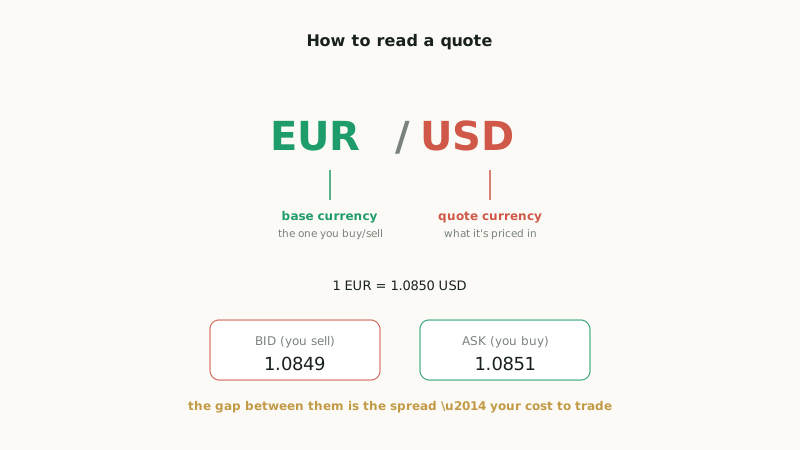
Every forex pair lists two currencies, and their order matters. The first currency listed is the base currency; the second is the quote currency (also called the counter currency). In EUR/USD, the euro is the base and the US dollar is the quote. This order is a fixed convention for each pair — it is always EUR/USD, never USD/EUR — and knowing which is which is the key to reading everything else.
The base currency is the one you are effectively buying or selling, and it is always treated as a single unit. The quote currency is what that one unit is priced in. So a quote tells you how much of the quote currency it takes to buy one unit of the base currency. When you "buy EUR/USD," you are buying one (or more) units of the base currency, the euro, paying for it in the quote currency, the dollar. When you "sell EUR/USD," you are selling the euro for dollars. The whole quote is built around this base-and-quote relationship, so fixing it firmly in mind makes the rest straightforward.
What the price means
The number in a quote — the 1.0850 in EUR/USD = 1.0850 — is simply how many units of the quote currency equal one unit of the base currency. EUR/USD = 1.0850 means one euro is worth 1.0850 US dollars: to buy a single euro, you need 1.0850 dollars. If the quote were USD/JPY = 150.25, it would mean one US dollar is worth 150.25 Japanese yen. The base is always the "one," and the price is what that one costs in the quote currency.
This interpretation makes it easy to understand what a change in the price means. If EUR/USD rises from 1.0850 to 1.0900, it now takes more dollars (1.0900 instead of 1.0850) to buy one euro — so the euro has strengthened against the dollar, or equivalently the dollar has weakened against the euro. If the pair falls, the base currency (euro) has weakened relative to the quote (dollar). The simple rule: when a pair's price rises, the base currency is strengthening; when it falls, the base currency is weakening — always relative to the quote currency. This is why going long is a bet on the base currency and going short is a bet against it.
Bid, ask and the spread
In practice you will see not one price but two: the bid and the ask. The bid is the price at which you can sell the base currency (the broker buys it from you); the ask (or offer) is the price at which you can buy the base currency (the broker sells it to you). The ask is always a little higher than the bid — you buy at the higher price and sell at the lower one. A quote might therefore read EUR/USD bid 1.0849 / ask 1.0851.
The gap between the bid and ask is the spread, and it represents a cost of trading. Because you would buy at the ask and sell at the bid, you begin every trade slightly behind by the amount of the spread — the price must move in your favour by at least the spread for you to break even. On liquid major pairs the spread is typically very tight (often around a pip or less), while on exotic pairs it is wider, which is one reason beginners are guided toward the majors. Understanding bid, ask and spread is essential not just for reading quotes but for appreciating your real trading costs, as discussed in how to choose a forex broker.
The base currency is always "one unit," and the price is what that one unit costs in the quote currency. From this everything follows: a rising pair means the base is strengthening, a falling pair means it is weakening, and you always buy at the ask and sell at the bid.
Finding the pips in a quote
Once you can read a quote, you can locate the pips within it — the standard unit of price movement. For most pairs, the pip is the fourth decimal place. In EUR/USD = 1.0850, the final "0" sits in the pip position; a move to 1.0851 is one pip, and a move to 1.0860 is ten pips. Many brokers show a fifth decimal (a pipette, a tenth of a pip) for finer pricing, so you might see 1.08505. For yen pairs like USD/JPY = 150.25, the pip is the second decimal place, so a move to 150.26 is one pip.
Being able to spot the pip position at a glance lets you instantly gauge how far a price has moved and how far your stop or target sits from your entry — the practical bridge from reading a quote to managing a trade. The combination of reading the quote (which currencies, which direction, at what price) and locating the pips (how far it has moved) gives you everything needed to interpret what you are looking at on a trading screen. These units are explained more fully in pips, lots and leverage.
A note on perspective
You may occasionally encounter the terms direct and indirect quotes, which simply describe a quote from the perspective of a particular home currency. A direct quote expresses the price of a foreign currency in terms of the domestic one, while an indirect quote does the reverse. For a US-based trader, USD/JPY (dollars priced in yen, from their view) and EUR/USD (euros priced in dollars) illustrate the two perspectives. In practice, retail traders rarely need to worry about this terminology — the base/quote convention is fixed for each pair regardless of where you sit, and you read every quote the same way: base currency priced in quote currency.
What matters far more than the terminology is the core skill this guide has built: looking at any pair and immediately understanding which currency you are buying, which you are selling, what the price represents, which way strength is flowing as the price moves, and where your costs and pip movements lie. With that, a trading screen full of quotes stops being intimidating and becomes simply information — the raw data on which all the analysis, strategy and risk management in the rest of this site operates.
Cross rates and a useful consequence
Most beginners start with pairs involving the US dollar, since the majors all include it, but you will also encounter cross rates (or crosses) — pairs that do not involve the dollar, such as EUR/GBP (euro against pound) or EUR/JPY (euro against yen). These are read in exactly the same way: the first currency is the base, the second is the quote, and the price says how many units of the quote currency equal one unit of the base. EUR/GBP = 0.8500 means one euro is worth 0.85 pounds. The base/quote logic is universal; the only difference with crosses is that neither currency is the dollar.
There is also a fixed convention for which currency comes first in any pair, broadly following an established order of seniority among currencies (the euro typically takes precedence, then the pound, and so on), which is why you always see EUR/USD rather than USD/EUR and EUR/GBP rather than GBP/EUR. You do not need to memorise the hierarchy — the pairs are simply quoted consistently, and you read them all the same way.
One practical consequence of the quote convention is genuinely useful to know: your profit or loss is denominated in the quote currency. Because the price expresses the base currency in terms of the quote currency, a move in the pair produces a gain or loss measured in that quote currency. On EUR/USD, your profit and loss arise in US dollars; on EUR/GBP, in pounds; on USD/JPY, in yen. If the quote currency differs from your account's currency, the broker converts the result automatically, but it is worth understanding where the raw profit or loss originates. This is also why pip values differ between pairs — a pip is worth a fixed amount of the quote currency, which then translates into your account currency at the prevailing rate. Reading the quote correctly, in other words, also tells you the currency in which you are making or losing money.
In a pair, the first currency is the base and the second is the quote; the price says how many units of the quote equal one unit of the base (EUR/USD = 1.0850 means 1 euro = 1.0850 dollars). A rising price means the base is strengthening. You sell at the bid, buy at the ask, and the gap is the spread. Crosses (no US dollar) read the same way, and your profit or loss is denominated in the quote currency. The pip is the 4th decimal (2nd for yen pairs).