Margin is the deposit that makes leveraged trading possible — and the mechanism that can wipe out an over-leveraged account in minutes. When you trade forex with leverage, you are controlling a large position with a relatively small amount of your own money; margin is that small amount, set aside as collateral. Understanding how margin works, and especially what happens when it runs low — the dreaded margin call and stop-out — is essential knowledge before risking real money. Many beginners blow up their accounts simply because they did not understand margin. This guide explains margin, the difference between used and free margin, the margin level, and the margin-call and stop-out process.
It is the mechanical companion to the leverage concept introduced in pips, lots and leverage, and it connects directly to risk management.
Key takeaways
Q: What is margin in forex trading?
A: Margin is the deposit a broker requires to open a leveraged position — not a fee, but collateral set aside while the trade is open. The amount depends on the leverage: higher leverage means a smaller margin requirement, for example around 1% of the position size at 1:100 leverage.
Q: What is a margin call?
A: A margin call is a warning from the broker when your account's margin level falls to a set threshold (often around 100%), meaning losses are eroding your margin. It signals that you must add funds or reduce positions, or risk the broker closing your trades automatically.
Q: What is a stop-out?
A: A stop-out is when the broker automatically closes your positions because your margin level has fallen below a critical threshold (often around 50%). It is a protective mechanism to stop your losses before the account goes negative, but it means trades are closed at a loss without your input.
What margin is
Margin is the amount of money a broker requires you to deposit to open a leveraged position — and a crucial point of understanding is that margin is not a cost or a fee. It is collateral: money from your account that is set aside and locked while the position is open, as security for the leveraged trade. When you close the position, the margin is released back to you (adjusted for any profit or loss). Margin is best thought of as a deposit held in good faith, not money spent.
The amount of margin required is determined by the leverage. The higher the leverage, the smaller the margin needed to control a given position. At 1:100 leverage, for example, you need about 1% of the position's value as margin; at 1:30 leverage, about 3.3%. So a leverage of 1:100 lets you open a position 100 times larger than the margin you put up. This is exactly the double-edged sword described in the leverage guide: margin lets you control large positions with little capital, magnifying both gains and losses. The margin requirement is simply the flip side of leverage — the deposit that the leverage ratio implies. Understanding margin as leverage-determined collateral is the foundation for everything that follows.
Used margin, free margin and equity
Several related terms describe the state of your account. Your balance is the cash in your account before accounting for open trades. Your equity is your balance plus or minus the floating profit or loss of any open positions — your account's real-time value if you closed everything now. As your open trades move, your equity rises and falls with them.
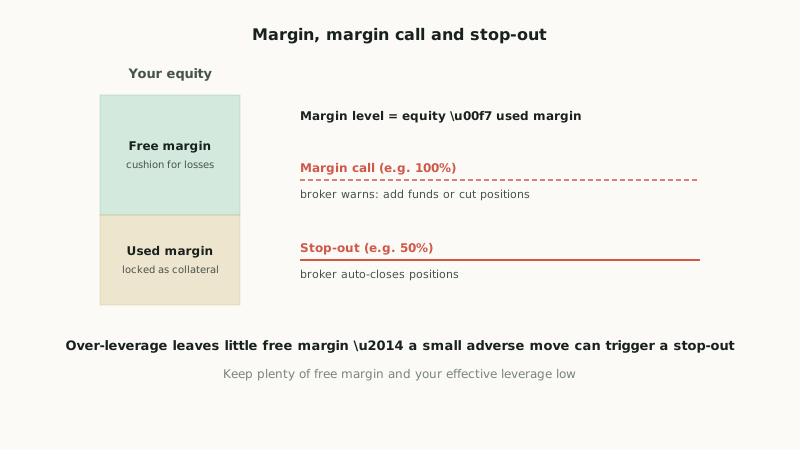
Used margin is the total margin currently locked up as collateral across all your open positions — money you cannot use for anything else while those trades are open. Free margin is the rest: your equity minus the used margin, representing the funds available to open new positions and, crucially, to absorb losses on your existing ones. Free margin is your cushion. When trades move against you, your equity falls, which shrinks your free margin — the buffer between you and trouble. This is the key relationship to internalise: free margin is what stands between your open positions and a margin call. A trader with ample free margin can withstand adverse moves; one whose free margin is nearly exhausted is dangerously exposed, with little room before the broker steps in.
The margin level
The single most important gauge of account health is the margin level, calculated as your equity divided by your used margin, expressed as a percentage (equity ÷ used margin × 100%). The margin level measures how much equity you have relative to the margin locked in your positions — a high margin level means a healthy cushion, while a low one means your equity is shrinking dangerously close to the margin requirement. Brokers use this percentage to decide when to issue a margin call and when to force-close positions.
As your open trades profit, your equity rises and your margin level climbs (healthier); as they lose, equity falls and the margin level drops (more dangerous). The margin level is therefore a live readout of how close you are to the broker's intervention thresholds. Every trader using leverage should understand and monitor it, because it is the number that determines whether your positions are safe or about to be forcibly closed. When the margin level is high, you have room; when it falls toward the broker's critical levels — described next — you are in the danger zone, and action is needed before the broker takes it for you.
Margin call and stop-out
When the margin level falls to a certain threshold — commonly around 100%, though it varies by broker — the broker issues a margin call: a warning that your losses are eroding your margin and that you must act, either by adding funds to your account (raising your equity) or by reducing your positions (lowering your used margin). The margin call is the broker's alarm bell, signalling that your account is under stress and that without action, forced closure looms.
If the margin level continues to fall — to a lower critical threshold, commonly around 50% — the broker triggers a stop-out: it automatically closes your positions (typically starting with the largest losing one) to prevent your account from going negative. The stop-out is a protective mechanism — it stops your losses before you owe the broker money — but it is brutal: your trades are closed at a loss, at the worst possible moment, without your input, often crystallising losses just before a potential recovery. The stop-out is the mechanism by which an over-leveraged account gets wiped out: a sharp adverse move drives the margin level down through the call and into the stop-out, and positions are liquidated. Avoiding ever reaching this point is a core risk-management goal, achieved by not over-leveraging in the first place.
Over-leveraging is the trap: pile on large positions and your used margin is high, your free margin thin, so a small adverse move sends the margin level crashing through the call into the stop-out — positions liquidated at the worst moment. The defence is simple: keep plenty of free margin and your effective leverage low, so normal market swings never threaten a stop-out.
Keeping a safe distance
The practical lesson of margin is the same as the lesson of leverage: do not over-leverage. The danger is not margin itself but using so much of it — opening positions so large relative to your account — that your free margin is thin and your margin level sits perilously close to the call and stop-out thresholds. In that state, even a small, normal adverse market move can trigger a margin call or stop-out, wiping out positions before they have any chance to work. This is precisely how beginners with too much leverage destroy their accounts: not through one catastrophic trade, but through ordinary volatility hitting an account with no margin cushion.
The defence is to maintain a generous buffer of free margin by keeping your effective leverage low — using only a small fraction of your available margin, so your positions are modest relative to your equity. This connects directly to the position-sizing discipline of the risk management section: sizing trades by risk (a small percentage of the account per trade) naturally keeps your margin usage low and your free margin ample, far from the danger thresholds. A trader who risks only 1% per trade and avoids stacking large positions will rarely if ever approach a margin call, because their effective leverage is modest regardless of the high leverage the broker offers. Margin, properly understood, reinforces the central risk-management message: the high leverage available in forex is dangerous precisely because it lets you consume your margin recklessly, and the path to survival is to use only a small part of it, keeping a wide, safe distance from the margin call and stop-out that destroy over-leveraged accounts.
A margin example
Concrete numbers make the mechanics clear. Suppose you have a £1,000 account and your broker offers 1:30 leverage, requiring about 3.3% margin. If you open a position worth £15,000 (using leverage), the used margin is roughly £500 (3.3% of £15,000) — half your account locked as collateral. Your free margin is the remaining £500 (equity of £1,000 minus £500 used), and your margin level is £1,000 ÷ £500 = 200%. That is a reasonably comfortable cushion: your equity is twice the margin tied up.
Now watch what happens as the trade moves against you. If the position loses £400, your equity falls to £600, your free margin shrinks to just £100 (£600 minus the £500 used), and your margin level drops to £600 ÷ £500 = 120% — approaching the typical 100% margin-call threshold. A further loss to £500 equity would put the margin level at exactly 100%, triggering a margin call, and continued losses toward £250 equity (a 50% margin level) would trigger a stop-out, force-closing the position. So a £750 adverse move on this position — entirely possible — would wipe out three-quarters of the account through forced liquidation.
The example shows the danger vividly. Had you instead opened a much smaller position — say £3,000, using only about £100 of margin — your free margin would be a healthy £900 and your margin level a robust 1,000%, able to withstand a far larger adverse move before any call. Same account, same leverage available, completely different risk, purely because of how much of the available margin you chose to use. This is the practical heart of the matter: it is not the leverage your broker offers that endangers you, but how much of it you actually deploy. Keeping positions small relative to your account — low effective leverage, ample free margin — keeps you far from the margin call and stop-out, exactly as the position-sizing discipline of risk management prescribes.
Margin is collateral (not a fee) set aside to open a leveraged position, determined by the leverage. Equity is balance ± open profit/loss; used margin is locked in trades; free margin (equity minus used margin) is your cushion. The margin level (equity ÷ used margin) gauges health: at a low threshold (often ~100%) the broker issues a margin call, and lower still (often ~50%) a stop-out auto-closes trades. Over-leveraging leaves thin free margin, so a small adverse move triggers a stop-out — it's not the leverage offered but how much you use that matters, so keep positions small and free margin ample.