
Most beginners pick a lot size out of thin air — a round number that "feels right." Skilled traders never do; they calculate it. The insight that changes everything is this: you don't choose your position size, you derive it. Decide how much money you're willing to risk on a trade, decide where your stop-loss goes, and the correct position size falls out of simple arithmetic — sized precisely so that, if the stop is hit, you lose exactly the amount you intended and no more. This guide is the practical how-to: the inputs, the formula, a worked example you can copy, and why getting this right is the heart of risk management.
It's the hands-on companion to the concept of position sizing, builds directly on setting a stop-loss and pips, lots and leverage, and is core to risk management.
Key takeaways
Q: How do you calculate position size in forex?
A: Decide how much money to risk on the trade (e.g. 1% of your account), measure your stop-loss distance in pips, and know the pip value for the pair. Then: position size = risk amount ÷ (stop distance in pips × pip value per lot). This sizes the trade so that if your stop is hit, you lose exactly your intended risk amount.
Q: What is the formula for position size?
A: Position size (in lots) = risk amount ÷ (stop-loss distance in pips × pip value per lot). For example, risking £100 with a 20-pip stop and a pip value of £10 per standard lot: £100 ÷ (20 × £10) = £100 ÷ £200 = 0.5 lots. The position size is the output, determined by your risk and stop.
Q: Why is position size an output rather than a choice?
A: Because to keep your risk constant, the size must follow from your fixed risk amount and stop distance — not the other way round. If you instead pick a size first, your risk varies unpredictably with each trade's stop distance. Fixing risk and stop, then calculating size, ensures every trade risks the same controlled amount.
The principle and the inputs
The principle is simple and powerful: decide how much you'll risk per trade, then size the position so that if your stop is hit, you lose exactly that amount. Your risk per trade is fixed (by your rules); your stop is placed where your analysis says it should be; and the position size is then calculated to make the two consistent. This is the disciplined approach that keeps your risk constant across every trade, regardless of how far away the stop is — the foundation of the position-sizing concept.
To calculate it, you need four inputs:
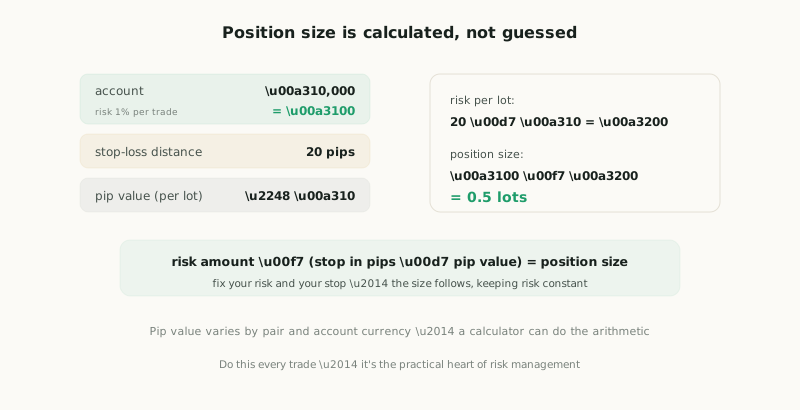
1. Your account size — the capital in your trading account (say, £10,000). 2. Your risk per trade — the amount (or percentage) you're willing to lose on this trade if the stop is hit. The widely-used rule is to risk only a small percentage, commonly 1–2% of the account per trade; risking 1% of a £10,000 account is £100. 3. Your stop-loss distance in pips — how far your stop is from your entry, measured in pips (the stop-loss placement determines this; say it's 20 pips). 4. The pip value — how much one pip is worth for the position, which depends on the pair and the lot size (the pips, lots and leverage guide explains pip value; for many pairs, one pip is worth roughly £10 per standard lot). With these four numbers — risk amount, stop distance, and pip value — you have everything needed to calculate the correct position size.
The formula and a worked example
The formula is: position size (in lots) = risk amount ÷ (stop-loss distance in pips × pip value per lot). Worked example: on a £10,000 account, you risk 1% = £100. Your stop is 20 pips away. For a standard lot, one pip is worth about £10, so the risk per standard lot is 20 pips × £10 = £200. Therefore the position size is £100 ÷ £200 = 0.5 lots. Trading 0.5 standard lots, a 20-pip stop-out costs exactly your intended £100. Change any input and the size adjusts: a tighter 10-pip stop would allow 1.0 lot (same £100 risk); a wider 40-pip stop would call for 0.25 lots. The risk stays £100 — the size flexes to keep it so.
Walk through the logic once and it becomes intuitive. You know you'll accept a £100 loss if wrong. You know your stop is 20 pips away. So the question is simply: how big a position loses exactly £100 over 20 pips? Since each pip costs you (pip value × position size), and you want 20 pips of movement to total £100, you work backwards: £100 of risk, spread over a 20-pip stop, at £10 per pip per lot, gives 0.5 lots. The arithmetic guarantees that your stop-out equals your planned risk. Notice the crucial relationship: the wider your stop, the smaller your position must be (to keep risk constant), and the tighter your stop, the larger your position can be. This is exactly right — it's why a trade with a far-away stop should be sized small, and a trade with a tight stop can be sized larger, all while risking the same fixed amount. The position size adapts to the stop distance so that your risk never changes.
Size is an output, plus practical notes
The deepest point to take away is that position size is an output, not a guess. You fix your risk (a percentage of your account) and your stop (where your analysis places it), and the size follows from the calculation — it is never an arbitrary choice. This is the opposite of how most beginners trade (picking a round-number lot size and accepting whatever risk that happens to imply). Deriving the size from fixed risk and stop is what keeps your risk constant and controlled on every trade, which is the entire purpose of position sizing. Get into the habit of running this calculation before every trade: it takes seconds, and it's the single most important piece of practical risk management you can do. A trade isn't ready to take until you've sized it to your risk.
A few practical notes. The pip value isn't always exactly £10 per standard lot — it varies by the pair and your account currency. For pairs quoted in US dollars, a standard lot pip is about $10 (a mini lot about $1, a micro lot about $0.10), but pairs involving the Japanese yen, or where your account currency differs from the quote currency, require a conversion, so the pip value differs. This sounds fiddly, but you rarely need to do it by hand: most brokers and trading platforms provide a position-size calculator (or pip-value calculator) that does the arithmetic for you — you enter your account size, risk percentage, stop distance and the pair, and it outputs the correct lot size. Beginners are well advised to use these calculators; the important thing is understanding what is being calculated and why (so you know the size is derived from your risk and stop), not memorising the arithmetic. The honest framing: calculating position size means fixing your risk (a percentage of your account) and your stop (in pips), then using the formula — risk amount ÷ (stop in pips × pip value) = position size — so that a stop-out loses exactly your intended risk. The size is the output, not a guess; wider stops mean smaller positions and vice versa, keeping risk constant. Use the formula or a calculator, account for pip-value variations, and do this every single trade. It's the practical heart of risk management, and the habit that, more than any other, lets a beginner survive long enough to learn.
Adjusting to different trades
Seeing how the calculation responds across different situations cements the idea that size is a derived, adaptive output. Consider the same £10,000 account and 1% (£100) risk, but varying the stop. With a tight 10-pip stop (at £10/pip/lot, that's £100 risk per lot), the size is £100 ÷ £100 = 1.0 lot. With a 20-pip stop, it's 0.5 lots (as in the worked example). With a wide 50-pip stop (£500 risk per lot), it's £100 ÷ £500 = 0.2 lots. Same account, same £100 risk — but the position size ranges from 1.0 lot down to 0.2 lots purely because the stop distance differs. This is the formula doing its job: a wider stop forces a smaller position so that the money at risk stays fixed at £100. It also reveals why simply "trading one lot every time" is so dangerous — it would mean risking £100 on the tight-stop trade but £500 on the wide-stop trade, five times the risk, with no logic behind it.
Two other variables shift the size too. As your account grows, your 1% risk amount grows with it (1% of £12,000 is £120, not £100), so your position sizes naturally increase as you compound — and shrink in a drawdown — which is exactly the sound, anti-martingale behaviour you want (risking more when winning, less when losing, all while keeping the percentage constant). And different pairs can have different pip values (especially yen pairs, or when your account currency differs from the quote currency), so the pip-value input changes from trade to trade — another reason to use a position-size calculator, which handles the pair-specific arithmetic for you. The unifying habit through all of this is the same: before every trade, fix your risk percentage, place your stop where your analysis dictates, and let the calculation give you the size. Don't anchor to a favourite lot size and work backwards — that inverts the logic and lets your risk vary uncontrollably. Let risk and stop be the inputs, and size be the output, every single time. Done consistently, this one habit keeps your risk steady across tight stops and wide ones, small accounts and grown ones, one pair and another — which is the entire point, and the practical bedrock of staying in the game.
Calculate position size; don't guess it. Inputs: account size, risk per trade (commonly 1–2% — e.g. £100 on a £10,000 account), stop-loss distance in pips, and pip value (≈£10 per pip per standard lot for many pairs). Formula: position size (lots) = risk amount ÷ (stop in pips × pip value per lot). Example: £100 risk, 20-pip stop, £10/pip/lot → £100 ÷ (20 × £10) = £100 ÷ £200 = 0.5 lots. The size is an output of your fixed risk and stop — wider stops mean smaller positions, tighter stops larger ones, keeping risk constant every trade. Pip value varies by pair and account currency (use a position-size calculator for the arithmetic). Run this calculation before every trade — it's the practical heart of risk management.