Leverage is the feature that draws people to forex — the ability to control a large position with a small amount of capital — and it is also the reason so many of them blow up. Used in excess, leverage turns an ordinary market wobble into a wiped-out account: a price move that should have been a minor setback becomes a catastrophic loss. Overleverage — using too much leverage, taking positions too large for your account — is widely regarded as the single most common destroyer of retail trading accounts. Understanding why it is so lethal, and the crucial point that you control it through position size rather than the leverage your broker offers, is among the most important lessons in all of risk management. This guide explains the danger, how overleverage amplifies losses, and how to avoid it.
It builds on the mechanics in pips, lots and leverage and margin and margin calls, and shows how overleverage accelerates the risk of ruin.
Key takeaways
Q: Why is overleverage so dangerous?
A: Because leverage amplifies losses as well as gains. With excessive leverage, a small, normal adverse price move causes a large loss relative to your account — potentially wiping out a big chunk of capital or triggering a margin call. Overleverage is widely regarded as the single most common way retail trading accounts are destroyed.
Q: Is leverage itself bad?
A: No — leverage is a neutral tool that lets you control a larger position with less capital. The danger is over-using it: taking positions too large for your account. The same leverage can be used prudently (small positions) or recklessly (huge ones); the problem is excess, not leverage itself.
Q: How do you avoid overleverage?
A: Control your position size and risk per trade rather than maxing out available leverage. The broker's leverage offer (say 1:500) is not how much you should use — size positions so each risks only a small, fixed percentage of your account, which keeps your actual leverage low regardless of what's available.
How leverage amplifies
The fundamental fact about leverage is that it amplifies both gains and losses — and traders fixate on the first half while underestimating the second. Leverage lets you control a position much larger than your capital (with, say, 1:100 leverage, a small deposit controls a position 100 times its size), so a given price move produces a gain or loss many times larger, relative to your capital, than it would unleveraged. This cuts both ways with perfect symmetry: the leverage that magnifies a favourable move into a large gain magnifies an adverse move into an equally large loss. The seductive promise of big gains from small capital is inseparable from the threat of big losses from small moves.
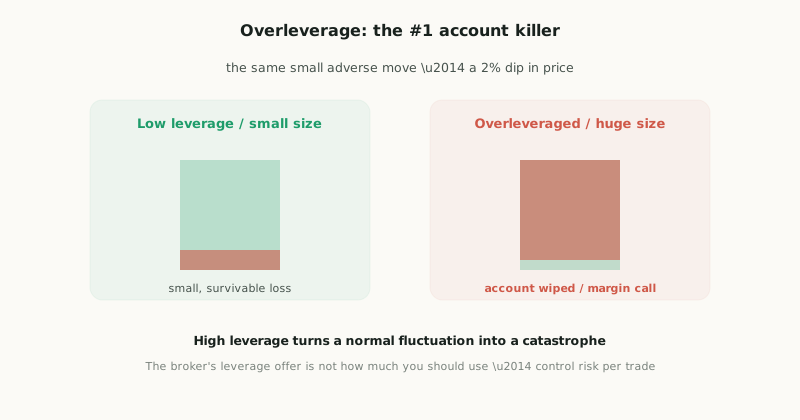
The danger becomes acute with excessive leverage, because it makes ordinary market movements catastrophic. With high leverage and a correspondingly large position, a small, entirely normal adverse price move — the kind that happens routinely — produces a large loss relative to your account. A 1% move against you might be trivial unleveraged, but heavily leveraged it could cost 20%, 50% or more of your account; a 2% move could wipe you out. Because markets fluctuate normally by such amounts all the time, an overleveraged trader is exposed to ruin from routine volatility, not just rare disasters — a perfectly ordinary wobble becomes fatal. This is compounded by margin calls (from the margin guide): when leveraged losses erode the capital backing the position below the required margin, the broker can forcibly close the position (liquidation), crystallising the loss at the worst moment and potentially before any recovery. So overleverage doesn't just risk large losses — it risks forced large losses triggered by normal market movement, leaving no room for the position to recover. The amplification that makes leverage attractive is precisely what makes its excess so destructive: it removes the margin for error that survival requires.
Overleverage destroys more retail accounts than any other single cause. It is so lethal because it kills with ordinary moves, not extraordinary ones: an overleveraged account can be wiped out by a routine fluctuation that a sensibly-sized account would barely notice. The trader feels in control — until a normal market wobble, amplified by excessive leverage, takes most or all of the account in one move, often via a forced margin-call liquidation. No edge, however good, survives overleverage, because you are destroyed before your edge can play out.
Position size is the real control
The most important and liberating insight about leverage is this: leverage itself is not the core risk control — position size is. A common confusion is to equate "how much leverage my broker offers" with "how much risk I'm taking," but these are different. The leverage available (the broker may offer 1:100, 1:500, or more) is merely the maximum position size your capital could control; it is not how much you must or should use. What actually determines your risk is your position size — how large a position you actually take — and you can have enormous leverage available while using very little of it by simply sizing your positions small.
This reframes the whole issue. The danger is never the availability of leverage but the use of too much of it — taking oversized positions. And the defence is the position-sizing discipline from the risk-management core: size each position so that it risks only a small, fixed percentage of your account (to its stop-loss), regardless of how much leverage is available. If you size your positions by risk-per-trade in this way, your actual leverage stays low and appropriate automatically, no matter what the broker offers — because risking 1% of your account on a trade with a sensible stop implies a modest position size, using only a fraction of the available leverage. In other words, position sizing controls your real leverage, and a trader who sizes positions properly is never overleveraged, even with 1:500 available. Conversely, a trader who ignores position sizing and "uses" the high leverage by taking huge positions is overleveraged and in mortal danger, even if the leverage offered is the same. The leverage number on the broker's account is a capacity, not an instruction: it tells you the most you could do, not what you should. The disciplined trader treats high available leverage as something to use sparingly — a fraction of what's offered — controlling actual risk through position size. This is why this site, like all sound risk teaching, emphasises position sizing and risk-per-trade rather than leverage ratios: control the size of your bets, and your leverage takes care of itself.
Avoiding overleverage
Avoiding overleverage, then, is largely a matter of disciplined position sizing and resisting temptation. The practical rules follow from the above. Size by risk, not by leverage: determine each position's size from your risk-per-trade rule (a small fixed percentage of the account to the stop-loss), not from how large a position the available leverage would allow — this keeps your real leverage low automatically. Treat the broker's leverage offer as a maximum to stay well below, not a target to reach: just because 1:500 is available does not mean you should use it; the prudent trader uses a small fraction. Respect the math of amplification: remember that high leverage means small moves cause large losses, so keep positions small enough that a normal adverse move — and even a larger-than-normal one — is survivable, leaving the margin for error that survival requires.
The hardest part is often psychological: the temptation of leverage is powerful. The promise of large gains from small capital lures traders — especially beginners and those trying to grow a small account quickly or recover losses — into using excessive leverage in pursuit of big, fast profits. This temptation is exactly when overleverage strikes: the trader takes an oversized, heavily-leveraged position chasing a big win, and a normal adverse move wipes them out. Resisting this temptation — accepting that prudent position sizing means smaller, slower gains in exchange for survival — is essential, and it connects to the trading-psychology lessons about greed, patience and the desire for quick riches. The honest, vital takeaway: leverage is a neutral tool, but overleverage — taking positions too large for your account — is the number-one way trading accounts are destroyed, because it turns ordinary market moves into catastrophic, often forced, losses that no edge can survive. You control it not by avoiding leverage but by controlling position size: size every trade by your risk-per-trade rule, treat available leverage as a capacity to use sparingly, and resist the temptation to chase big gains with oversized positions. Do this, and overleverage — the destroyer of so many accounts — simply cannot harm you, because your real risk stays controlled no matter what leverage is on offer. Survival first; and survival means never letting leverage size your positions for you.
Leverage limits and the small-account trap
It is telling that financial regulators in many regions have stepped in to cap the leverage offered to retail traders — precisely because overleverage was destroying so many accounts. Where some brokers once offered extreme leverage (and offshore brokers may still), various regulators now restrict retail forex leverage to far lower maximums, judging that the high figures lured inexperienced traders into ruinous positions. The exact limits vary by jurisdiction and change over time, but the principle behind them is the lesson of this guide: very high leverage is dangerous enough to retail traders that authorities limit it for their protection. That regulators felt compelled to act underscores just how lethal overleverage has proven in practice — it is not a theoretical risk but a documented, widespread cause of retail losses.
The most dangerous version of the temptation is the small-account trap. A trader with a small account, impatient to grow it into something meaningful (or to recover losses), reasons that only large, heavily-leveraged positions can produce worthwhile gains quickly — and so uses excessive leverage to take outsized bets. This is exactly the path to ruin: the oversized positions mean a normal adverse move wipes out a large share of the small account, and a short losing streak ends it. The hard truth, consistent with the risk-of-ruin and expectancy lessons, is that a small account cannot be safely grown quickly — prudent position sizing on a small account simply does produce small absolute gains, and trying to escape that math with leverage just converts the small account into a blown one faster. The disciplined path is to accept slow, survivable growth (or to add capital), not to reach for leverage to force speed. The trader who internalises this — that overleverage is the enemy, that the broker's leverage offer is a capacity to use sparingly, and that survival through proper position sizing must come before all else — has absorbed perhaps the single most important survival lesson in trading.
Leverage amplifies both gains and losses; overleverage (positions too large for your account) is the number-one destroyer of retail accounts because it turns ordinary adverse moves into catastrophic, often forced (margin-call) losses — no edge survives it. But leverage itself is neutral: the real control is position size, not the leverage offered. The broker's leverage (1:100, 1:500) is a maximum capacity, not an instruction — size each trade by your risk-per-trade rule (a small fixed % to the stop) and your actual leverage stays low automatically. Regulators cap retail leverage in many regions precisely because overleverage ruins so many. Beware the small-account trap: you can't safely grow a small account fast with leverage — that just blows it up quicker. Control position size, use leverage sparingly, and put survival first.