Before you can profit, you have to survive — and survival, it turns out, is a mathematical question with a name: risk of ruin. Risk of ruin is the probability that you will lose enough of your capital to be knocked out of the game entirely, unable to continue. It is the most fundamental risk a trader faces, because no edge, however good, matters if you blow up before it can play out. And the most important and counterintuitive lesson of risk of ruin is this: even a winning strategy can ruin you if you risk too much per trade. This guide explains what risk of ruin is, what drives it, and why keeping risk per trade small is the key to staying in the game.
It is the mathematical foundation beneath position sizing and the survival-first message of risk management, and it connects to the math of drawdowns.
Key takeaways
Q: What is risk of ruin?
A: Risk of ruin is the probability that a trader will lose enough of their capital to be unable to continue — effectively blowing up the account. It depends on the trader's edge (win rate and reward-to-risk), the percentage of capital risked per trade, and the variance of results.
Q: How do you reduce risk of ruin?
A: The most powerful lever is reducing the percentage of capital risked per trade. With a positive edge and a small risk per trade, such as 1-2%, the risk of ruin becomes very small. Risking large amounts per trade sharply raises the risk of ruin, even with a winning strategy.
Q: Can you go broke with a winning strategy?
A: Yes. Even a strategy with a positive edge can blow up an account if too much is risked per trade, because normal losing streaks (variance) can wipe out an over-leveraged account before the edge has time to play out. Survival requires sizing positions small enough to withstand inevitable losing runs.
What risk of ruin is
Risk of ruin is the probability of losing so much capital that you cannot continue trading — whether that means literally emptying the account, or falling below a threshold from which recovery is practically impossible. It reframes trading around the most basic question of all: not "how much can I make?" but "what are the odds I get wiped out?" Because being wiped out is terminal — you cannot trade your way back from zero — minimising the risk of ruin is the precondition for everything else. Survival comes first; profit is only possible for those who survive.
Risk of ruin depends on three things working together: your edge (your win rate and reward-to-risk ratio, which together determine your expectancy), the percentage of capital you risk per trade, and the variance inherent in any sequence of trades (the inevitable losing streaks). These combine to determine the probability that a run of losses drives your account to ruin before your edge can compound it upward. Understanding how these factors interact — and which of them you most control — is the heart of risk-of-ruin thinking, and it leads directly to the practical disciplines of position sizing. The key realisation is that ruin is not just about having a bad strategy; it is about the interaction of edge, bet size and variance.
The role of edge
The first factor is your edge — whether your strategy has positive expectancy, as covered in the expectancy guide. Edge sets the fundamental backdrop for risk of ruin. With a negative edge (negative expectancy), ruin is essentially certain eventually, regardless of how you size your bets: a losing strategy will grind your account to nothing over enough trades, because each trade loses on average. No position-sizing cleverness can save a strategy that lacks an edge — it merely changes how quickly ruin arrives. This is why having a genuine edge is the non-negotiable starting point.
With a positive edge, ruin becomes avoidable but not automatically avoided. A winning strategy tilts the odds in your favour over many trades, but it does not eliminate losing streaks, and — crucially — it does not by itself guarantee survival, because how you size your bets determines whether you survive long enough for the edge to express itself. This is the pivotal insight: a positive edge is necessary for long-term survival but not sufficient. You can have a genuinely winning strategy and still blow up, if you risk too much per trade and a normal losing streak ruins you before the edge compounds. Edge gets you in the game; position sizing keeps you there.
The decisive factor: risk per trade
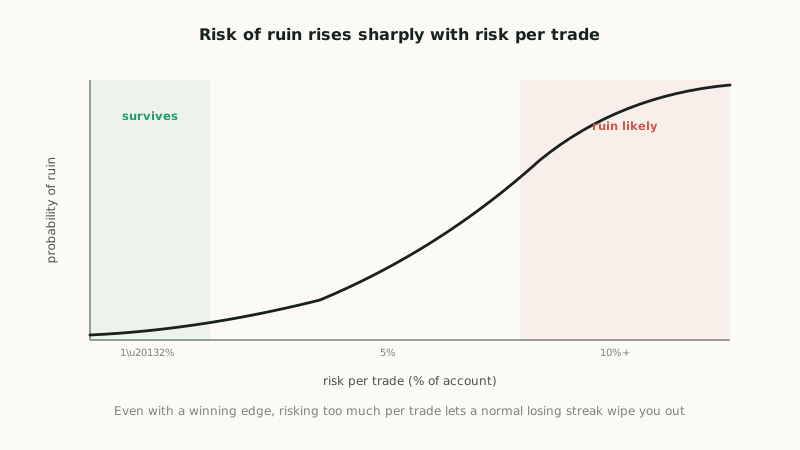
The factor you most control, and the one that most powerfully determines risk of ruin, is the percentage of capital you risk per trade. This is where the mathematics becomes both striking and practical. As risk per trade increases, the risk of ruin rises sharply and non-linearly — doubling your risk per trade does far more than double your risk of ruin. Conversely, keeping risk per trade small drives the risk of ruin down dramatically. With a positive edge and a small risk per trade (the familiar 1-2% rule), the risk of ruin can be reduced to a very small number — near zero for practical purposes. With a large risk per trade, even a good edge faces a meaningful, sometimes alarming, chance of ruin.
The reason is variance — the inevitability of losing streaks. Even a strategy that wins 60% of the time will, over many trades, produce runs of consecutive losses; a long enough losing streak is not just possible but statistically certain to occur eventually. If your risk per trade is large, such a streak can devastate or wipe out your account before your edge has a chance to recover it. If your risk per trade is small, the same streak causes only a manageable drawdown that your edge can recover from. This is precisely why a winning strategy can still ruin you: the variance produces a losing streak, and oversized bets turn that streak into ruin. Small position sizes are the buffer that lets you absorb the inevitable losing runs and survive to let your edge work. This is the mathematical heart of the 1-2% rule from the position-sizing guide — it is not arbitrary caution but the lever that drives risk of ruin toward zero.
A winning strategy can still blow up your account. Variance guarantees losing streaks; if you risk too much per trade, a normal streak ruins you before your edge can compound. Risk of ruin rises steeply with bet size, so small position sizing (1-2%) is not timidity — it is the mathematical mechanism that keeps ruin near zero and lets your edge actually play out.
Sequence risk and the order of trades
A subtle but important aspect of risk of ruin is sequence risk — the danger posed by the order in which wins and losses arrive. Over a long run, a positive-edge strategy should profit; but the sequence matters enormously for survival, because a cluster of losses arriving early, before you have built any cushion of profit, is far more dangerous than the same losses arriving later. A run of losses at the very start can ruin an over-leveraged account before the edge has produced anything to absorb them.
This is why two traders with the identical winning strategy can have completely different fates depending on the luck of the draw in their early trades — and why prudent position sizing matters most for protecting against bad early sequences. Sizing small means even an unlucky early losing streak causes only a survivable drawdown, preserving your capital and your ability to continue until the edge asserts itself. It also reinforces a humbling truth: there is genuine randomness in trading outcomes, especially over short runs, and even a sound strategy can be derailed by an unlucky sequence if poorly sized. The defence, once again, is conservative position sizing, which makes you robust to bad sequences rather than dependent on a favourable one. Survival is partly about edge, but it is also about being sized to withstand the worst that variance and sequence can throw at you early on.
Putting survival first
The practical philosophy that flows from risk of ruin is survival first — the recognition that staying in the game is the precondition for profiting from it, and that avoiding ruin therefore takes precedence over maximising returns. This inverts the beginner's instinct to focus on gains: the experienced trader's first question is "how do I make sure I don't get wiped out?", because they understand that ruin is terminal while drawdowns are recoverable. Trading conservatively enough to drive the risk of ruin toward zero is the foundation on which all long-term success is built.
Concretely, this means: ensure you have a genuine edge (without it, ruin is certain); risk only a small percentage per trade (the single most powerful lever, driving ruin sharply down); and size to withstand the inevitable losing streaks and unlucky early sequences. These are exactly the disciplines of the position-sizing and risk-management guides, and risk of ruin provides their mathematical justification — it explains why the 1-2% rule works and why over-leveraging is fatal. The deep lesson is that trading success is less about being right more often or making spectacular gains, and more about not getting wiped out while a modest edge compounds over time. Master the risk of ruin — keep it near zero through small, disciplined position sizing — and you give your edge the time it needs to turn into profit. Ignore it, risk too much, and even a winning strategy can end in ruin.
Risk of ruin is the probability of losing enough capital to be knocked out of the game. It depends on your edge, your risk per trade, and variance. A negative edge means ruin is eventually certain; a positive edge makes survival possible but not guaranteed — because oversized bets let a normal losing streak (or unlucky early sequence) wipe you out before the edge compounds. Risk per trade is the decisive lever: ruin rises steeply with bet size, so small position sizing (1-2%) drives it near zero. Survival comes first — it's the precondition for profit.