Ask a beginner about a trading strategy and they will ask "what's the win rate?" Ask a professional and they will ask "what's the expectancy?" — and that difference in question reveals a fundamental misunderstanding that costs many traders dearly. The truth is that win rate alone is meaningless: you can win the large majority of your trades and still lose money, or lose the majority and still profit handsomely. The number that actually determines whether a strategy makes money is expectancy, which combines your win rate and the size of your wins and losses into your true edge. This guide explains expectancy, why win rate alone deceives, and why expectancy is the number that matters.
It combines the reward-to-risk ratio with win rate into the edge that risk of ruin and all of risk management depend on.
Key takeaways
Q: What is expectancy in trading?
A: Expectancy is the average amount you can expect to win or lose per trade, calculated as (win rate × average win) minus (loss rate × average loss). Positive expectancy means a genuine edge that profits over many trades; negative expectancy means a losing system, regardless of win rate.
Q: Why is win rate alone meaningless?
A: Because win rate ignores the size of wins and losses. A high win rate can still lose money if the losses are larger than the wins, and a low win rate can be highly profitable if the wins are much larger than the losses. Only expectancy, which accounts for both, reveals whether a system makes money.
Q: Can you be profitable with a low win rate?
A: Yes. A strategy that wins only 40% of the time can be very profitable if its average win is much larger than its average loss — for example, winning trades of 3R and losing trades of 1R produce positive expectancy. Trend-following strategies often have low win rates but high expectancy.
The win-rate trap
The intuitive appeal of win rate — the percentage of your trades that are winners — is obvious: winning feels like succeeding, so a high win rate seems like a good strategy. This intuition is a trap, and it is one of the most common and costly misunderstandings in trading. The problem is that win rate, by itself, tells you nothing about whether you make money, because it completely ignores the size of your wins and losses.
Consider the two ways this deceives. A trader can have a high win rate and lose money: if they win 70% of trades but their occasional losses are far larger than their frequent small wins, the big losses overwhelm the many small gains, and the account bleeds despite "winning most of the time." This is dangerously seductive, because the frequent wins feel like success while the capital quietly erodes. Conversely, a trader can have a low win rate and make money: if they win only 40% of trades but their wins are much larger than their losses, the large wins more than cover the frequent small losses, and the account grows despite "losing most of the time." This feels counterintuitive and even uncomfortable — losing more often than winning — yet it is how many of the most successful strategies (trend following especially) operate. Win rate alone cannot distinguish a profitable strategy from a losing one, which is exactly why focusing on it leads traders astray.
What expectancy is
Expectancy is the number that fixes the win-rate trap by accounting for both how often you win and how much you win and lose. It is the average amount you can expect to win (or lose) per trade, calculated as:
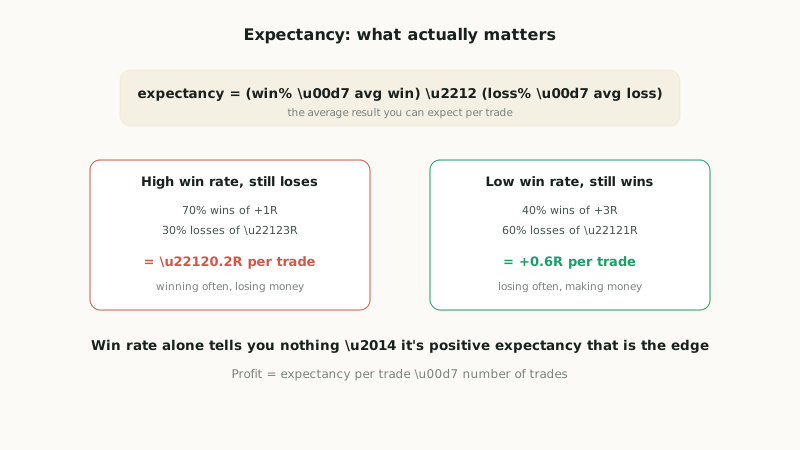
Expectancy = (win rate × average win) − (loss rate × average loss)
A positive expectancy means that, on average, each trade makes money — you have a genuine edge, and the strategy will profit over many trades. A negative expectancy means each trade loses on average — a losing system that will erode your capital over time, regardless of its win rate. Zero expectancy is break-even (before costs). Expectancy is, in essence, the mathematical definition of an edge, and it is the single most important number to know about any strategy.
Expectancy is often expressed in R — multiples of the amount risked per trade — which makes it clean and comparable. If your average loss is 1R (you risk 1R and lose it) and your average win is some multiple of R, expectancy in R is (win% × average win in R) − (loss% × average loss in R). For example, a strategy winning 40% of the time with average wins of 3R and average losses of 1R has expectancy of (0.4 × 3) − (0.6 × 1) = 1.2 − 0.6 = +0.6R per trade — strongly positive despite the sub-50% win rate. Meanwhile a strategy winning 70% but with average wins of 1R and average losses of 3R has expectancy of (0.7 × 1) − (0.3 × 3) = 0.7 − 0.9 = −0.2R per trade — negative despite the high win rate. The formula lays bare what win rate alone conceals.
The interplay of win rate and reward-to-risk
Expectancy reveals that win rate and the reward-to-risk ratio (the size of wins relative to losses, covered in its own guide) are two halves of a whole, and that they trade off against each other. A strategy can achieve positive expectancy through different combinations: a high win rate with modest reward-to-risk, or a low win rate with high reward-to-risk — and many points in between. What matters is not either number alone but how they combine into expectancy.
This explains the characteristic profiles of different strategy types. Trend-following strategies typically have low win rates but high reward-to-risk — many small losses punctuated by occasional large winners that ride trends — producing positive expectancy from the big wins despite frequent losses. Range-trading or scalping strategies often have high win rates but lower reward-to-risk — frequent small wins — which can be profitable but is vulnerable to the occasional large loss that can wipe out many small gains (the high-win-rate trap if losses are not controlled). Neither profile is inherently better; both can have positive expectancy. Understanding this interplay frees you from the false belief that you need a high win rate, and lets you evaluate any strategy by the only thing that matters: does the combination of its win rate and reward-to-risk produce positive expectancy? It also explains why letting winners run and cutting losses short (improving reward-to-risk) can make even a modest win rate highly profitable.
Win rate and reward-to-risk trade off, and only their combination — expectancy — matters. This is liberating: you don't need to be right often. A 40% win rate with 3:1 winners beats a 70% win rate with 3:1 losers. Stop chasing a high win rate and start maximising expectancy, which is what "let winners run, cut losses short" actually does.
From expectancy to profit
Expectancy connects to actual profit through a simple relationship: your total profit over time is roughly your expectancy per trade multiplied by the number of trades. A positive expectancy of, say, +0.3R per trade, applied over 200 trades, yields about +60R of profit (before considering compounding and position sizing). This shows why expectancy is the engine of profitability — it is the per-trade edge that, repeated over many trades, accumulates into your overall result.
This relationship has two important implications. First, it underscores that trading profit comes from repeatedly applying a positive-expectancy edge over many trades, not from any single trade — which is why the process-over-outcome and consistency themes recur throughout this site. Any individual trade's outcome is dominated by variance; it is the expectancy expressed over many trades that produces reliable profit. Second, it shows that frequency matters alongside expectancy: a smaller edge applied more often can outproduce a larger edge applied rarely, though more trades also means more exposure to costs. The combination of a positive expectancy and a sufficient number of quality trades, sized properly to survive the variance (the risk-of-ruin lesson), is the complete recipe for profitability. Expectancy is the edge; survival lets it compound; frequency scales it. Focusing on building and protecting a positive expectancy — rather than chasing a high win rate — is what separates traders who understand their craft from those who do not.
Using expectancy in practice
Practically, expectancy should be the lens through which you evaluate and improve your trading. Calculate it from your trading journal — your record of actual wins, losses and their sizes (which is one of the most valuable reasons to keep a journal, as the journal guide explains) — to know whether your real trading has a positive edge, rather than guessing. A strategy with proven positive expectancy in your own results is one worth trading and scaling; one with negative expectancy needs fixing or abandoning, however good its win rate feels.
Expectancy also guides improvement. Since expectancy combines win rate and reward-to-risk, you can improve it by raising either: tightening your strategy to win more often, or — often more powerfully — improving your reward-to-risk by letting winners run and cutting losses short. Many traders find the biggest gains come from the reward-to-risk side, because improving how much you make on winners and lose on losers can transform a marginal strategy into a strongly positive one without needing to win more often. Above all, expectancy reframes the goal of trading correctly: not to be right as often as possible, but to have a positive edge that, applied with discipline over many trades and protected by sound position sizing, compounds into profit. Internalising that expectancy, not win rate, is what makes money is one of the most important conceptual leaps a developing trader can make.
Win rate alone is meaningless — you can win most trades and lose money, or lose most and profit. Expectancy = (win rate × average win) − (loss rate × average loss) is the average result per trade and the true measure of your edge: positive means profitable over many trades, negative means a losing system. Win rate and reward-to-risk trade off, so a low win rate with big winners (trend following) can beat a high win rate with big losers. Total profit ≈ expectancy × number of trades. Track it from your journal and improve it — it's the number that matters.