If there is one habit that separates traders who improve from those who plateau, it is keeping a trading journal. It is the highest-value, lowest-effort practice in all of trading — a simple record of every trade that transforms your trading from a stream of forgettable decisions into a body of evidence you can learn from. Without a journal, you cannot systematically improve; you simply repeat your mistakes, unaware of the patterns in your own behaviour. With one, every trade — winner or loser — becomes a lesson, and your trading becomes a genuine skill that compounds over time. This guide explains what to record, why journaling matters so much, and how the review process turns records into improvement.
It is the feedback engine behind the trading plan, the data source for expectancy, and a key tool for the psychology of trading.
Key takeaways
Q: What is a trading journal?
A: A trading journal is a record of every trade you take, including the entry, exit, stop, target, position size, the reasoning or setup behind it, the result, and notes on your execution and emotional state. It provides the feedback you need to review your trading objectively and improve.
Q: Why is keeping a trading journal important?
A: A journal is the feedback loop that lets you improve systematically. It reveals which setups work and which leak money, enforces accountability, lets you judge your process separately from outcomes, and provides the data to calculate your real expectancy. Without it, you tend to repeat mistakes unknowingly.
Q: What should you record in a trading journal?
A: Record the date, pair and direction; your entry, exit, stop and target; your position size and risk; the setup or reason for the trade; the result (ideally in R multiples); and notes on how you executed and how you felt, including any mistakes or deviations from your plan.
What a trading journal is
A trading journal is a record of every trade you take — not just the numbers, but the reasoning and context behind each one. At its core it is a log: each trade documented with its key details, kept consistently over time so that a picture of your trading builds up. The journal can be a spreadsheet, a notebook, or dedicated software; the format matters far less than the habit of recording every trade, honestly and consistently. It is your trading's memory and its evidence base.
The purpose of the journal is to provide feedback — the information you need to see what you are actually doing, evaluate it objectively, and improve. Trading without a journal is like trying to improve at a skill with your eyes closed: you take action after action with no clear record of what worked, what didn't, or why, so you cannot learn systematically and tend to repeat the same mistakes. The journal opens your eyes, turning the formless flow of trades into structured data you can analyse. This feedback function is why the journal is so central to improvement, and why nearly every serious trader keeps one. It is the mechanism by which experience actually becomes learning rather than just repetition.
What to record
A useful journal entry captures both the hard data and the softer context of each trade. The hard data includes: the date, the pair, and the direction (long/short); your entry, exit, stop-loss and take-profit levels; your position size and the amount (or percentage) risked; and the result, ideally expressed in R multiples (how many multiples of your risk you won or lost), which makes trades comparable and feeds directly into your expectancy calculation. This quantitative record is the backbone of the journal and the basis for the statistical review.
Just as valuable is the qualitative context: the setup or reason for the trade (what your strategy identified, why you took it), notes on your execution (did you follow your plan, or deviate?), and — importantly — your emotional state and any mistakes (were you anxious, overconfident, revenge trading; did you move your stop, exit early out of fear, or break a rule?). This emotional and behavioural record is what makes the journal a tool for the psychological side of trading, not just the mechanical side. Over time, these notes reveal your recurring patterns — the emotional triggers, the rule-breaking, the situations where you falter — which are often the real obstacles to improvement. Recording how you felt and how you behaved, alongside what you did, captures the full picture needed to understand and improve your trading.
Why journaling drives improvement
The journal drives improvement through several mechanisms. First, it reveals patterns — both strengths and weaknesses — that are invisible in the moment but obvious across many recorded trades. You discover which setups are genuinely profitable and which are "leaks" that lose money; which conditions suit you and which don't; what times, pairs or situations produce your best and worst results. These patterns, drawn from your own data, are far more valuable than generic advice, because they are specific to you. Identifying and fixing leaks — cutting the losing setups, doing more of the winning ones — is one of the most direct routes to improvement, and it is only possible with a journal.
Second, the journal enforces accountability and honesty: recording every trade, including the ones where you broke your rules, confronts you with your actual behaviour rather than a flattering memory of it. Third, and crucially, it enables the process-over-outcome evaluation the psychology section emphasises: by recording whether you followed your plan separately from whether the trade won, you can judge the quality of your decisions independent of their random outcomes. A trade that followed your plan but lost was a good trade; one that broke your rules but won was a bad one (you got lucky). This distinction — impossible without a record — is fundamental to improving, because it focuses you on the process you control rather than the outcomes you don't. The journal is what makes process-focused trading practically possible.
The journal lets you judge the process, not just the outcome. A losing trade that followed your plan is a good trade; a winning one that broke your rules is a bad trade you got lucky on. Without a record you can't tell them apart — so you learn the wrong lessons from random outcomes. The journal is how experience becomes genuine learning instead of mere repetition.
The review process
A journal only delivers its value when you review it — recording trades is necessary but not sufficient; the learning happens in the analysis. Regular review (weekly, monthly, or both) is where you step back from individual trades and examine the body of evidence: calculating your statistics (win rate, average win and loss, and crucially your expectancy), spotting the patterns and leaks, and assessing whether you followed your plan. This is the analytical heart of improvement, turning raw records into actionable insight.
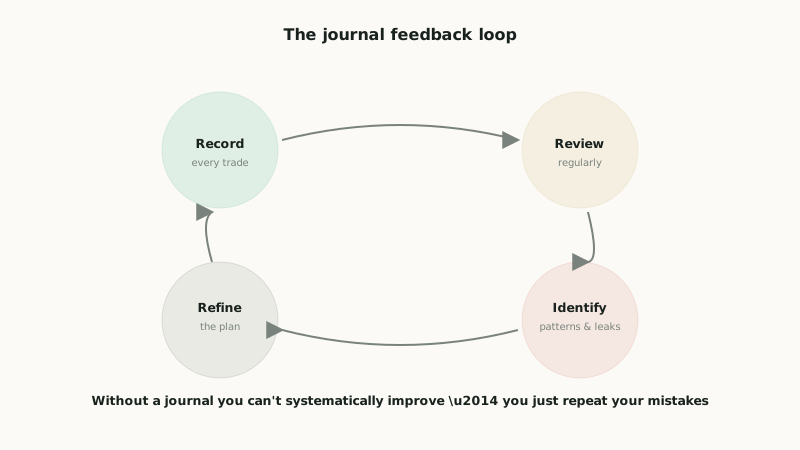
The review feeds a feedback loop: you record your trades, review them to identify what's working and what's leaking, refine your trading plan accordingly, then trade and record again — a continuous cycle of improvement. This loop is how trading becomes a skill that genuinely develops rather than a static activity, and it connects the journal directly to the trading plan, which is refined based on what the journal reveals. The key discipline in review is to be objective and honest — looking for the truth in your data, including uncomfortable truths about your mistakes and emotional patterns, rather than seeking comfort or excuses. Reviews should also be done calmly and periodically, drawing conclusions from many trades, not reacting emotionally to the last one. Done well, the review process is where the journal pays its enormous dividends, converting the simple habit of recording trades into steady, evidence-based improvement over time.
Making it a habit
The journal's value is realised only through consistency, so the practical challenge is making it a sustained habit. Record every trade, ideally soon after taking it while the reasoning and emotions are fresh, and resist the temptation to skip the losers or the embarrassing rule-breaks — those are often the most instructive entries. Keep the format simple enough that you will actually maintain it: an elaborate journal you abandon is worse than a simple one you keep. The aim is a sustainable habit, not a perfect record.
The journal ties together much of what this site teaches. It provides the data to calculate expectancy and verify your edge; it enables the process-over-outcome evaluation central to trading psychology; it feeds the refinement of your trading plan; and it reveals the behavioural and emotional patterns that often separate success from failure. For so little effort — a few minutes per trade and a periodic review — it delivers more improvement than almost any other single practice, which is why it is described as the highest-value, lowest-effort habit in trading. A trader who journals consistently, reviews honestly, and refines based on the evidence has a feedback loop that turns experience into genuine, compounding skill — while one who trades without a journal is left repeating mistakes they cannot even see. Start a journal, keep it faithfully, and let it make every trade a lesson.
Tools and what to track over time
The journal's format matters far less than the habit, but a few practical choices help. A simple spreadsheet is enough for most traders and has the advantage of letting you calculate your statistics automatically — win rate, average win and loss, expectancy, and totals — as you log trades. Dedicated journaling software can automate much of this and add charts and analytics, which some find motivating, but it is not necessary; the discipline of recording and reviewing matters more than the sophistication of the tool. Choose whatever you will actually maintain consistently.
Beyond individual trades, it is worth tracking a few things over time to see the bigger picture. Your equity curve — a running chart of your account balance — reveals at a glance whether you are trending up, flat or down, and how smooth or volatile your results are. Your expectancy and key statistics, recalculated periodically, tell you whether your edge is holding, improving or degrading. And tracking your adherence to your plan — what fraction of trades followed your rules versus deviated — turns discipline itself into a measurable metric you can work to improve. These higher-level views, built from the individual entries, are where much of the journal's strategic value lies.
Watching these measures over time also guards against two opposite errors: complacency when a lucky streak flatters poor process, and panic when an unlucky streak punishes good process. Because you can see your expectancy and plan-adherence across many trades, you judge yourself by the durable evidence rather than the latest outcome — the process-over-outcome discipline made concrete. A journal that captures both the trade-by-trade detail and these over-time metrics gives you the complete feedback picture: what you did, how well you followed your plan, and whether your edge is real and holding — everything you need to improve systematically.
A trading journal records every trade — entry, exit, stop, target, size, the setup/reason, the result (in R), and notes on execution and emotion. It's the feedback loop that drives improvement: record, review regularly, identify patterns and leaks, refine your plan, repeat. A simple spreadsheet suffices; track your equity curve, expectancy and plan-adherence over time. It reveals which setups work, enforces honesty, provides your expectancy data, and lets you judge process separately from random outcomes. The highest-value, lowest-effort habit in trading — keep it consistently and review it honestly.