
Ask most struggling traders what they need and they will say a better strategy, a sharper indicator, a more reliable setup. They are almost always wrong. The overwhelming majority of traders fail not because they lack a strategy, but because they cannot follow the one they have. They know to cut losses and let winners run — and then, under the pressure of a live trade, do precisely the opposite. Trading psychology is the study of this gap between knowing and doing, and mastering it is, alongside risk management, the true deciding factor in whether a trader succeeds. This guide explains why the mind matters more than the method, and how to begin mastering it.
Trading psychology is the inseparable partner of risk management: risk rules only protect you if you have the discipline to follow them, and discipline is a psychological skill.
Key takeaways
Q: What is trading psychology?
A: Trading psychology is the study and management of the emotions and mental biases that influence trading decisions. It addresses how fear, greed, and cognitive biases cause traders to deviate from their plans, and how discipline and self-awareness keep decisions rational under pressure.
Q: Why is psychology so important in trading?
A: Because most traders fail not from lack of knowledge but from failing to follow what they know. Emotions like fear and greed hijack decisions in the moment, so the ability to stay disciplined and execute a plan consistently is often the deciding factor between success and failure.
Q: What is the knowing-doing gap in trading?
A: It is the gap between understanding the right action and actually taking it under emotional pressure. A trader may know to cut losses and let winners run, yet do the opposite when fear and greed take over. Closing this gap through discipline is the core challenge of trading psychology.
The deciding factor
It is often said that trading is "80% psychology," and while the exact figure is unprovable, the spirit is correct: at the level of two traders with similar knowledge, what separates them is almost entirely psychological. Both may recognise the same setups, understand the same risk principles, and know the same rules. The difference is that one executes those rules consistently under pressure while the other, gripped by emotion, abandons them at the worst possible moments — holding a loser in hope, cutting a winner in fear, oversizing after a win, chasing a trade out of greed.
This is why a sophisticated strategy is worth far less than the discipline to follow a simple one. The market is an environment expressly designed to provoke emotion: real money is at stake, outcomes are uncertain, and losses and gains trigger powerful instinctive responses. Those instincts — honed for survival, not for trading — are frequently the exact opposite of what successful trading requires. The trader's central task is therefore not primarily to predict the market but to manage themselves within it, and that is what trading psychology trains.
The two dominant emotions
Two emotions drive most trading mistakes: fear and greed. Fear causes a trader to hesitate on valid setups, cut winning trades too early, panic-exit at the worst moment, and freeze after a loss. Greed causes the opposite excesses: oversizing positions, holding winners until they turn into losers, overtrading, chasing moves, and refusing to take profit. Between them, fear and greed account for the great majority of the ways traders deviate from their plans, and they are explored in depth in fear and greed in trading.
What makes these emotions so dangerous is that they strike precisely when clear thinking matters most — in the heat of a live position with money on the line. The antidote, which runs through everything in trading psychology, is pre-commitment: making decisions in advance, when calm and rational (where to enter, where the stop goes, where to take profit, how much to risk), and then executing that plan mechanically when emotion would otherwise take over. A decision made in advance cannot be hijacked by an emotion that has not yet arisen.
The cycle of market emotions
Beyond the individual trader, emotion operates at the level of the whole crowd, producing a recognisable cycle of market emotions that drives the boom-and-bust patterns the classical theories describe. As a market rises, the crowd moves from optimism to excitement to outright euphoria at the top — the point of maximum financial risk, precisely when it feels safest. As the market falls, euphoria gives way to anxiety, denial, fear, and finally panic and capitulation at the bottom — the point of maximum opportunity, precisely when it feels most hopeless.
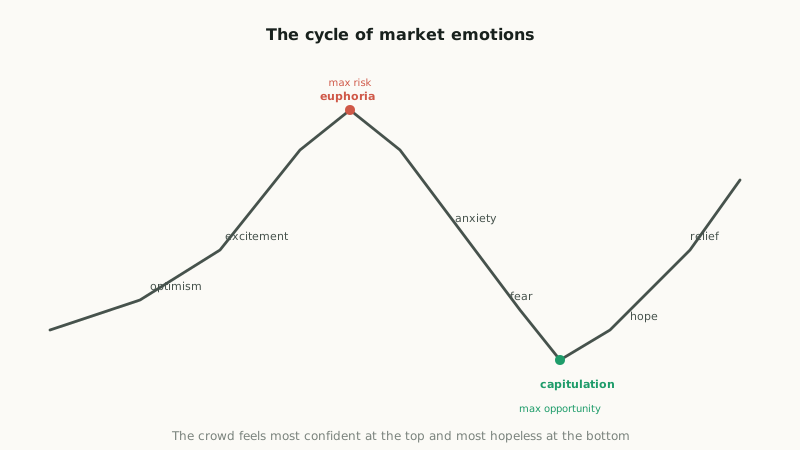
This cycle is the psychological engine behind Dow's market phases, Wyckoff's accumulation and distribution, and the "smart money buys when others despair" narrative of Smart Money Concepts. The practical lesson is contrarian and humbling: your own emotions tend to peak in the wrong direction at the wrong time, feeling most bullish at tops and most bearish at bottoms. Recognising that your feelings are part of this crowd cycle — and therefore often a signal to do the opposite — is one of the most valuable forms of self-awareness a trader can develop.
Your emotions are not private — they are part of the crowd's emotional cycle, and they tend to peak in exactly the wrong direction at exactly the wrong time. Feeling euphoric and certain near a top, or hopeless near a bottom, is not insight; it is the crowd cycle operating through you.
Biases beneath the emotions
Beneath the obvious emotions lie subtler distortions: cognitive biases, the systematic errors in thinking that affect all human decision-making and are especially costly in trading. Confirmation bias leads traders to seek only information that supports their position; loss aversion makes losses hurt about twice as much as equivalent gains feel good, causing traders to hold losers and cut winners; overconfidence after a winning streak prompts reckless oversizing. These biases are explored in cognitive biases in trading.
The important thing to understand is that biases cannot simply be willed away — they are built into human cognition, and even traders who know about them remain susceptible. What discipline and self-awareness can do is limit their damage: a rules-based process, made in advance and followed mechanically, constrains the situations in which a bias can hijack a decision. You cannot delete confirmation bias, but a rule that forces you to define your invalidation level before entering means the bias has less room to operate. The goal is not a bias-free mind — impossible — but a process robust enough to limit what your biases can cost you.
Closing the knowing-doing gap
The solution that runs through all of trading psychology is the cultivation of discipline — the consistent ability to execute a pre-defined plan regardless of what you feel in the moment. This is built through several reinforcing habits: a written trading plan that pre-commits your decisions; a routine that keeps you in a stable, prepared state; a trading journal that builds self-awareness by recording not just trades but the emotions around them; and a focus on process over outcome — judging yourself on whether you followed your plan, not on whether a given trade won. These are covered in building trading discipline.
The reframing at the heart of it all is to stop seeing trading as a series of predictions to get right and start seeing it as a process to execute well. A trade that loses while following the plan is a success; a trade that wins by breaking the rules is a failure, because of the habit it reinforces. This shift — from outcome to process, from prediction to discipline, from controlling the market to controlling yourself — is what closes the knowing-doing gap. It is harder than learning any strategy, which is exactly why so few traders manage it, and why those who do gain such an advantage.
A note on perspective
Finally, a word of perspective that the intensity of trading can obscure. Trading is meant to be a disciplined financial activity, not a source of emotional turmoil — and if it begins to feel compulsive, to dominate your thoughts, or to cause genuine distress, that is a sign to step back rather than push harder. The healthiest traders treat it as a process to be executed calmly, are willing to walk away during a bad run, and never risk money they cannot afford to lose. If trading ever starts to feel like a compulsion you cannot control, or to harm your wellbeing or relationships, stepping away and seeking support from people you trust is the wise and strong choice, not a failure. Sustainable trading and a sustainable life go together.
Self-awareness as the first skill
Before any technique can help, one skill underpins all of trading psychology: self-awareness — the ability to notice your own emotional and mental state as it is happening, rather than only recognising it in hindsight. The reason fear and greed are so effective at hijacking decisions is that they usually operate below conscious notice; by the time you have acted, the emotion has already done its work. A trader who can catch the feeling as it arises — the flush of greed as a move accelerates, the tightening of fear as a position dips — gains a precious moment of choice before the impulse becomes an action.
This awareness is trainable. Keeping a trading journal that records emotions alongside trades builds it over time, as you start to recognise the recurring states that precede your mistakes. So does the simple habit of pausing to check in with yourself before entering a trade: am I calm and following my plan, or am I feeling the pull of fear, greed, boredom or the urge to recover a loss? Naming the state out loud or in writing weakens its grip, because a feeling that has been consciously identified is far easier to set aside than one operating in the dark. Self-awareness does not eliminate the emotions — nothing does — but it creates the gap between feeling and acting in which discipline becomes possible. It is the foundation on which every other psychological skill is built.
Most traders fail not from lack of knowledge but from failing to follow what they know — the knowing-doing gap. Fear and greed hijack decisions in the moment; cognitive biases distort them beneath the surface; and your emotions ride the crowd cycle, peaking wrongly at tops and bottoms. The answer is discipline built on self-awareness: notice your state, pre-commit your decisions, follow a process, and judge yourself on execution, not outcome. If trading ever feels compulsive or harmful, step back — that is strength, not failure.