Behind almost every trading mistake stand two emotions: fear and greed. They are the twin forces that pull traders off their plans, and they are powerful precisely because they are ancient, instinctive, and largely unconscious — they act on you before you have noticed they are there. Fear makes you too cautious; greed makes you too reckless. Both feel, in the moment, like sound judgement. Learning to recognise exactly how each one sabotages your trading is the first and most important step toward disarming them. This guide breaks down the specific damage each emotion causes and how a rules-based approach keeps them in check.
They are the dominant emotions introduced in trading psychology explained, and they feed the destructive behaviours covered in revenge trading and FOMO.
Key takeaways
Q: How do fear and greed affect trading?
A: Fear causes traders to hesitate on valid setups, cut winning trades too early, panic-exit, and freeze after losses. Greed causes oversizing, holding winners until they reverse, overtrading, chasing moves, and refusing to take profit. Both lead traders to abandon their plans.
Q: How do you control fear and greed in trading?
A: The most effective method is pre-commitment: deciding entries, stops, targets and position sizes in advance when calm, then executing that plan mechanically. A written plan removes in-the-moment decisions, which is exactly when fear and greed do their damage.
Q: Is greed worse than fear in trading?
A: Neither is worse; they cause different damage. Fear costs you opportunity and profit by making you too cautious, while greed costs you capital by making you reckless. Both pull you away from your plan, and disciplined traders guard against both.
How fear sabotages
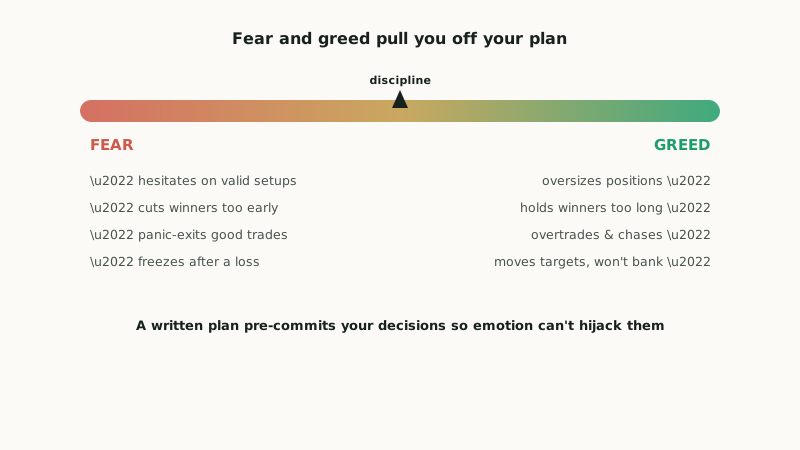
Fear is the emotion of loss and uncertainty, and it produces a recognisable set of self-defeating behaviours. It makes a trader hesitate on valid setups — seeing a textbook entry but failing to take it, paralysed by the fear of being wrong, then watching the trade work without them. It makes them cut winners too early — exiting a profitable trade at the first wobble, terrified of giving back the gain, and so systematically capping their winners far below their potential. It makes them panic-exit — bailing out of a perfectly valid trade during a normal pullback because the temporary drawdown is unbearable.
Fear also causes traders to freeze after a loss, becoming so loss-averse that they cannot take the next valid setup — which, by the odds, may well have been a winner that recovered the loss. The common thread is that fear makes you too cautious at the wrong moments: it does not protect you from bad trades so much as rob you of good ones and of the full profit on your winners. Its cost is opportunity and upside — the trades not taken and the gains not captured — which is invisible on a statement but very real in the difference between a trader's potential and actual results.
How greed sabotages
Greed is the emotion of gain and desire, and its damage is the mirror image of fear's. It makes a trader oversize positions — risking too much because a setup looks irresistible or to make back a loss faster — violating position sizing and exposing the account to a damaging loss. It makes them hold winners too long — refusing to take profit at a sensible target because they want more, watching a healthy winner reverse into a loser as they wait for a gain that never comes. It makes them overtrade — taking marginal, low-quality setups out of a hunger for action and profit, when patience and selectivity would serve far better.
Greed also produces chasing — jumping into a move already well underway because of the fear of missing out on profit, entering at a poor price with no proper setup — and the refusal to bank profit, constantly moving targets further away as price approaches them. The common thread is that greed makes you too reckless at the wrong moments: it does not maximise your gains so much as it exposes your capital to outsized risk and converts winners into losers. Where fear costs opportunity, greed costs capital, and capital is the thing you cannot afford to lose.
The push and pull
What makes fear and greed so insidious is that they often operate in sequence, whipsawing a trader between extremes. A trader cuts a winner early out of fear, then watches it continue without them and, gripped by greed and regret, chases it back in at a worse price — only to panic-exit again on the next wobble. A losing trade triggers fear and a frozen state, which curdles into the greedy, reckless desire to win it back fast. The two emotions do not just cause isolated mistakes; they create destructive cycles, each feeding the other, that can unravel a trader's discipline over the course of a single session.
This push and pull is also why the emotions are so hard to fight with willpower alone. In the moment, fear and greed do not announce themselves as emotions — they masquerade as reasonable thoughts ("the trend looks weak, I should take my profit"; "this move is too strong to miss"). By the time you recognise the feeling, the impulse has often already shaped your decision. Trying to out-argue these emotions trade by trade, in real time, is a losing battle, because they are faster and more persuasive than deliberate reasoning under pressure.
You cannot reliably defeat fear and greed in the moment, because they disguise themselves as good judgement and act before you notice them. The only dependable defence is to decide in advance, when calm, and remove the in-the-moment decision entirely — a plan made by your rational self to constrain your emotional self.
The antidote: pre-commitment
Since fear and greed cannot be reliably beaten in real time, the solution is to take the decisions away from your in-the-moment self and give them to your calm, rational, pre-trade self. This is pre-commitment, and it is the master technique of trading psychology. Before entering a trade — when no money is yet at risk and emotion is quiet — you decide everything: where you will enter, where the stop goes, where you will take profit, and how much you will risk. Then, once in the trade, your only job is to execute the plan you already made, not to make new decisions under emotional pressure.
This is precisely why the risk management tools matter so much psychologically as well as financially. A pre-set stop loss defeats fear's panic-exit and greed's refusal to cut a loser, because the exit was decided in advance. A pre-set profit target defeats greed's "let it run forever" and fear's "take it now," because the exit was decided in advance. Pre-defined position sizing defeats greed's oversizing, because the size was decided in advance. The plan is your rational self reaching forward in time to constrain your emotional self — and following it mechanically, even when every instinct screams otherwise, is the essence of disciplined trading.
Fear and greed on forex
The 24-hour, highly-leveraged forex market is especially fertile ground for fear and greed. The constant availability of the market feeds the greedy urge to overtrade — there is always another setup, always action to be had — and high leverage feeds the urge to oversize. The speed of news-driven moves provokes both the fear of being caught wrong and the greed of chasing a sharp move. Currency traders therefore need the pre-commitment discipline even more than most, precisely because their market offers so many opportunities to act on emotion.
The practical defences are the same as everywhere: trade only pre-planned setups with pre-defined stops, targets and sizes; use hard stops and realistic targets so the exits are automatic; limit how many trades you take to curb the greedy overtrading impulse; and step away after a loss rather than chasing it. Above all, recognise that the goal is not to feel no fear or greed — that is impossible — but to build a process robust enough that the emotions, however strongly felt, cannot reach the decisions. Master that, and you have mastered the larger part of trading.
Recognising the emotions in real time
Since the defence against fear and greed is ultimately to catch them before they reach your decisions, it helps to know the tells — the signs that one of them has taken hold. Greed often announces itself physically and mentally: a quickening excitement as a move accelerates, the thought "this time is different," an urge to add to a winner beyond your plan or to take a trade you had not prepared. Fear has its own signature: a knot of anxiety as a position dips, the impulse to check the screen obsessively, a reluctance to pull the trigger on a setup that meets all your criteria, or relief the instant you exit a trade early.
The practical skill is to treat these sensations as a signal to pause rather than as instructions to act. When you notice the flush of greed or the grip of fear, that is precisely the moment to step back to your plan and ask: does this action follow my pre-made rules, or is the emotion writing the script? Often, simply naming the feeling — "this is greed wanting me to oversize," "this is fear wanting me to bail early" — is enough to break its hold, because a feeling identified consciously loses much of its automatic power. Some traders build a deliberate pause into their process: before any decision that deviates from the plan, they stop, name their state, and require themselves to justify the action against their written rules. This is not about suppressing emotion, which cannot be done, but about inserting a moment of awareness between the feeling and the act — the small gap in which discipline lives.
Fear makes you hesitate, cut winners early, panic-exit and freeze — costing opportunity. Greed makes you oversize, hold winners too long, overtrade and chase — costing capital. They whipsaw you in sequence and disguise themselves as good judgement, so they can't be beaten in the moment. Learn their tells, name the feeling to weaken it, and pre-commit your entry, stop, target and size in advance. The goal is a process the emotions can't reach, not the absence of emotion.