
Fear and greed are the loud emotions, but beneath them run quieter, more insidious distortions: cognitive biases, the built-in glitches in human thinking that systematically warp our decisions without our noticing. They are not character flaws or signs of stupidity — they are features of how every human brain works, evolved for a world very different from the financial markets, and they distort the decisions of novice and expert alike. You cannot delete them, but understanding the main ones lets you build a process that contains the damage. This guide covers the biases that most affect traders and how to limit their cost.
These are the deeper distortions beneath the emotions described in trading psychology explained, and the reason a rules-based process matters so much.
Key takeaways
Q: What are cognitive biases in trading?
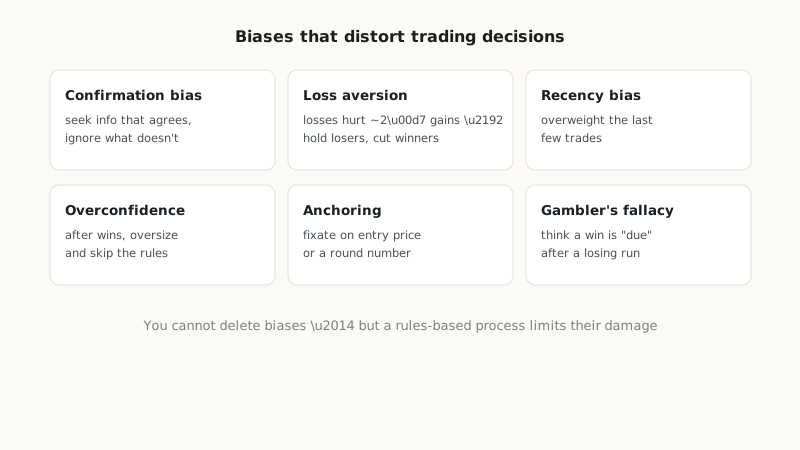
A: Cognitive biases are systematic errors in thinking that distort trading decisions. Common ones include confirmation bias, loss aversion, recency bias, anchoring, overconfidence and the gambler's fallacy. They are built into human cognition and affect even experienced traders.
Q: What is loss aversion in trading?
A: Loss aversion is the tendency for losses to feel roughly twice as painful as equivalent gains feel good. In trading it causes people to hold losing trades too long (to avoid realising the loss) and to cut winning trades too early (to lock in the gain), the opposite of sound practice.
Q: How do you overcome cognitive biases in trading?
A: You cannot eliminate biases, but you can limit their damage with a rules-based process: pre-defined entries, stops and targets made when calm, a trading journal to spot patterns, and seeking out evidence that contradicts your view rather than only what confirms it.
Confirmation bias
Confirmation bias is the tendency to seek out, favour and remember information that confirms what you already believe, while ignoring or discounting information that contradicts it. In trading, it is corrosive: once a trader has taken a position (or even just formed an opinion), they begin to notice only the evidence that supports it. A trader who is long will fixate on every bullish signal and explain away every bearish one, building a one-sided case for a trade that the full picture might not justify. The bias turns analysis into rationalisation.
Its particular danger is that it operates after you have committed, reinforcing a position regardless of whether it deserves reinforcing. It makes traders hold losing trades — finding endless reasons the trade will still work — and blinds them to the evidence that they are wrong. The defence is to deliberately seek out the contrary case: before and during a trade, ask "what would tell me I'm wrong?" and define, in advance, the specific evidence (the invalidation level) that would end the trade. A pre-set stop is, in part, a structural defence against confirmation bias — it acts on contrary evidence whether or not your biased mind wants to acknowledge it.
Loss aversion
Loss aversion is perhaps the most damaging bias of all: the well-documented finding that losses feel roughly twice as painful as equivalent gains feel pleasurable. Losing $100 hurts about as much as winning $200 feels good. This asymmetry has a devastating effect on trading behaviour, because it pushes traders to do exactly the wrong thing on both sides. To avoid the acute pain of realising a loss, traders hold losing trades far too long, hoping for a recovery rather than accepting the loss — letting small losses become large ones. To lock in the pleasure of a gain before it can vanish, they cut winning trades too early.
The result is the precise opposite of the cardinal trading principle of "cut your losses and let your winners run." Loss aversion makes traders run their losses and cut their winners — a pattern guaranteed to produce small wins and large losses, the recipe for a losing account even with a decent strategy. This single bias destroys more traders than perhaps any other. The defence, once again, is pre-commitment: a pre-set stop forces the loss to be cut regardless of how painful it feels, and a pre-set target (or trailing stop) lets the winner run past the point where loss aversion would have you bank it. The rules do what your biased instincts will not.
Recency bias and anchoring
Recency bias is the tendency to overweight recent events and assume they will continue. A trader on a winning streak becomes overconfident and reckless, assuming the wins will keep coming; a trader on a losing streak becomes fearful and may abandon a sound strategy at the worst time, just before it would have recovered. Recency bias makes traders extrapolate the recent past into the future, when trading outcomes are substantially independent — the last few results say little about the next one. The defence is to focus on long-run expectancy and a large sample of trades rather than reacting to the most recent handful.
Anchoring is the tendency to fixate on a particular reference price — often your own entry price, or a recent high or low, or a round number — and judge everything relative to it. A trader who anchors on their entry price may refuse to exit a losing trade until it "gets back to breakeven," letting a manageable loss grow because they are emotionally anchored to a number that has no bearing on what the market will do next. The market does not know or care where you entered. The defence is to make decisions based on current structure and the trade's invalidation level, not on irrelevant anchors like your entry price or a number you have fixated on.
The deadliest bias is loss aversion, because it inverts the one rule that matters most: instead of cutting losses and letting winners run, it makes you run losses and cut winners. Almost every other discipline in trading exists, in part, to override this single built-in instinct.
Overconfidence and the gambler's fallacy
Overconfidence bias leads traders to overestimate their knowledge, skill and the accuracy of their predictions — typically worst after a run of wins, when a trader concludes they have "figured out" the market and begins to oversize, skip their rules, and take marginal trades. This is often how a good winning streak sets up the loss that gives it all back. The defence is to keep position sizing and rules constant regardless of recent success, treating a winning streak with the same disciplined caution as any other period.
The gambler's fallacy is the belief that independent events are somehow "due" to balance out — that after several losses, a win is more likely, or that after several wins, a loss looms. In trading, this leads to dangerous behaviour like increasing size after losses ("I'm due for a win, so I'll bet bigger") — the martingale instinct that destroys accounts. In reality, each trade's outcome is largely independent of the last; you are never "due." Related is the sunk cost fallacy, holding a losing trade because of the money already committed to it, as though past losses obligate you to risk more. The defence to all of these is the same: a consistent, rules-based process that sizes and manages each trade on its own merits, immune to the illusion of patterns in independent outcomes.
Limiting the damage
The crucial thing to understand about cognitive biases is that they cannot be eliminated — they are hardwired, and even traders who know them intimately remain susceptible, because the biases operate below conscious awareness. The realistic goal is not a bias-free mind but a process robust enough to limit what the biases can cost you. This is the deeper reason that rules-based, pre-committed trading is so powerful: every rule made in advance is a situation in which a bias has less room to distort the decision.
Three habits do most of the work. First, a rules-based plan made when calm — pre-defined entries, stops and targets — removes many decisions from the biased, in-the-moment self. Second, a trading journal builds self-awareness by recording your decisions and emotions, letting you spot your personal bias patterns over time (perhaps you consistently cut winners early, revealing your loss aversion). Third, the deliberate habit of seeking disconfirming evidence — actively asking what would prove you wrong — counters confirmation bias directly. None of these makes you rational; they make your process resilient to your irrationality, which is the most any trader can achieve and exactly what the disciplined ones do.
More biases worth knowing
A handful of further biases round out the picture, each with its own characteristic damage. The sunk cost fallacy deserves emphasis because it compounds loss aversion: it is the tendency to keep committing to a losing position because of what you have already put in, as though past losses create an obligation to risk more. "I've held this trade through a big drawdown, so I can't sell now" is the sunk cost fallacy talking — and the correct response is that the money already lost is gone and irrelevant to whether the trade is worth holding from this moment forward. Each trade should be judged only on its prospects from here, never on what it has already cost.
Hindsight bias is the "I knew it all along" effect: after a move has happened, it feels as though it was obvious and predictable, when in truth it was genuinely uncertain beforehand. This is corrosive because it breeds overconfidence ("I saw that coming, so I can see the next one") and unfair self-criticism ("how did I miss something so obvious?"). The market is only obvious in the rear-view mirror. A trading journal, by recording what you actually thought before each trade, is the best defence — it preserves the real uncertainty against your memory's tendency to rewrite it.
Finally, herd behaviour (or the bandwagon effect) is the pull to do what the crowd is doing — buying because everyone is bullish, selling in a panic because everyone is fearful — which, as the cycle of market emotions shows, tends to put you on the wrong side at the extremes. And attribution bias leads traders to credit their wins to skill and blame their losses on bad luck or external factors, which prevents honest learning. The common thread across all of these is that they distort your perception of cause, probability and your own role — and the common defence, once again, is an honest journal and a rules-based process that judges decisions on their merits rather than on the stories your biased mind prefers to tell.
Cognitive biases are built-in thinking errors that distort trading: confirmation bias (seeing only supporting evidence), loss aversion (running losers, cutting winners — the deadliest), recency bias, anchoring, overconfidence, the gambler's fallacy, sunk cost (throwing good money after bad), hindsight bias, herd behaviour and self-serving attribution. You can't delete them, only contain them — with a rules-based plan, a trading journal, and the habit of seeking evidence you're wrong.