
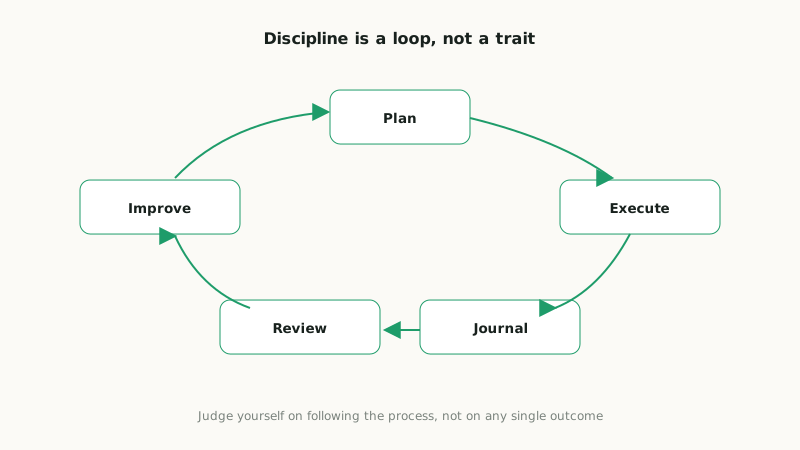
The good news about discipline is that it is not a personality trait you are either born with or doomed to lack — it is a system you build. Traders who execute flawlessly under pressure are not superhumanly strong-willed; they have constructed an environment of plans, habits and routines that makes disciplined behaviour the path of least resistance and undisciplined behaviour difficult. This reframing is liberating: you do not need to win a moment-by-moment battle of willpower against your emotions (a battle you will often lose), you need to build the systems that make the battle unnecessary. This guide covers the four pillars of that system: the plan, the journal, the routine, and the right mindset.
This is the practical answer to the challenges laid out across the psychology cluster — trading psychology, fear and greed and cognitive biases — and the bridge to risk management.
Key takeaways
Q: How do you build trading discipline?
A: Discipline is built through systems, not willpower: a written trading plan that pre-defines your rules, a trading journal that builds self-awareness, a consistent routine that keeps you in a stable state, and a process-over-outcome mindset that judges you on execution rather than individual results.
Q: What should a trading plan include?
A: A trading plan should define your strategy and the setups you trade, your rules for entries and exits, your stop-loss and profit-target approach, your position sizing and risk per trade, and the conditions under which you will and won't trade. It pre-commits decisions so emotion can't override them.
Q: Why keep a trading journal?
A: A trading journal records your trades along with the reasoning and emotions behind them. Reviewing it builds self-awareness, reveals your recurring mistakes and biases, measures your real expectancy, and turns experience into improvement rather than just repetition.
The trading plan
The foundation of discipline is a written trading plan — a document, made when you are calm and rational, that pre-defines every decision so that emotion has nothing to decide in the moment. A complete plan specifies: the strategy you trade and the exact setups you will take; your rules for entries and exits; how you place stops and set targets; your position sizing and the fixed risk per trade; and the conditions under which you will and, crucially, will not trade. The plan is your rational self legislating for your emotional self in advance.
The power of a written plan is that it converts trading from a series of improvised, emotion-prone decisions into the execution of pre-made ones. When a setup appears, you are not asking "should I take this?" in the heat of the moment — you are checking it against your plan's criteria, a far more objective act. When you are in a trade, you are not deciding when to exit under emotional pressure — you are following the stop and target you set in advance. The plan is the single most important tool for closing the knowing-doing gap, because it moves the knowing into a form that compels the doing. A plan that exists only in your head is not a plan; the act of writing it down is what makes it binding.
The trading journal
If the plan governs your decisions going forward, the trading journal is how you learn from the decisions behind you. A journal records each trade — the setup, the reasoning, the entry, exit and result — but, just as importantly, it records the emotional and mental state around the trade: what you were feeling, whether you followed your plan, what you were thinking when you entered or exited. This record is what transforms raw experience into genuine improvement, because without it, traders simply repeat the same mistakes, their memories conveniently editing out the undisciplined decisions.
Reviewing the journal regularly is where the value is realised. Over time, patterns emerge that are invisible trade-by-trade: perhaps you consistently cut winners early (revealing loss aversion), or repeatedly take low-quality trades when bored (revealing an overtrading tendency), or break your rules in a particular emotional state. The journal makes your personal weaknesses concrete and visible, which is the first step to addressing them. It also lets you measure your true expectancy from real results, separating a genuine edge from luck. A trading journal is, in effect, a mirror for your trading psychology — and the most reliable tool for converting experience into skill rather than just into scar tissue.
Routine and state management
The third pillar is a consistent routine that keeps you in a stable, prepared mental state — because the quality of your decisions depends heavily on the state you are in when you make them. A trader who sits down stressed, tired, distracted or emotionally charged will execute their plan poorly no matter how good it is. A routine — a consistent pre-trading preparation, a defined process for analysing the market, regular breaks, knowing when not to trade — creates the conditions in which discipline is possible.
A large part of this is state management: recognising when you are not in a fit state to trade and having the discipline to step away. Trading while angry (after a loss), euphoric (after a win), exhausted, or distracted by life stress dramatically raises the odds of an undisciplined mistake. The disciplined trader treats their own state as a tradeable condition: if the state is poor, the correct action is to not trade, just as surely as a poor setup means not trading. Knowing when to step away — after a loss, when tilted, when tired — is as much a part of discipline as knowing when to enter, and it is the routine that builds the self-awareness to do it.
Discipline is built, not summoned. You will lose most real-time willpower battles against your emotions — so don't fight them there. Instead build the systems (a written plan, a journal, a routine) that make the disciplined action automatic and the undisciplined one difficult. The work is done in advance, when you are calm, not in the heat of the trade.
Process over outcome
The fourth pillar is a mindset shift, and it is the most profound: judging yourself on process, not outcome. Because trading outcomes are probabilistic, any single trade's result is heavily influenced by luck — a perfectly executed trade can lose, and a reckless, rule-breaking one can win. If you judge yourself by individual results, you will draw exactly the wrong lessons: feeling validated by the lucky rule-break (and repeating it) and crushed by the disciplined loss (and doubting your plan). This is how good habits get unlearned and bad ones reinforced.
The disciplined trader instead judges each trade by whether they followed their process. A trade that loses while perfectly executing the plan is a good trade — it was a correct decision with an unlucky outcome, and repeating such decisions is exactly what you want. A trade that wins by breaking the rules is a bad trade — a poor decision with a lucky outcome, and the habit it reinforces will eventually be punished. Over many trades, good process produces good results, because a positive edge plays out across a large sample. Detaching from the outcome of any single trade and committing to the quality of your process is what makes consistent discipline psychologically sustainable — it aligns what feels rewarding with what actually works.
Building discipline as a forex trader
For the forex trader, these four pillars come together into a sustainable practice. Write a trading plan that defines your setups, your risk per trade, your stops and targets, and the times and conditions you will trade (the 24-hour market makes "when not to trade" especially important — you cannot and should not trade all of it). Keep a journal of every trade and the state behind it, and review it regularly to find your patterns. Build a routine that keeps you prepared and includes the discipline to step away when tired, tilted, or after a loss. And judge yourself, always, on whether you followed the process rather than on any single result.
None of this is complicated, but all of it requires the humility to accept that your emotions and biases are real, powerful, and not going away — and that the answer is to build systems that work with that reality rather than pretending you can simply will yourself to be rational. The traders who last are not those with iron self-control in the moment; they are those who did the unglamorous work in advance of building a plan, a journal, a routine and a process-focused mindset. Discipline, in the end, is just the accumulated result of those systems doing their job, trade after trade, until following them becomes who you are as a trader.
Consistency and patience
Two qualities tie the four pillars together and deserve their own mention, because they are where discipline ultimately shows up: consistency and patience. Consistency means applying the same process, the same rules and the same risk on every trade, through winning streaks and losing streaks alike — not loosening the rules when confident nor abandoning them when discouraged. It is consistency that lets a positive edge express itself, because an edge only plays out across a large sample of trades taken the same disciplined way. A trader who follows the plan on nine trades and improvises on the tenth has, in effect, no plan; the value is in the unbroken application. Discipline, in this sense, compounds: each trade taken correctly reinforces the habit and the edge, while each exception erodes both.
Patience is the close partner of consistency, and it is genuinely a skill rather than a personality trait — one that can be developed. It is the patience to wait for your setups rather than forcing trades out of boredom; the patience to let a winner reach its target rather than grabbing profit early; and the patience to let your results accumulate over months and years rather than demanding them today. Much of the damage in trading comes from impatience: overtrading, chasing, cutting winners, sizing up to get rich faster. The patient trader accepts that consistent, modest gains compounded over time are how trading actually builds wealth, and that the desire for fast, large results is precisely the impulse that leads to the undisciplined behaviour that destroys accounts. Consistency and patience are not glamorous, but they are what the four pillars are ultimately for — and what separates the traders who endure from those who flare out.
Discipline is a system you build, not a trait you summon. Its four pillars: a written trading plan that pre-commits every decision; a journal that records trades and emotions so you learn from them; a routine and state management so you only trade when fit to; and a process-over-outcome mindset that judges you on execution, not results. Hold them together with consistency (the same rules every trade) and patience (waiting for setups, letting results compound). Do the work in advance, when calm.