
Two emotional spirals do more damage to trading accounts than any bad setup ever could: revenge trading — chasing a loss to win it back — and FOMO — chasing a move for fear of missing out. Both feel urgent and reasonable in the moment. Both involve abandoning your plan in the grip of emotion. And both are among the fastest ways to turn a manageable situation into a ruined account. Understanding how these spirals work, why they are so seductive, and — most importantly — the practical rules for breaking them is essential self-defence for any trader. This guide covers both, with an emphasis on the concrete steps that interrupt the loop.
These are the destructive behaviours that fear and greed, covered in fear and greed in trading, produce at their most dangerous.
Key takeaways
Q: What is revenge trading?
A: Revenge trading is the impulsive attempt to immediately win back a loss by entering a new, often oversized and unplanned trade driven by anger and frustration. It typically leads to further losses, creating a destructive spiral that can erase an account far faster than the original loss.
Q: What is FOMO in trading?
A: FOMO — fear of missing out — is the urge to jump into a price move that is already well underway, for fear of missing the profit. It causes traders to enter late at poor prices without a proper setup, usually just as the move is ending, leading to losses.
Q: How do you stop revenge trading?
A: Step away from the screen after a loss, set a daily loss limit that ends your trading for the day if hit, and never increase position size to recover. Recognising the emotional state and physically removing yourself from the market is the most reliable way to break the spiral.
The revenge-trading spiral
Revenge trading begins with a loss — and not necessarily a large one. The loss triggers anger, frustration, and a powerful, almost physical urge to win it back immediately, to make the market "pay" and restore the wounded ego. Driven by this emotion, the trader enters a new trade impulsively: without a proper setup, often oversized (to recover the loss faster), and outside their plan entirely. Because this trade is driven by emotion rather than analysis, it frequently loses too — which intensifies the anger, prompting an even larger, more reckless trade, and so on.
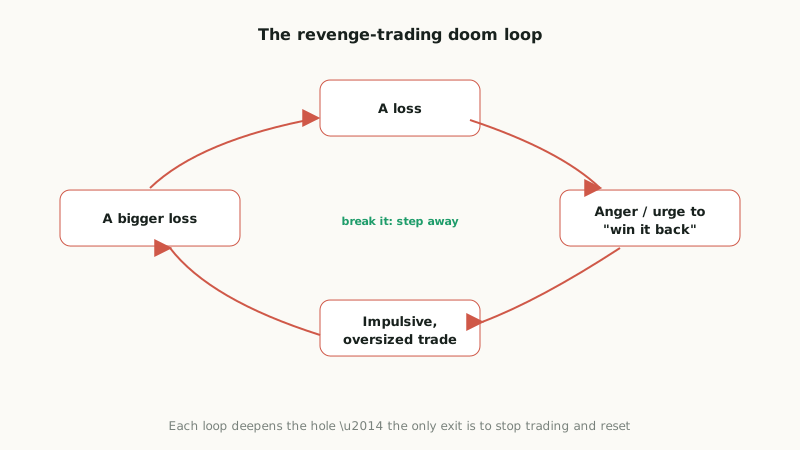
This is the doom loop, sometimes called "tilt" (a term borrowed from poker): a self-reinforcing spiral in which each loss fuels a more reckless attempt to recover, and each failed attempt deepens the emotional state driving it. A trader on tilt can lose, in a single session of revenge trading, many times what the original loss cost — and occasionally an entire account — because the normal restraints of position sizing and setup quality have been thrown aside. The cruel irony is that the desperate effort to avoid acknowledging a small loss produces a catastrophic one. Revenge trading is the precise mechanism by which capital preservation collapses.
FOMO: chasing the move
FOMO — fear of missing out — is the other side of the same emotional coin, driven by greed and regret rather than anger. It strikes when a trader watches a strong move unfold without them: a sharp rally they did not take, climbing higher and higher. The fear of missing the profit becomes unbearable, and the trader jumps in — late, at a poor price, with no proper setup or plan, simply because they cannot stand to watch the move continue without participating. They are, in effect, chasing.
The problem is that by the time a move is obvious and emotionally irresistible enough to trigger FOMO, it is frequently late in its run — the trader buys near the top of the rally, just as it is about to reverse or stall, getting the worst possible entry. FOMO entries lack a defined stop and target because they were never planned, so they also tend to be poorly managed. The result is entering bad trades at bad prices at bad times, the opposite of the patient, selective approach that works. FOMO is greed's way of punishing patience, luring the trader into action precisely when restraint was the right move.
Why they are so seductive
Both spirals are dangerous precisely because, in the moment, they do not feel like mistakes — they feel like correct, urgent responses. Revenge trading feels like taking decisive action to fix a problem; FOMO feels like seizing an obvious opportunity. The emotional brain frames both as reasonable, even necessary, and supplies plausible-sounding justifications ("I need to make that back"; "this move is too strong to miss"). This is what makes them so hard to resist with willpower alone: you are not fighting an obviously bad idea, but one that your own mind is actively dressing up as a good one.
Underlying both is an inability to accept the situation as it is — to accept that the loss happened and is now sunk, or that the missed move is gone and not yours to capture. The discomfort of acceptance drives the urge to act, and the action makes things worse. This is why the solutions are less about clever analysis and more about managing your emotional state and removing yourself from the situation before the spiral takes hold. You cannot reason your way out of tilt in real time, because the reasoning faculty is exactly what the emotion has hijacked.
The urge to revenge-trade or chase a move feels like good judgement, not emotion — that is exactly why it's dangerous. You can't out-think it in the moment. The only reliable defence is a pre-set rule that physically removes you from the market before the spiral can take hold.
Breaking the loop
Because these spirals cannot be reliably defeated by in-the-moment willpower, the defences are structural — rules set in advance that interrupt the loop mechanically. The most important is to step away after a loss: physically leave the screen, take a break, and let the emotional charge dissipate before considering another trade. A loss that is not immediately "avenged" loses its power to trigger the spiral. Many disciplined traders make it a rule to stop trading for a set period — or the rest of the day — after any significant loss.
The second key defence is a daily loss limit: a pre-set maximum you are willing to lose in a day, after which you stop trading entirely, no exceptions. This is the structural circuit-breaker that prevents a bad start from becoming a catastrophic day — it ends the session before the doom loop can run. The third is the absolute rule, from risk management, to never increase position size to recover losses, which directly disarms the most dangerous feature of revenge trading. For FOMO specifically, the antidote is the mindset that there is always another trade — like buses, setups keep coming, so missing one costs nothing, and chasing it costs plenty. A missed opportunity is not a loss; it is simply a trade that was never yours to take.
When it goes beyond a bad habit
It is worth being honest that for some people, these patterns can shade into something more serious than a discipline problem. If you find yourself repeatedly unable to stop revenge trading despite your best intentions, chasing losses with money you cannot afford, hiding your trading from people close to you, or feeling that trading has become a compulsion you cannot control, these are signs to step well back. That is not a judgement — markets are deliberately engineered to be compelling, and the line between intense engagement and compulsive behaviour can blur. The strong and sensible response is to pause trading entirely, talk to someone you trust, and seek support if you need it. Protecting your wellbeing and your relationships always comes before any trade, and there is no edge worth pursuing at their expense.
For the ordinary, non-compulsive version of these spirals — the bad session, the tilt after a frustrating loss — the structural rules above are usually enough: step away, respect a daily loss limit, never size up to recover, and remember that another setup is always coming. Build those rules in advance, when calm, and follow them mechanically when the emotional storm hits, and you defang the two behaviours that destroy more accounts than any flawed strategy ever could.
What to do after a big loss
Because the loss is the spark that lights the revenge-trading fuse, it is worth having a deliberate protocol for what you do after one — decided in advance, so you are not improvising in an emotional state. The first step is the simplest and most important: stop trading. Close the platform, step away from the screen, and put physical distance between yourself and the market. The urge to immediately re-engage is the doom loop forming; refusing to act on it, even for an hour or the rest of the day, is what starves it of fuel. Nothing good is decided in the minutes after a painful loss.
The second step, taken later when the emotional charge has faded, is to review the loss objectively. Was it a good trade that simply lost — a correct decision with an unlucky outcome — or did you break your rules? This distinction matters enormously. A disciplined loss requires no correction; it was the cost of doing business, and the right response is to feel nothing in particular about it. A loss from broken rules is a process failure to note in your journal and learn from. Either way, the review is analytical, not emotional, and it happens after the cooling-off period, never in the heat of the moment.
The third step, when you do return, is to return small. Resume at your normal (or even reduced) position size, taking only your highest-quality, fully-planned setups. The instinct after a loss is to size up to recover faster; the correct action is the opposite, easing back in at normal risk and letting your edge rebuild the account gradually. This protocol — stop, review objectively once calm, return small — turns the dangerous aftermath of a loss into a controlled, routine reset, and it is the single most effective structural defence against the revenge spiral.
Revenge trading (chasing a loss with impulsive, oversized trades) and FOMO (chasing a move for fear of missing out) are emotional spirals that feel like good judgement but destroy accounts. Break the loop with structural rules: step away after a loss, set a daily loss limit, never size up to recover, and remember there's always another trade. Have a post-loss protocol — stop, review objectively once calm, return small. If the behaviour becomes compulsive or harmful, step back and seek support — that comes first.