
Most traders fail not from a lack of knowledge but a lack of structure — trading on impulse, deviating under emotion, never quite consistent enough to let an edge play out. The antidote is a trading plan: a written document that defines exactly how you trade, your personal rulebook. A trading plan turns trading from a series of in-the-moment decisions into a repeatable, disciplined process, and it is one of the most powerful tools a trader can have — yet many never bother to write one. This guide explains what a trading plan is, its essential components, and why having one (and following it) is so important. It is, in a sense, the capstone that ties together strategy, risk management and psychology.
It brings together the strategy, risk management and psychology covered across the site into one coherent, personal document.
Key takeaways
Q: What is a trading plan?
A: A trading plan is a written document that defines how you trade — your personal rulebook. It specifies your goals, the markets and style you trade, your strategy and setups, your risk-management rules, your routine, and how you record and review your trades, turning trading into a consistent, repeatable process.
Q: What should a trading plan include?
A: A complete trading plan includes your goals, the markets and timeframe you trade, your strategy and entry/exit criteria, your risk-management rules (risk per trade, stops, position sizing), your trading routine, a record-keeping or journaling method, and a process for regularly reviewing and refining your approach.
Q: Why do you need a trading plan?
A: A trading plan provides structure that removes impulsive, emotional decisions in the heat of the moment. It makes your trading consistent and repeatable, lets you evaluate your performance objectively against your own rules, and is one of the strongest defences against the emotional mistakes that defeat most traders.
What a trading plan is
A trading plan is a written document that sets out, in advance and in your own words, exactly how you will trade — a comprehensive personal rulebook covering what you trade, when, how, and under what risk constraints. The emphasis on written is deliberate and important: a plan that lives only in your head is not a plan but a vague intention, easily bent and rationalised in the heat of the moment. Committing it to writing makes it concrete, specific and binding — something you can hold yourself to and check yourself against.
The purpose of a trading plan is to bring structure and consistency to your trading, and above all to remove emotional, impulsive decision-making from the moments when emotion is strongest. When you have predefined your rules — what setups you take, how much you risk, where your stops go, what you do after a loss — you are not making fraught decisions under pressure; you are simply executing your plan. This is why the trading plan is so closely tied to the psychology of trading: it is the practical mechanism by which you impose discipline on yourself in advance, when you are calm and rational, so that the emotional in-the-moment self has clear rules to follow rather than free rein to make mistakes. A trading plan is, fundamentally, a tool for being consistent and disciplined despite the emotions that would otherwise undermine you.
The essential components
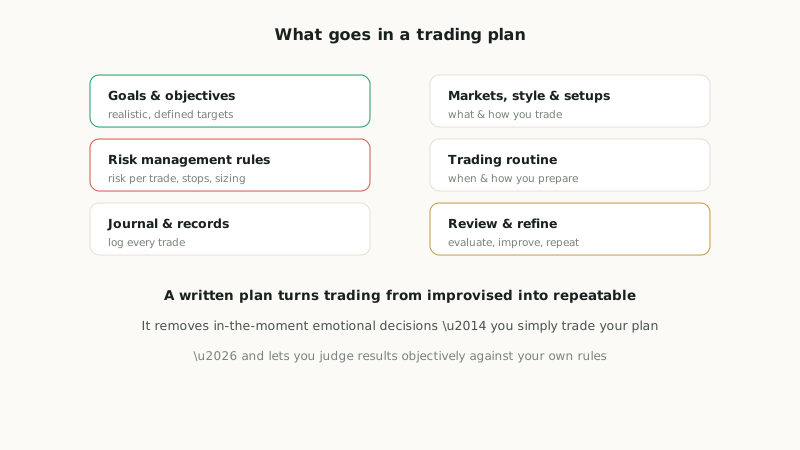
A complete trading plan covers several components, each addressing a key aspect of trading. Goals and objectives come first — realistic, defined aims for your trading, which shape everything else and keep expectations grounded (the unrealistic expectations the psychology section warns against are a common source of trouble). Next, the markets, style and setups: which pairs you trade, on what timeframe and style (drawing on the trading-styles guide), and the specific strategy and entry criteria you use (from the strategies section) — defining precisely what you trade and how you identify a trade.
Then the risk-management rules, arguably the most important section: your risk per trade (a small percentage of the account), your stop-loss placement, your position-sizing method, and any limits on total exposure — the disciplines from the risk management section, written as firm rules. A trading routine specifies when and how you trade: your preparation, your analysis process, the hours you operate (informed by the sessions and best-times guides). A record-keeping method commits you to journaling every trade. And a review process sets out how you will regularly evaluate your results and refine your approach. Many plans also include explicit psychological and discipline rules — such as a maximum number of losses or a loss limit per day after which you stop, or a defined cooling-off protocol after a bad trade — to guard against the tilt and revenge trading the psychology section describes. Together, these components form a complete blueprint for your trading.
Why a plan makes you consistent
The deep value of a trading plan is that it makes you consistent, and consistency is what allows a trading edge to actually produce results. As the strategies section stresses, even a sound, edge-bearing strategy fails if applied erratically — abandoned after a loss, overridden by impulse, deviated from under emotional pressure. A trading plan is the structure that prevents this erratic application: by predefining your rules and committing to follow them, you apply your strategy the same way every time, which is the only way its statistical edge can play out over many trades.
A plan also enables objective evaluation. Because your rules are written down, you can judge your trading against them: did you follow your plan or not? This separates the quality of your process (did you trade your plan?) from the outcome of any single trade (did it win?), which is exactly the process-over-outcome thinking the psychology section advocates. A trade that followed your plan but lost is a good trade (the process was right); one that violated your plan but won is a bad trade (you got lucky). Without a written plan, this crucial distinction is impossible, and you are left judging yourself by random outcomes rather than the controllable process. The plan thus turns trading from an emotional, improvised, luck-dependent activity into a structured, repeatable, evaluable process — the foundation of genuine improvement.
"Plan your trade and trade your plan" endures because a written plan moves your decisions from the emotional heat of the moment to the calm of advance preparation. You decide the rules when rational, then merely execute when tempted — which is how a plan defeats the impulsive deviations that wreck undisciplined traders. The plan is rational-you protecting against emotional-you.
Building and using your plan
Building a trading plan means working through each component and writing down your decisions — a process valuable in itself, because it forces you to think through aspects of your trading you might otherwise leave vague. Start with realistic goals, decide what and how you will trade, set firm risk rules, define your routine and review process, and write it all down clearly. The plan need not be elaborate or lengthy; it needs to be clear, specific and yours — rules you understand and believe in, tailored to your strategy, style and circumstances. A simple plan you actually follow beats an elaborate one you ignore.
Crucially, a trading plan is not written once and forgotten — it is a living document, refined through the review process as you learn what works and what doesn't. Your journal feeds your reviews, your reviews refine your plan, and the plan guides your trading: a continuous improvement loop. But refinement should be deliberate and evidence-based (done calmly during review, informed by your records), never impulsive mid-trade tinkering driven by a recent loss — that is exactly the undisciplined deviation the plan exists to prevent. The discipline is to follow the plan while trading and refine it only during structured review. A trader who builds a sound plan, follows it faithfully through the emotional ups and downs, and refines it methodically over time has the structure that turns scattered knowledge into consistent practice — which is why the trading plan is the natural capstone tying together everything this site teaches about strategy, risk and psychology.
A simple plan in practice
To make the idea concrete, consider what a simple trading plan might actually contain — not as a template to copy, but to show how the components translate into specific, personal rules. The goals might read: "Trade part-time around my job; aim to trade consistently and protect capital while learning, not to get rich quickly." The markets and style: "Swing trade EUR/USD and GBP/USD on the daily and 4-hour charts, holding positions for several days." The strategy: "Trade with the daily trend only; enter on pullbacks to the 20-period moving average that show a bullish (or bearish) reversal candle."
The risk rules would be specific and firm: "Risk a maximum of 1% of account equity per trade; always use a stop-loss placed beyond the pullback; never hold more than two correlated positions at once; aim for a minimum 2:1 reward-to-risk." The routine: "Review charts each evening after the New York close; plan any trades for the next day; check the economic calendar for high-impact news." The records and review: "Log every trade with its reasoning in a journal; review the journal weekly and assess whether I followed my rules." And a discipline rule: "After two losing trades in a day, stop trading until the next session."
Notice how concrete and personal each line is — specific pairs, a specific entry, a specific risk percentage, a specific routine — and how the components from across the site (strategy, risk, sessions, psychology, journaling) come together into one coherent document tailored to this particular trader's circumstances. A plan like this fits on a single page, yet it removes almost all in-the-moment guesswork: faced with a potential trade, the trader simply checks it against these rules. That is the goal — not an elaborate manual, but a clear, specific, personal set of rules you genuinely follow. Your own plan will differ in every particular, reflecting your markets, style, risk tolerance and life, but it should have this same concrete, checkable quality: rules clear enough that you always know whether a given action is "in the plan" or not.
A trading plan is a written rulebook: goals, markets and style, strategy and setups, risk-management rules, routine, record-keeping, review process, and discipline rules (like daily loss limits). Writing it down makes it binding and moves decisions from the emotional heat of the moment to calm advance preparation. Keep it concrete and personal — specific pairs, entries, risk percentages and routines, clear enough that you always know whether an action is "in the plan." It makes you consistent (so your edge can play out) and lets you judge your process objectively. Follow it while trading; refine it only during structured review.