A demo account is the perfect place to learn the ropes of forex trading — and a deceptive one. It lets you trade with virtual money in real market conditions, risk-free, so you can learn the platform, test strategies and practise without losing a penny. It teaches almost everything a beginner needs… except the one thing that defeats most traders: the emotion of having real money on the line. The gap between demo and live trading is primarily psychological, and understanding it — along with how to bridge it — is essential to a sound start. This guide explains what demo accounts are good for, their crucial limitation, and how to transition to live trading without blowing up.
This connects the practical first steps from what is forex trading to the all-important trading psychology that real stakes unleash.
Key takeaways
Q: What is a demo trading account?
A: A demo account is a practice account that lets you trade with virtual money using real market prices and a real trading platform. It is free and risk-free, designed for learning the platform, testing strategies and practising without putting any real money at stake.
Q: Why is demo trading different from live trading?
A: The biggest difference is emotion. Demo trading uses virtual money, so it cannot replicate the fear, greed and stress of risking real money. Many traders perform well on demo but struggle live, because the psychological pressure of real stakes changes their behaviour and discipline.
Q: How long should you trade on demo before going live?
A: Long enough to learn the platform, understand the mechanics, and consistently apply a tested strategy — but not so long that you never face real emotion. A common approach is to master the basics on demo, then transition to live trading with small position sizes to introduce real stakes gradually.
What a demo account is for
A demo account provides virtual money to trade with, using real market prices on a real trading platform — a faithful simulation of live trading in every respect except that the money is not real. Demo accounts are free, offered by virtually all brokers, and they are genuinely valuable for several things. First, learning the platform: getting comfortable with placing orders, setting stops and take-profits, reading charts and navigating the software, without the risk of an expensive fumble. Second, understanding the mechanics: how trades work, how pips and lots translate to profit and loss, how margin behaves — all learnable safely on demo.
Third, and importantly, testing strategies: a demo account lets you forward-test a trading approach in current market conditions to see whether it has promise, building the familiarity and basic competence to apply it. As the strategies section notes, testing a strategy before risking real money is essential, and the demo account is a key tool for that forward-testing. For a complete beginner, time on a demo account is close to mandatory — it is where you learn to operate without the cost of learning being real losses. Skipping demo entirely and jumping straight into live trading with no platform familiarity or strategy is a recipe for expensive, avoidable mistakes. The demo account is the practice ground, and it serves that role excellently.
The crucial limitation: no real emotion
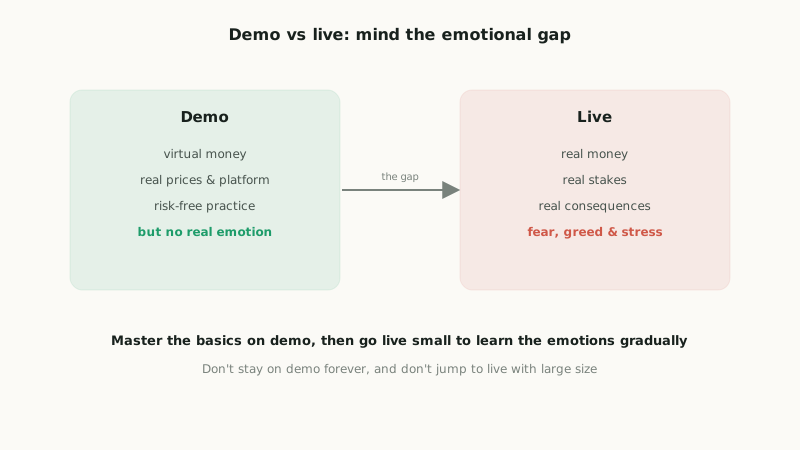
For all its value, the demo account has one profound limitation that every trader must understand: it cannot replicate the emotion of trading real money. This is not a minor caveat — it is the single most important thing to know about demo trading. When the money is virtual, the fear of loss, the greed for gain, the stress of a position moving against you, the temptation to deviate from your plan — none of these operate with anything like their real-world force. You can watch a virtual position lose with detached calm that evaporates the moment real money is at stake.
This matters enormously because, as the trading psychology section makes clear, emotion and discipline are what defeat most traders — not a lack of knowledge or a flawed strategy. The demo account develops the knowledge and the mechanics but leaves the emotional and psychological dimension entirely untested. This explains a phenomenon that surprises and frustrates many: traders who perform beautifully on demo, calmly following their strategy and booking virtual profits, then struggle badly when they go live, abandoning their rules under the unfamiliar pressure of real stakes. They had mastered everything except the part that matters most. The detached competence of demo trading can even breed false confidence, masking the emotional challenges that only real money reveals. Recognising that demo trading omits the hardest part of trading — the psychology — is essential to using it wisely and to anticipating the very different experience of going live.
Other differences
Beyond the emotional gap, there are some smaller practical differences between demo and live trading worth noting. Demo execution is often somewhat idealised: fills can be cleaner, slippage less pronounced, and the frictions of real trading slightly understated, because the broker is not managing real orders against real liquidity. The difference is usually modest, but it means demo results can flatter slightly compared to live conditions, especially for very short-term, execution-sensitive styles like scalping.
There is also a subtler behavioural difference: because demo money feels inconsequential, traders sometimes behave differently on demo in ways beyond just calmness — taking trades they would never take with real money, risking absurd amounts, or trading carelessly because nothing is at stake. This can make demo results unrepresentative not because of execution, but because the trader was not really trading as they would for real. The lesson is to treat demo trading as seriously as possible — trading the same size (proportionally), following the same rules, and respecting the virtual money as if it were real — to make the practice as transferable as possible. Even so, the fundamental emotional gap remains: demo can approximate the mechanics closely, but it cannot manufacture the genuine stakes that drive real trading psychology.
Demo trading teaches everything except the thing that defeats most traders: real emotion. This is why so many trade brilliantly on demo and fall apart live — they mastered the mechanics but never faced the fear and greed of real money. The detached calm of demo can breed false confidence about the very challenge that matters most.
Bridging the gap
The solution to the demo-live gap is a careful transition, avoiding two opposite errors. The first error is staying on demo forever: because demo never develops the emotional side, endless demo trading delays the real learning that only live trading provides. At some point, you have to face real stakes to learn to handle them — the emotional skills cannot be built any other way. The second, opposite error is rushing to live trading with large size: jumping from comfortable virtual trading to a full-sized real account exposes you to the full force of emotion and the full risk of large losses all at once, often with predictably bad results.
The sensible path threads between these: master the basics on demo, then go live with small — even minimal — position sizes, introducing real emotion gradually while keeping the financial risk modest. Trading live with small size means real money is genuinely at stake (so you start building the emotional skills and discipline), but the amounts are small enough that the inevitable early mistakes and the learning process are not financially devastating. As you demonstrate that you can follow your plan with discipline under real (if small) stakes, you can gradually increase size. This staged approach — demo to learn the mechanics, then small live to learn the emotions, then scaling up with proven discipline — respects both the value of demo and its fundamental limitation. It connects directly to the position-sizing and psychology principles elsewhere on the site: start small, manage risk, and build the emotional competence that demo cannot teach, in the only place it can be learned — the live market, with real but limited money on the line.
Getting the most from demo
Because demo trading's value depends entirely on how seriously you treat it, a few practices make it far more useful. First, trade realistic size: use a demo account funded with an amount similar to what you will actually trade live, and risk the same small percentage per trade you intend to use for real. A demo account loaded with £100,000 of virtual money, traded in huge sizes you would never risk in reality, teaches nothing transferable. Matching the demo to your intended real conditions makes the practice meaningful.
Second, follow your rules exactly as you would (or will) live — the same strategy, the same stop-losses, the same plan. The temptation on demo is to trade loosely, take random trades, or skip the discipline because nothing is at stake; resisting this and treating every demo trade as real builds the disciplined habits you want to carry into live trading. Third, keep a journal of your demo trades just as you would live ones, recording your reasoning and reviewing your results, so the demo period genuinely builds the record-keeping and review habits the trading-plan and psychology sections emphasise.
Fourth, set a goal and a rough time frame for the demo phase — specific competencies to demonstrate (consistent rule-following, understanding the platform, a tested strategy showing promise) before transitioning to live — so demo serves as a deliberate stepping stone rather than an open-ended comfort zone. The aim is to extract everything demo can teach (the mechanics, the platform, strategy familiarity, disciplined habits) while remembering what it cannot (real emotion), and then to move on to small live trading to learn the rest. Used seriously and purposefully like this, the demo account is an excellent foundation; used carelessly, it is little more than a video game that may even instil bad habits. Treating it with the same seriousness you would real money is what makes the difference.
A demo account uses virtual money with real prices and platform — ideal for learning the mechanics, the platform, and testing strategies risk-free. Its crucial limitation: it can't replicate the emotion of real money, which is what defeats most traders, so many trade well on demo then struggle live. Get the most from it by trading realistic size, following your rules exactly, journaling, and setting a goal to move on. Bridge the gap by mastering basics on demo, then going live with small size to build emotional discipline gradually — don't stay on demo forever or jump to large live size.