"What's the best forex strategy?" is the question every beginner asks, and it has no single answer — but it does have a useful map. A trading strategy is simply a defined set of rules for capturing an edge: rules for what to trade, when to enter, how to manage the position, and when to exit. The bewildering variety of named strategies out there sorts neatly along just two axes: which market condition a strategy is built for, and over what timeframe it operates. Understand those two dimensions and the whole landscape of strategies becomes navigable. This guide lays out the map, and explains how to choose, test and use a strategy well.
This pillar organises the Trading Strategies section, which already covers the Smart Money Concepts approach in depth and now adds the core strategy styles. It rests on the risk management and trading psychology that make any strategy workable.
Key takeaways
Q: What is a forex trading strategy?
A: A forex trading strategy is a defined set of rules for entering, managing and exiting trades, designed to capture a repeatable edge. A complete strategy specifies which setups to trade, how to size positions, where to place stops and targets, and the conditions under which to trade and not trade.
Q: What are the main types of trading strategy?
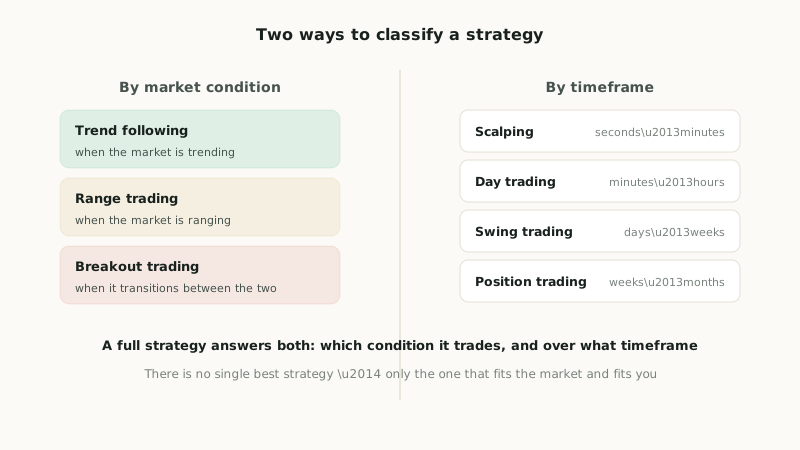
A: Strategies sort along two axes. By market condition: trend-following (for trending markets), range trading (for sideways markets) and breakout trading (for transitions). By timeframe: scalping, day trading, swing trading and position trading, from seconds to months.
Q: Which forex trading strategy is best?
A: There is no single best strategy. The best one matches both the current market condition and your own personality, lifestyle and available time. A strategy also needs a genuine edge (positive expectancy), thorough testing, and the discipline to follow it consistently.
What a strategy actually is
Before the types, it helps to be clear about what a strategy is and is not. A trading strategy is a complete, defined set of rules covering the whole trade: which setups or conditions you trade, your precise entry criteria, how you size the position (risk per trade), where your stop loss goes, where you take profit, and — crucially — the conditions under which you will and will not trade. A strategy is not a vague intention or a single indicator; it is a repeatable, rule-based process that can be followed consistently and judged objectively.
The purpose of all those rules is to capture an edge — a positive expectancy that, applied consistently over many trades, produces a profit. This is the deeper point: a strategy is only worthwhile if it has a genuine edge, and a strategy without positive expectancy is just a structured way to lose money. Everything else — the indicators, the patterns, the entry signals — serves the goal of identifying situations where the odds are in your favour. And no strategy, however good its edge, works without the risk management to survive its losing streaks and the discipline to follow it through them, which is why this section sits alongside the risk and psychology pillars rather than apart from them.
By market condition
The first axis sorts strategies by the market condition they are built for, and it rests on a fundamental truth: markets are either trending (moving persistently in one direction) or ranging (oscillating sideways), with transitions between the two. Different strategies suit different conditions, and the three core approaches map directly onto them:
- Trend-following strategies trade with an established trend, aiming to ride a persistent move — best when the market is trending. Covered in trend-following strategies.
- Range trading strategies trade the oscillations of a sideways market, buying near support and selling near resistance — best when the market is ranging. Covered in range trading strategies.
- Breakout strategies trade the transition, entering as price breaks out of a consolidation into a new trend — best at the moment a range gives way. Covered in breakout trading strategies.
The crucial insight is that a strategy must match the condition. A trend-following strategy applied to a ranging market gets whipsawed; a range strategy applied to a trending market keeps fighting the trend and losing. Much of the skill in using strategies lies in correctly reading the current condition and deploying the appropriate approach — or sitting out when conditions do not suit your strategy.
By timeframe
The second axis sorts strategies by timeframe — how long trades are held and how frequently they are taken — which corresponds to the major trading styles. Scalping holds trades for seconds to minutes, taking many trades a day for small gains. Day trading holds for minutes to hours and closes everything by day's end. Swing trading holds for days to weeks, capturing medium-term swings. Position trading holds for weeks to months, riding long-term trends. These styles, explored in trading styles by timeframe, span an enormous range from the frantic to the patient.
This axis is largely about fit with the trader rather than fit with the market. The shorter timeframes demand intense screen time, fast reactions and tolerance for stress; the longer ones require patience and the ability to hold through fluctuations. The best timeframe for you depends on your personality, your available time, your temperament and your capital — a person with a full-time job cannot scalp, and an impatient person will struggle to position-trade. The two axes are independent: you can trade a trend-following strategy as a scalper or as a position trader, a range strategy intraday or over weeks. A complete strategy is defined by a point on both axes — which condition it trades, over which timeframe.
Two independent questions define any strategy: what market condition does it trade (trend, range, or breakout), and over what timeframe (scalp to position). The first must match the market; the second must match you. Mismatch either — a range strategy in a trend, or scalping when you can't watch screens — and even a sound strategy fails.
Choosing and testing a strategy
Choosing a strategy means finding one that fits on both axes — suited to conditions you can identify and trade, and to your own circumstances and temperament — and that has a genuine edge. A common and sensible path for beginners is to start with a single, well-defined strategy for one market condition on one timeframe (say, a simple trend-following approach for swing trading the majors), master it thoroughly, and only later expand. Trying to trade every condition and timeframe at once, with a tangle of strategies, is a recipe for confusion.
Whatever strategy you choose, it must be tested before you risk real money on it. Backtesting (checking how the strategy would have performed on historical data) and forward-testing (running it on a demo account in current conditions) reveal whether it actually has an edge, expose its weaknesses, and build the familiarity and confidence to follow it under pressure. A strategy you have not tested is a hypothesis, not an edge. This testing also connects to the trading journal and the process-over-outcome mindset from the psychology section: you judge a strategy by its results across many trades, not by any single outcome, and you refine it based on evidence rather than emotion.
A strategy is only as good as your discipline
The final and most important point ties this section to the rest of the site: a strategy is only as good as the discipline to follow it. Traders endlessly hunt for a better strategy when their real problem is the failure to follow the one they have — abandoning rules under emotional pressure, deviating after a loss, taking trades the strategy does not sanction. As the psychology section stresses, the knowing-doing gap defeats more traders than any flaw in their strategy. A modest strategy followed with discipline beats a brilliant one applied erratically.
This means the search for the "best" strategy is somewhat misguided. There is no holy grail, no secret system that prints money — and chasing one distracts from what actually matters: finding a sound, edge-bearing strategy that fits the market and fits you, sizing positions to survive its losing streaks, and following it with consistent discipline over many trades. The strategies covered in this section are proven, sensible frameworks for different conditions and timeframes; their value is realised only when combined with the risk management and psychology that the rest of the site develops. Choose one that fits, test it, size it safely, and follow it faithfully — that, far more than the choice of strategy itself, is what separates success from failure.
How the strategies fit together
It would be a mistake to think of trend following, range trading and breakout trading as rival camps you must choose between for life. They are better understood as three tools for three conditions, and a complete trader can use all three — deploying whichever matches the market's current state. This is possible because markets cycle through the conditions: a range eventually gives way to a breakout, which establishes a trend, which eventually exhausts and settles into a new range, and so on. Each phase of this cycle has its matching strategy.
Seen this way, the three approaches form a coherent whole that follows the market through its phases. While a market ranges, you can range-trade the boundaries; when it breaks out, you switch to a breakout entry; once a trend establishes, trend-following techniques ride it; and when that trend tires and a new range forms, you return to range trading. The astute trader reads which phase the market is in — ranging, breaking out, or trending — and applies the appropriate tool, transitioning between them as the market itself transitions. This is the deeper reason that correctly reading the current condition is the master skill of strategy: the strategies themselves are straightforward; knowing which one the market currently calls for is where the judgement lies.
That said, there is nothing wrong with specialising in one condition — many successful traders trade only trends, or only ranges, simply sitting out the conditions that do not suit their chosen approach. Specialising or using all three are both valid; what is not valid is applying a strategy to the wrong condition. Whether you master one approach and wait for its condition, or learn all three and rotate between them, the non-negotiable principle is to match the strategy to the market — never trend-follow a range or range-trade a trend.
A trading strategy is a defined, rule-based process for capturing an edge. Strategies sort on two axes: by market condition (trend-following, range trading, breakout) — which must match the market — and by timeframe (scalping to position) — which must match you. The three condition-strategies are tools for the phases markets cycle through; read the current condition and apply the matching one (or specialise and wait for it). Ensure a real edge, test before trading live, and — above all — follow it with discipline. There is no holy grail.