Scalper, day trader, swing trader, position trader — four names for trading the same market over wildly different horizons, from a few seconds to many months. These trading styles form the second great axis of strategy (alongside the market-condition axis of trend, range and breakout), and choosing among them is one of the most consequential decisions a trader makes. The striking thing is that the right choice depends far less on the market than on you — your personality, your available time, your temperament, your tolerance for stress. This guide explains the four styles, their pros and cons, and how to match one to your own life.
This is the timeframe axis of forex trading strategies, and it connects closely to the best times to trade and to trading psychology.
Key takeaways
Q: What are the main forex trading styles?
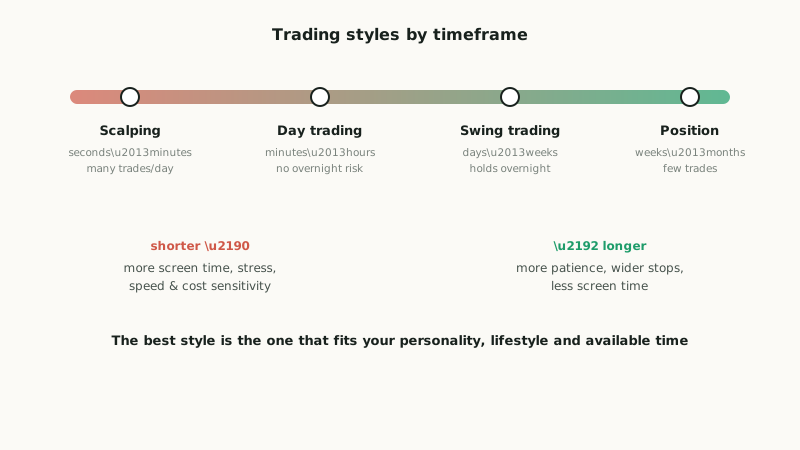
A: The four main styles, by timeframe, are scalping (seconds to minutes), day trading (minutes to hours, closing positions by day's end), swing trading (days to weeks) and position trading (weeks to months). They differ in holding time, trade frequency, and the demands they place on the trader.
Q: Which trading style is best for beginners?
A: Many beginners find swing trading more manageable than scalping or day trading, because it requires less screen time, is less stressful and less sensitive to costs and split-second timing. The best style ultimately depends on your personality, available time and temperament rather than a universal rule.
Q: What is the difference between day trading and swing trading?
A: Day traders open and close positions within the same day, holding for minutes to hours and taking no overnight risk. Swing traders hold positions for days to weeks to capture larger moves, accepting overnight exposure but requiring far less continuous screen time.
Scalping
Scalping is the shortest-term style, holding trades for seconds to minutes and taking many trades — sometimes dozens or more — in a day. The scalper aims to capture small price movements repeatedly, accumulating many tiny profits. It is the most intense and demanding style: it requires intense focus and fast reactions, sustained screen time, rapid execution, and — because the profits per trade are so small — very low trading costs, since spreads and commissions eat directly into the thin margins. Scalpers gravitate to the most liquid pairs (tightest spreads) during the most active hours (the London/NY overlap).
Scalping's appeal is frequent action and the avoidance of overnight or even multi-hour risk. Its drawbacks are significant: it is high-stress, time-intensive (demanding constant attention while trading), and unforgiving of cost — a slightly wide spread can erase a scalp's profit. It also demands excellent discipline and emotional control under rapid-fire pressure, where the psychology challenges covered elsewhere on this site are amplified by speed. Scalping suits a particular temperament — fast, focused, able to make quick decisions calmly under pressure — and is generally not recommended for beginners, who are usually better served learning on slower timeframes before attempting the demands of scalping.
Day trading
Day trading holds trades for minutes to hours and — its defining feature — closes all positions by the end of the trading day, taking no overnight risk. Day traders take several trades a day, capturing intraday moves, and sleep with no open positions exposed to overnight news or gaps. It is less frantic than scalping but still demands substantial screen time and focus during the trading session, and it suits those who can dedicate hours of the day to active trading.
The appeal of day trading is the avoidance of overnight risk (no exposure to gaps or news while you sleep) combined with frequent opportunity, without quite the relentless intensity of scalping. Its drawbacks are the significant time commitment — it is effectively a job requiring presence during market hours — and, like scalping, sensitivity to costs and the psychological demands of frequent intraday decisions. Day trading sits between scalping and swing trading on every dimension: shorter and more intensive than swing trading, longer and less frantic than scalping. It suits those with the time to trade actively during sessions and the temperament for repeated intraday decision-making, but who prefer not to hold risk overnight.
Swing and position trading
Swing trading holds trades for days to weeks, aiming to capture medium-term "swings" in price. It takes far fewer trades than day trading or scalping and — crucially — requires much less screen time, since trades are managed over days rather than monitored minute-by-minute. This makes swing trading popular with those who cannot watch screens all day, including part-time traders with other jobs. The trade-off is accepting overnight risk (exposure to gaps and news while positions are held) and, often, wider stops to accommodate the larger moves and multi-day holds. Many find swing trading the most manageable style, balancing meaningful opportunity against modest time demands and lower stress.
Position trading is the longest-term style, holding trades for weeks to months (or longer) to ride major, long-term trends. It takes very few trades, relies more heavily on fundamental analysis (the long-term economic forces that drive sustained currency trends), and requires the least screen time of all — but demands considerable patience and the willingness to hold through substantial fluctuations, with correspondingly wide stops. Position trading suits patient, fundamentally-minded traders who think in big-picture terms and have no interest in (or time for) active daily trading. Both swing and position trading trade the bigger moves over longer horizons, accepting overnight and longer-term risk in exchange for far less time at the screen — the opposite end of the spectrum from scalping.
The timeframe axis is about fit with you, not the market. Shorter styles demand more time, speed, stress tolerance and cost-sensitivity; longer styles demand more patience and wider stops but little screen time. There is no "best" timeframe — only the one your personality, schedule and temperament can actually sustain.
Matching a style to yourself
Because the timeframe axis is about fit with the trader, choosing a style is an exercise in honest self-assessment rather than finding the "best" approach. The key questions are practical and personal. How much time can you dedicate? A full-time job rules out scalping and day trading and points toward swing or position trading. What is your temperament? If rapid-fire decisions under pressure stress you, the shorter styles will be miserable and error-prone; if you are impatient, the longer styles will frustrate you. What is your tolerance for overnight risk, for stress, for frequent decisions? Each style places different demands, and a mismatch makes trading both unpleasant and unprofitable.
This self-matching matters enormously because a style that fights your nature or your circumstances is one you cannot execute with discipline — and discipline, as the psychology section stresses, is what determines success. A naturally patient person with a day job who tries to scalp will fail not because scalping doesn't work, but because it doesn't work for them; the same person swing trading might thrive. For most beginners, the slower styles (swing trading in particular) are a sensible starting point: less stressful, less time-demanding, more forgiving of costs and split-second timing, and more conducive to learning calmly. As you gain experience, you can discover which style truly fits. But the principle holds throughout: the best trading style is not the most profitable in the abstract — it is the one you can execute consistently, sustainably, and with discipline, given who you are and the life you lead.
Combining timeframes and evolving your style
The four styles are not rigid boxes, and in practice most traders blend timeframes rather than operating purely on one. The most common blend is top-down analysis: a swing trader might consult the daily chart for the overall trend, the four-hour for the setup, and the hourly for a precise entry, even though the trade itself is held for days. This use of multiple timeframes — a higher one for context and a lower one for timing — enriches any style and connects to the multi-timeframe analysis valuable in trend following. Your style is defined by how long you hold and how often you trade, but the analysis behind it can and should draw on several timeframes.
It is also worth recognising that your style may evolve as you gain experience and as your life changes. A trader who starts swing trading around a full-time job might move toward day trading if they later trade full-time, or drift toward position trading as they come to prefer a slower, more fundamentals-driven approach. There is no obligation to pick one style forever; the right style for you now may not be the right style in a few years, and adapting as your circumstances and preferences change is entirely sensible. What matters is that, at any given time, your style fits your current life and temperament.
A practical consideration that influences the choice is capital and costs. The shorter styles, trading frequently for small gains, are highly sensitive to spreads and commissions — costs that compound across many trades and can quietly erode a scalper's or day trader's edge. The longer styles, trading infrequently for larger moves, are far less cost-sensitive, since the spread is trivial relative to a multi-day swing. Smaller accounts and higher relative costs therefore often favour the longer styles, where costs matter less and the screen-time demands are lower. Weighing all of this — your time, temperament, capital, costs, and how they may change — leads you to a style you can sustain. And sustainability is the whole point: the best style is simply the one you can execute with discipline, day after day, given the trader and the life you actually have.
The four styles: scalping (seconds–minutes, intense, cost-sensitive), day trading (minutes–hours, no overnight risk, time-intensive), swing trading (days–weeks, less screen time — often best for beginners), and position trading (weeks–months, fundamentals-driven, patient). Shorter means more time, stress and cost-sensitivity; longer means more patience and wider stops. Blend timeframes in your analysis (higher for context, lower for entry), expect your style to evolve, and weigh capital and costs. The best style is the one you can sustain with discipline.