"The trend is your friend" is the oldest piece of advice in trading, and it endures because it is among the soundest. Trend following is the strategy of trading with the market's prevailing direction rather than against it — buying in uptrends, selling in downtrends, and aiming to ride a persistent move for as long as it lasts. It is the natural way to put into practice the cardinal principle of letting winners run, and it suits the reality that markets, when they trend, can trend a long way. This guide explains how to identify a trend, the main ways to enter, how to ride the move, and when to exit.
It is the core strategy for trending conditions within the framework of forex trading strategies, and it leans heavily on moving averages and market structure.
Key takeaways
Q: What is trend following in forex?
A: Trend following is a strategy that trades in the direction of an established trend, aiming to ride a persistent move rather than predict reversals. It buys in uptrends and sells in downtrends, entering on pullbacks or breakouts and holding until the trend shows signs of ending.
Q: How do you identify a trend?
A: An uptrend makes a series of higher highs and higher lows; a downtrend makes lower highs and lower lows. Tools like moving averages help confirm direction — price above a rising average suggests an uptrend. A market without this structure is ranging, not trending.
Q: How do you enter a trend-following trade?
A: The two main approaches are entering on a pullback (waiting for price to retrace to support, a moving average or a Fibonacci level within the trend, then resuming) or on a breakout (entering as price breaks to a new high or low in the trend's direction).
Identifying the trend
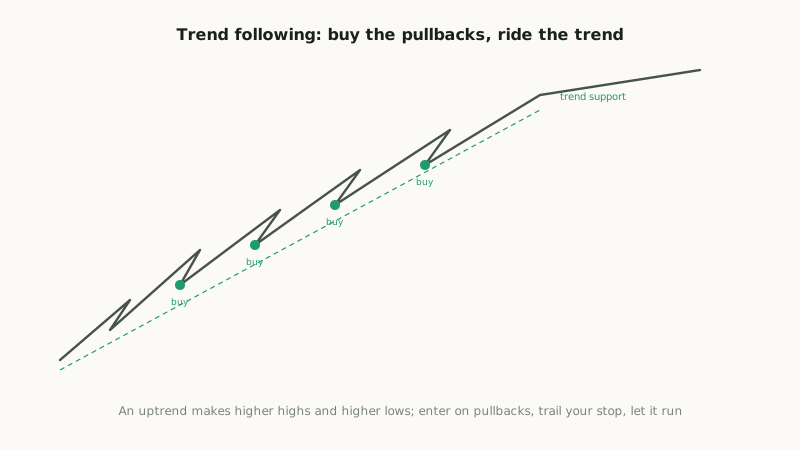
Trend following begins with correctly identifying that a trend exists and which way it runs — because the whole strategy depends on trading with it. The classic definition is structural: an uptrend makes a series of higher highs and higher lows, each peak and trough above the last, as buyers steadily win; a downtrend makes lower highs and lower lows, as sellers dominate. This higher-high-higher-low (or lower-high-lower-low) structure is the clearest signature of a trend, and reading it is a skill drawn straight from price-action analysis.
Indicators help confirm what the structure shows. A moving average is the classic trend tool: price above a rising average suggests an uptrend, below a falling one a downtrend, and the slope of the average gives the direction at a glance. Some traders use moving-average alignment (a faster average above a slower one, both rising) as trend confirmation. The crucial discipline is honesty about whether a trend genuinely exists: if price is not making higher highs and higher lows, and the averages are flat and tangled, the market is ranging, not trending — and a trend-following strategy will be whipsawed. Trend following only works when there is a trend to follow, so identifying the condition correctly is the essential first step.
Entering with the trend
Once a trend is identified, there are two main ways to enter in its direction. The first and often preferred approach is the pullback entry: rather than chasing price as it runs, you wait for a temporary retracement against the trend — a pullback to a support level, a moving average, or a Fibonacci retracement level within the trend — and enter as the trend resumes. In an uptrend, this means buying the dips; in a downtrend, selling the rallies. The pullback entry gives a better price, a tighter stop (just beyond the pullback low or high), and a more favourable risk-reward than chasing.
The second approach is the breakout entry: entering as price breaks to a new high (in an uptrend) or new low (in a downtrend), joining the trend as it makes fresh progress. This enters on strength and confirmation — you know the trend is continuing because price is making new extremes — but at a less favourable price than a pullback, and with the risk of a false breakout. Many trend followers favour pullback entries for their better risk-reward, watching for price to retrace to a key level (the 50 or 20 moving average is popular) and show signs of resuming — perhaps a bullish candlestick pattern at support in an uptrend — before entering in the trend's direction. Either way, the entry is always with the trend, never against it.
Riding the trend
The heart of trend following — and where its profits come from — is riding the trend, letting a winning trade run for as long as the trend persists rather than taking a quick profit. This is the practical application of "let your winners run," and it is what allows trend following to capture the large moves that make the strategy worthwhile. The challenge is psychological: as covered in the trading psychology section, the urge to bank a profit early (driven by the fear of giving it back) is powerful, and resisting it to let a trend play out is a key discipline.
The standard tool for riding a trend is the trailing stop: rather than a fixed take-profit, you trail your stop behind price as the trend advances — raising it in an uptrend, lowering it in a downtrend — locking in accumulating profit while leaving room for the trend to continue. The trailing stop can follow a moving average, the trend's structure (each new higher low in an uptrend), or a volatility measure. This lets the trade run with the trend and only exits when the trend genuinely reverses enough to hit the trailing stop, capturing the bulk of the move while protecting gains. Riding the trend with a trailing stop embodies the trend follower's mantra: cut losses short (a defined initial stop) and let winners run (a trailing stop following the trend).
Trend following's edge comes entirely from the rides — the few trades that run far. This means accepting many small losses and modest wins in exchange for the occasional large winner that pays for them all. The discipline is to cut the losers quickly and, far harder, to let the winners run rather than snatching small profits.
Exiting the trend
A trend follower exits when the trend ends — not on a hunch, a target, or fear, but on evidence that the trend that justified the trade is over. The signs are the reverse of those that identified it: in an uptrend, a lower low (breaking the higher-high-higher-low structure) signals the trend may be ending; a moving-average cross or a decisive break of trend support gives similar warning. The trailing stop often handles the exit automatically, getting you out as the reversal takes hold.
The key discipline at exit mirrors the discipline of entry: you exit because the trend has changed, not because you have a profit you are afraid to lose or a loss you are reluctant to take. Exiting too early (on the first pullback, out of fear) caps the winners that trend following depends on; refusing to exit when the trend has clearly reversed turns a winner into a loser. The structural signals — a break of the trend's higher-low or lower-high pattern — provide an objective basis for the exit, removing the emotion. Trend following, done well, is thus a complete, rule-based process: identify the trend, enter with it on a pullback or breakout, ride it with a trailing stop, and exit when its structure breaks.
Trend following on forex
Trend following works well on forex, where currencies can trend strongly for extended periods, driven by the persistent interest-rate and economic differentials covered in the fundamental analysis section — a central bank in a prolonged hiking cycle, for instance, can drive a long, ride-able currency trend. This connection between fundamentals (which can sustain a trend) and trend-following technicals (which trade it) is a natural synthesis: fundamentals suggest the directional bias, trend following provides the rules to trade it.
The main caveat is the one that defines the strategy: trend following only works in trending markets, and currencies spend significant time ranging, where a trend-following approach gets whipsawed by false signals. The disciplined trend follower therefore trades selectively — deploying the strategy when a clear trend exists and standing aside (or switching approach) when the market ranges. Combined with sound position sizing (to survive the many small losses that precede the big winners) and the patience to let trends run (the psychological core of the approach), trend following is one of the most robust and time-honoured strategies available — the disciplined expression of trading with the market rather than against it.
Multiple timeframe trend analysis
One of the most powerful refinements to trend following is multiple timeframe analysis — reading the trend on more than one timeframe and aligning your trades with the bigger picture. The principle is that trends exist on every timeframe, nested within each other: a downtrend on the hourly chart might be just a pullback within an uptrend on the daily. Trading in the direction of the higher timeframe trend, while using a lower timeframe for precise entry, stacks the odds in your favour by ensuring you are trading with the dominant trend rather than against it.
A common, effective approach is "top-down": identify the trend on a higher timeframe (say the daily) to establish your directional bias, then drop to a lower timeframe (say the hourly) to time entries in that direction. In a daily uptrend, you would use the hourly chart to find pullback entries to buy — never to sell — so that even your short-term entries align with the larger trend. This filters out the tempting counter-trend trades that look attractive on the lower timeframe but fight the dominant direction, which is exactly where many trend-following losses come from.
Multiple timeframe analysis also helps with the perennial challenge of distinguishing a genuine trend from noise: what looks like a chaotic, untradeable mess on a low timeframe often resolves into a clear trend when you step back to a higher one. Aligning timeframes — higher for direction, lower for entry — brings discipline and context to trend following, ensuring that the higher-high-higher-low structure you are trading is the one that matters rather than a minor fluctuation within a larger opposing trend. It is one of the simplest ways to improve a trend-following approach, and it connects directly to the multi-timeframe idea introduced in the indicators section.
Trend following trades with the market: buy uptrends (higher highs and lows), sell downtrends, confirmed by structure and moving averages. Enter on pullbacks (better price) or breakouts (confirmation), ride the trend with a trailing stop — cut losses short, let winners run — and exit when the structure breaks. Use multiple timeframe analysis (higher timeframe for direction, lower for entry) to trade with the dominant trend. It only works in trending markets, so trade it selectively and size to survive the small losses before the big winners.