If there is one indicator every trader knows, it is the moving average. It is the most popular technical tool in existence, and for good reason: it takes the noisy, jagged path of price and smooths it into a single clean line that reveals the underlying trend. Simple to understand, endlessly versatile, and the building block of countless strategies and other indicators, the moving average is the natural first indicator to master. This guide explains the two main types, how to choose periods, and the three core ways moving averages are used — for trend, for dynamic support and resistance, and for crossovers.
It is the classic trend indicator within the framework of technical indicators explained, and the foundation of the MACD.
Key takeaways
Q: What is a moving average?
A: A moving average is the average price over a set number of periods, plotted as a line that smooths out price fluctuations to reveal the underlying trend. As each new period closes, the average updates, so the line 'moves' along with price while filtering out short-term noise.
Q: What is the difference between SMA and EMA?
A: A simple moving average (SMA) gives equal weight to every period in its calculation. An exponential moving average (EMA) gives more weight to recent prices, so it reacts faster to new price action. EMAs are more responsive; SMAs are smoother and slower.
Q: What is a golden cross and a death cross?
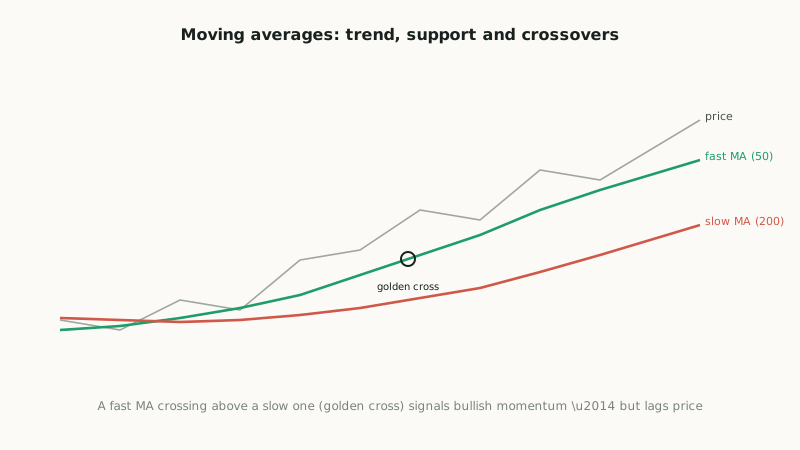
A: A golden cross occurs when a shorter moving average crosses above a longer one (such as the 50 above the 200), signalling bullish momentum. A death cross is the opposite — the shorter crossing below the longer — signalling bearish momentum.
What a moving average is
A moving average is simply the average price over a set number of periods, recalculated as each new period closes and plotted as a continuous line. A 50-period moving average on a daily chart, for instance, is the average of the last 50 daily closing prices; tomorrow, it drops the oldest price and adds the newest, so the average "moves" forward in time. The effect is to smooth price: the random, noisy fluctuations of individual periods are averaged out, leaving a cleaner line that reflects the underlying direction.
This smoothing is the moving average's core value. Raw price is jagged and noisy, making the trend hard to see amid the wiggles; the moving average filters that noise and renders the trend visible at a glance. The trade-off, inherent in any average of past data, is that the line lags price — because it is built from past periods, it turns only after price has already changed direction for a while. This makes the moving average a classic lagging indicator: reliable at confirming a trend, but late to signal its start. Understanding this lag is essential to using it well, and it shapes everything about how moving averages are applied.
Simple versus exponential
There are two main types of moving average, differing in how they weight the prices. A simple moving average (SMA) gives equal weight to every period in its calculation — the price 50 days ago counts just as much as yesterday's. An exponential moving average (EMA) gives more weight to recent prices, so it responds faster to new price action and turns more quickly than an SMA of the same period.
The choice between them is a trade-off between responsiveness and smoothness. The EMA reacts faster, so it follows price more closely and signals changes sooner — but it is also more prone to whipsaws (false signals from short-term noise), precisely because it is more sensitive. The SMA is smoother and slower, filtering noise more thoroughly but lagging more. Neither is universally better: faster-trading approaches often favour the responsive EMA, while those wanting a smoother read of the bigger trend may prefer the SMA. Many traders simply experiment to see which suits their pairs and style. The key is to understand that you are choosing where to sit on the responsiveness-versus-smoothness spectrum, with the EMA toward responsive and the SMA toward smooth.
Choosing the period
The other choice is the period — how many price bars the average covers — and this determines the timeframe of trend the moving average reflects. A shorter period (like 10 or 20) hugs price closely, reacts quickly, and reflects the short-term trend, but is noisier and gives more false signals. A longer period (like 100 or 200) is smoother and slower, reflecting the major long-term trend, but lags considerably. Common periods include 20, 50, 100 and 200, each capturing a different horizon.
The 200-period moving average deserves special mention: on the daily chart it is one of the most widely watched indicators in all of markets, treated as a key gauge of the long-term trend. Price above a rising 200-day average is broadly considered a long-term uptrend, and below a falling one a long-term downtrend; the level itself often acts as significant support or resistance precisely because so many participants watch it. The choice of period should match your trading horizon: short-term traders watch shorter averages, longer-term traders the 50, 100 and 200. Many traders plot two or three averages of different periods together, which enables the crossover signals discussed below.
The three core uses
Moving averages are used in three main ways. The first is reading trend direction: the slope of the average shows the trend (rising = uptrend, falling = downtrend), and price relative to the average gives a quick bias — price above a rising average suggests an uptrend, below a falling one a downtrend. This is the simplest and arguably most valuable use: a clean read of which way the market is trending.
The second use is as dynamic support and resistance. In a trend, price often pulls back to a moving average and bounces from it — the average acting as a moving floor in an uptrend or ceiling in a downtrend. Traders watch for price to retrace to a key average (often the 50 or 20) and resume the trend, providing potential entry points in the trend's direction. The third use is crossovers: signals generated when price crosses an average, or when two averages of different periods cross each other. The most famous are the golden cross (a shorter average crossing above a longer one, e.g. the 50 above the 200 — bullish) and the death cross (the shorter crossing below the longer — bearish). These crossover signals are popular trend-change indications, though, being based on lagging averages, they confirm rather than predict.
The moving average's lag is not a flaw to fight but a nature to respect. It will always confirm a trend late and whipsaw in a range — so use it where it shines (reading and confirming trends, dynamic support in trending markets) and distrust it where it struggles (choppy, directionless markets, where crossovers fire false signal after false signal).
Strengths, weaknesses and forex use
The moving average's great strength is in trending markets, where it cleanly reveals direction, provides dynamic support and resistance, and its crossovers catch real trend changes. Its great weakness is in ranging, sideways markets, where price oscillates back and forth across the average, generating a stream of false crossover signals and whipsaws that can be costly. This is the single most important practical caveat: moving averages are trend tools, and applying them naively in a range is a recipe for repeated small losses. Recognising whether the market is trending or ranging is therefore essential before relying on moving-average signals.
On forex, moving averages work on any pair and timeframe, needing no volume data, and they are among the most widely used tools in the market — which gives their key levels (especially the 200-day) a degree of self-fulfilling significance as so many traders watch them. As with all indicators, they are best used as confirmation alongside price action and other evidence, not as standalone signal generators — a moving-average crossover that coincides with a price-action breakout at a key level is far more compelling than the crossover alone. Combine a sensible choice of type and period with awareness of the trend-versus-range condition, and the moving average earns its place as the most useful and versatile indicator a forex trader can learn.
Using multiple moving averages
Many traders plot more than one moving average at once, which unlocks techniques beyond what a single line offers. The most common is a pairing of a faster and a slower average — the 50 and 200 are the classic combination — which gives both a short-term and a long-term trend read on one chart and enables the crossover signals (the golden and death cross) that arise when they cross. The relationship between the two lines is itself informative: when the faster average is above the slower and both are rising, the trend is healthy and aligned; when they converge or cross, the trend may be shifting.
Some traders extend this to a moving-average ribbon — several averages of increasing period plotted together. When the ribbon is cleanly "fanned out" in order (fastest on top in an uptrend, with even spacing), it signals a strong, healthy trend; when the ribbon tangles and the lines cross over one another, it signals a weakening trend or a transition to a range. The ribbon turns the simple moving average into a richer visual gauge of trend strength and health, not just direction.
A practical way to use two averages is to assign them roles: the slower average (say the 200) defines the overall trend and bias — only take trades in its direction — while the faster average (say the 50 or 20) provides dynamic support/resistance and entry timing within that trend. In an uptrend defined by a rising slow average, you might look to buy when price pulls back to the faster average and holds. This division of labour — slow for trend, fast for entries — is a clean, widely-used framework that combines the moving average's strengths while respecting that it is a trend tool best used in trending conditions. Just avoid the temptation to add too many averages: a couple with clear roles beats a screen full of redundant lines.
A moving average smooths price into a trend line; it's lagging, so it confirms late. SMAs weight all periods equally (smoother); EMAs weight recent prices more (faster). Shorter periods are responsive and noisy, longer ones (50, 100, 200) smoother — the 200 is the key long-term gauge. Use them for trend direction, dynamic support/resistance, and crossovers (golden/death cross). Pairing a slow average (for trend) with a fast one (for entries) is a clean framework. They shine in trends and whipsaw in ranges — use as confirmation, not standalone signals.